Executive Summary & Key Takeaways
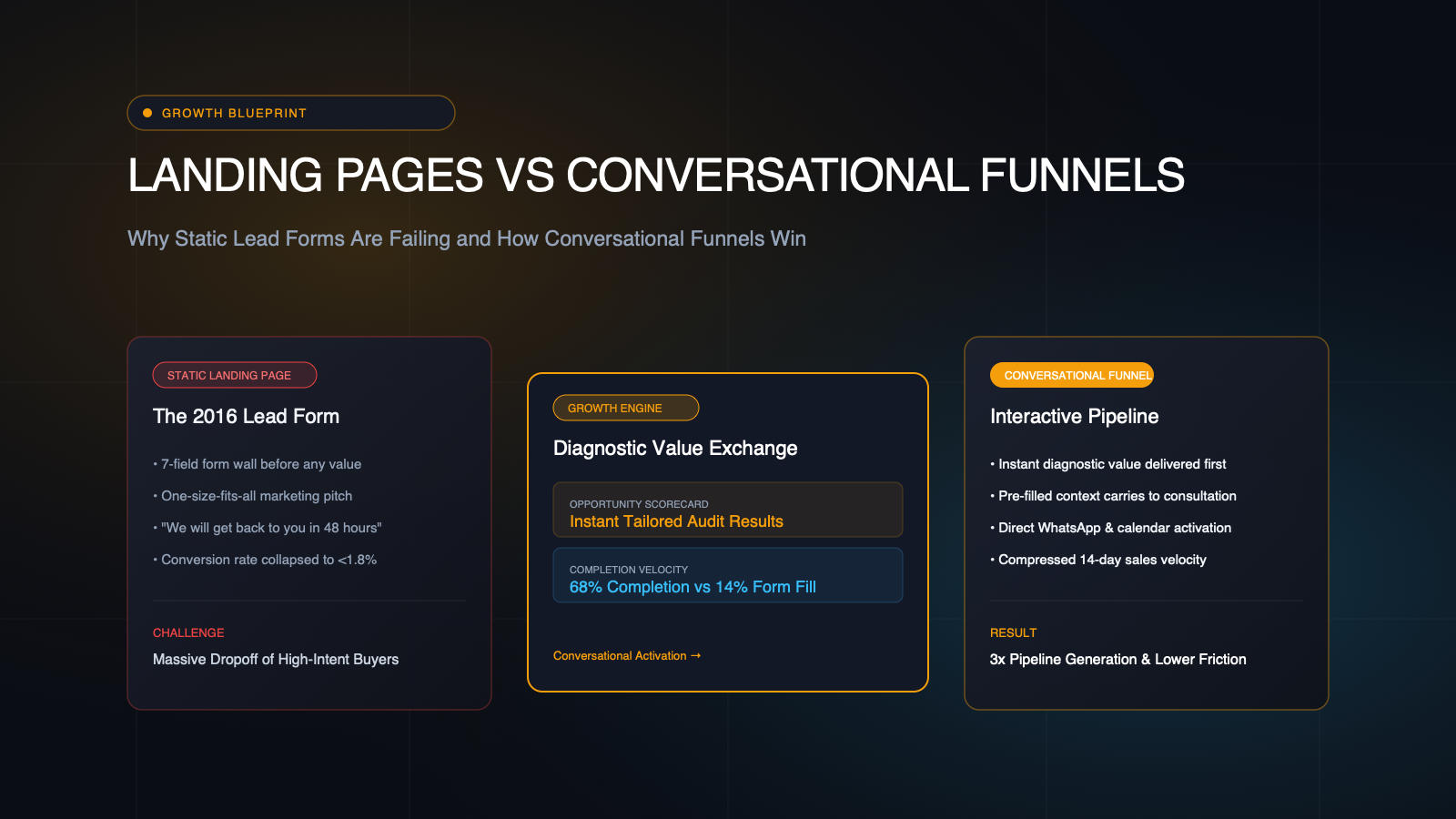
- B2B Form Conversion Collapse: Static 7-field forms have fallen from 4.5% to under 1.8% conversion across high-ticket B2B sectors.
- The Asymmetric Value Barrier: Forcing buyers to give data before seeing diagnostic value drives immediate 70%+ bounce rates.
- Conversational Funnels Accelerate Pipeline: Interactive audits and live opportunity diagnostics compress sales cycles from 90 days to under 3 weeks.
If you look at the growth marketing playbooks of 2018, every campaign centered around a single asset: the static landing page.
The architecture was ubiquitous: a hero headline, a subheadline, three bullet points, a stock photo of smiling executives, and a towering 7-field form demanding a name, company email, phone number, company size, and annual revenue.
In 2026, this format is facing a catastrophic collapse in conversion efficiency: B2B landing page form completions have plummeted from an average of 4.5% to under 1.8%.
Why? Because today’s high-consideration buyers have been conditioned by conversational AI interfaces like ChatGPT and Claude to expect immediate, bespoke, and interactive diagnostic answers.
When a high-value prospect visits a static landing page that refuses to answer their question until they surrender their contact details to an automated SDR email sequence, they simply hit the back button.
To capture these buyers, modern growth teams must replace static landing pages with Conversational Funnels.
The Root Cause of Landing Page Decay
The decline of static landing pages is not an aesthetic problem—it is a structural disconnect between buyer expectations and traditional capture mechanisms:
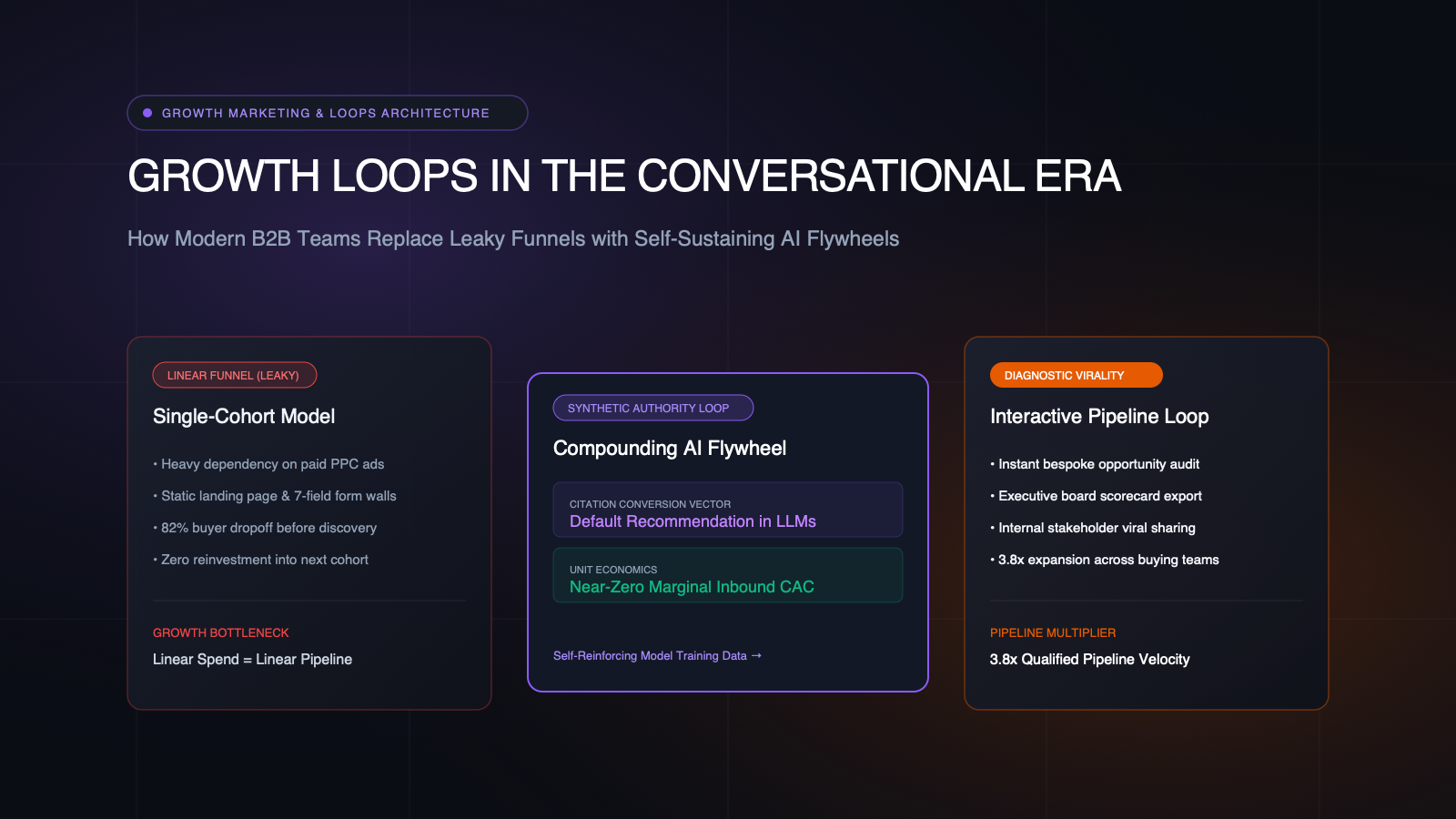
Static Landing Page Paradigm
Buyer has a complex, multi-layered problem → Clicks ad → Sees one-to-many generic pitch
- Forced Data Extortion: Demands 7 personal fields upfront
- 70%+ Immediate Bounce: Prospect refuses high-pressure sales sequences
- Delayed SDR email days later when momentum is completely lost
Conversational Funnel Paradigm
Buyer has a complex problem → Clicks ad or AI link → Enters interactive diagnostic
- Immediate Value Exchange: AI calculates opportunity score in real time
- Context-Carrying Activation: Prospect books consultation to execute recommendations
- Pre-qualified sales dialogue with zero repetitive questions
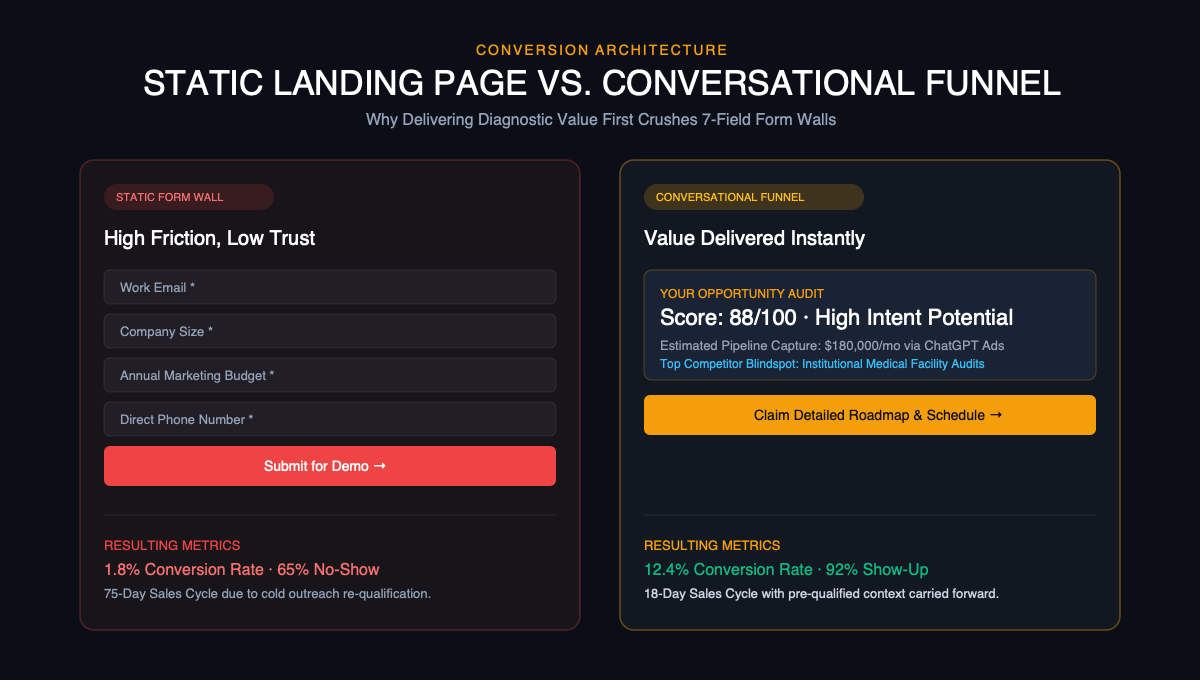
The 3 Fatal Flaws of Static Pages:
- The Asymmetric Value Exchange: Demanding extensive personal and company data before demonstrating any unique value creates immediate buyer resistance.
- Inability to Handle Multi-Variable Context: High-ticket buyers rarely have a generic problem. They have specific constraints (e.g., legacy software stacks, HIPAA compliance, tight timelines) that a single static headline cannot address.
- The Friction-Filled Handoff: Even when someone fills out a form, the delay of 24–48 hours for an SDR email kills conversion momentum. By the time a sales rep reaches out, the prospect has already consulted an AI assistant and found an alternative provider.
Anatomy of a High-Converting Conversational Funnel
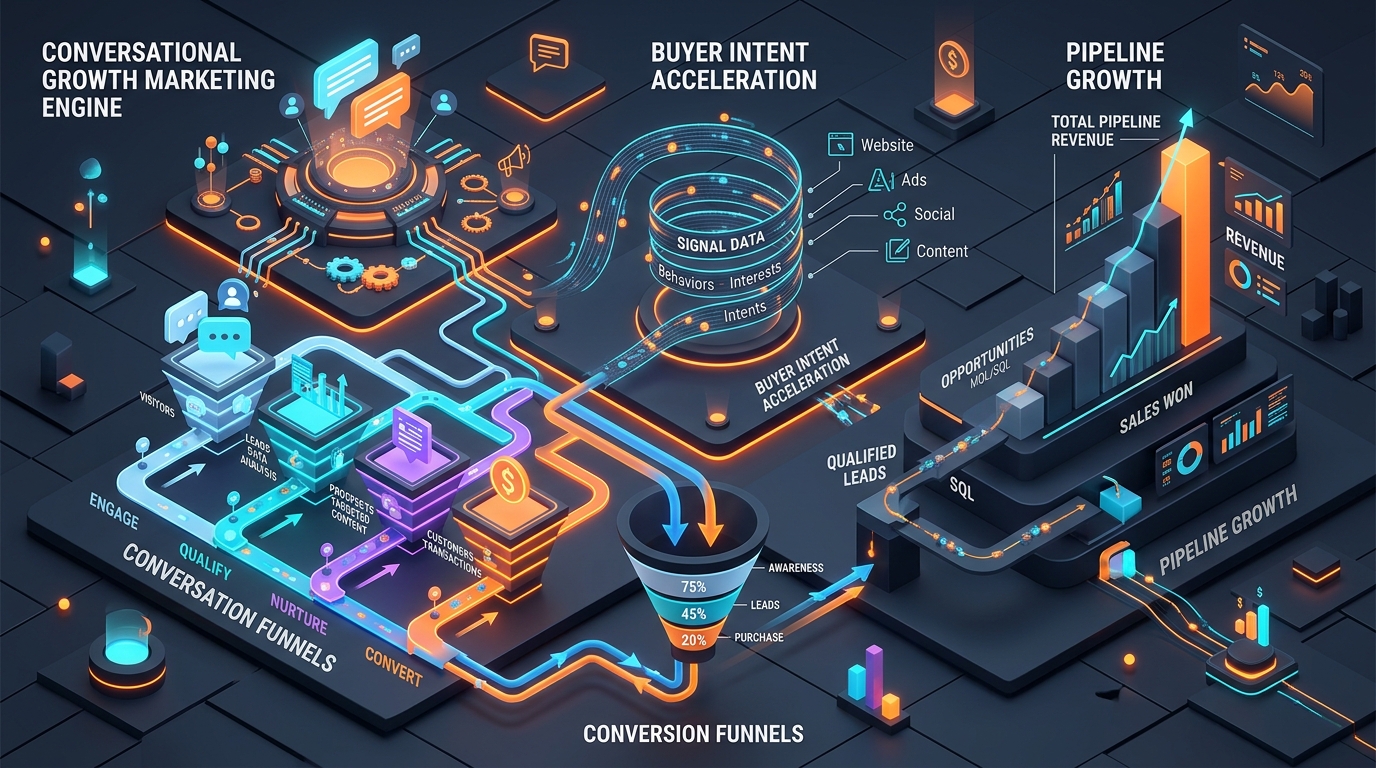
A conversational funnel transforms passive readers into active participants. It operates through four stages:
Stage 1: The Contextual Hook
Instead of a generic "Request a Demo" or "Contact Us" CTA, the conversational funnel opens with a diagnostic invitation:
- "Benchmark your brand's visibility in conversational AI."
- "Calculate your projected Cost Per Qualified Intent (CPQI)."
- "Identify your top 5 competitor intent vulnerabilities."
Stage 2: The Guided Diagnostic
Rather than demanding an email address up front, the funnel engages the user in a rapid, consultative questionnaire:
- What is your current monthly ad spend across Google/Meta?
- What is your average contract value or patient LTV?
- Which CRM or practice management software do you use?
Because each question is directly relevant to calculating their custom benchmark, completion rates exceed 80%.
Stage 3: Instant Value Reveal
The user receives an immediate calculation before being asked for contact information:
- Their estimated conversational search volume
- Their potential CAC savings under a managed flat-rate model (\$99/month)
- A customized opportunity scorecard
Stage 4: The Frictionless Consultation Bridge
Now that the prospect has experienced tangible value, they gladly schedule a strategy call or connect via direct WhatsApp chat to review implementation steps.
The Conversion Impact: Hard Numbers
| Funnel Dimension | Traditional Static Landing Page | Interactive Conversational Funnel | Impact |
|---|---|---|---|
| Initial Bounce Rate | 65% – 78% | 22% – 35% | 55% Bounce Reduction |
| Engagement Rate | Under 2.0% form fill | 8.5% – 14.0% audit start | 4x Engagement Lift |
| Lead Qualification | Self-reported, often falsified | Verified operational data | 100% Verified ICP Data |
| Sales Cycle Duration | 60 – 90 Days | 14 – 28 Days | 3x Velocity Acceleration |
Transitioning Your Growth Stack to Conversational Funnels
- Audit Your Highest-Volume PPC Pages: Identify the landing pages with the highest bounce rates and replace static forms with diagnostic questionnaires.
- Integrate Context-Passing APIs: Ensure user responses are automatically passed to your CRM and SDR Slack channels in real time.
- Test Conversational CTAs: Transition from "Book a Call" to "Calculate Your Opportunity Score".
Experience a Conversational Funnel in Action
Want to see how an interactive diagnostic outperforms a static form?
👉 Launch Your Free Opportunity Report — Answer 4 quick questions about your business, see your conversational market potential, and receive a customized strategy report from Aepify.
Ready to explore ChatGPT Ads?
Find out where your business could show up in high-intent AI conversations.