If you manage paid media budgets in 2026, you are intimately familiar with the Google Ads margin squeeze.
Over the past four years, average Cost Per Click (CPC) across high-consideration B2B, legal, healthcare, and financial services has escalated by 38% year-over-year. Concurrently, Google's aggressive expansion of "close variant" matching has obscured search term visibility, forcing advertisers to pay premium rates for ambiguous clicks while Google AI Overviews intercept user attention before anyone reaches a sponsored link.
Performance marketing teams are spending more money to buy colder traffic that converts at lower rates on static landing pages.
Meanwhile, hundreds of millions of commercial buyers have migrated their active decision-making into Large Language Models. When an enterprise software buyer, medical director, or commercial developer needs to solve an operational constraint, they don't type a fragmented three-word keyword into Google. They submit a 200-word prompt to ChatGPT detailing their tech stack, compliance hurdles, headcount, and budget ceiling.
This structural shift presents modern media buyers with both an urgent necessity and an immense financial opportunity: transitioning paid media budgets from legacy keyword auctions to conversational intent bidding.
- The End of Keyword Bidding: Conversational advertising does not price individual search tokens; it dynamically clears ad inventory based on Semantic Intent Depth, multi-turn dialogue context, and buyer readiness.
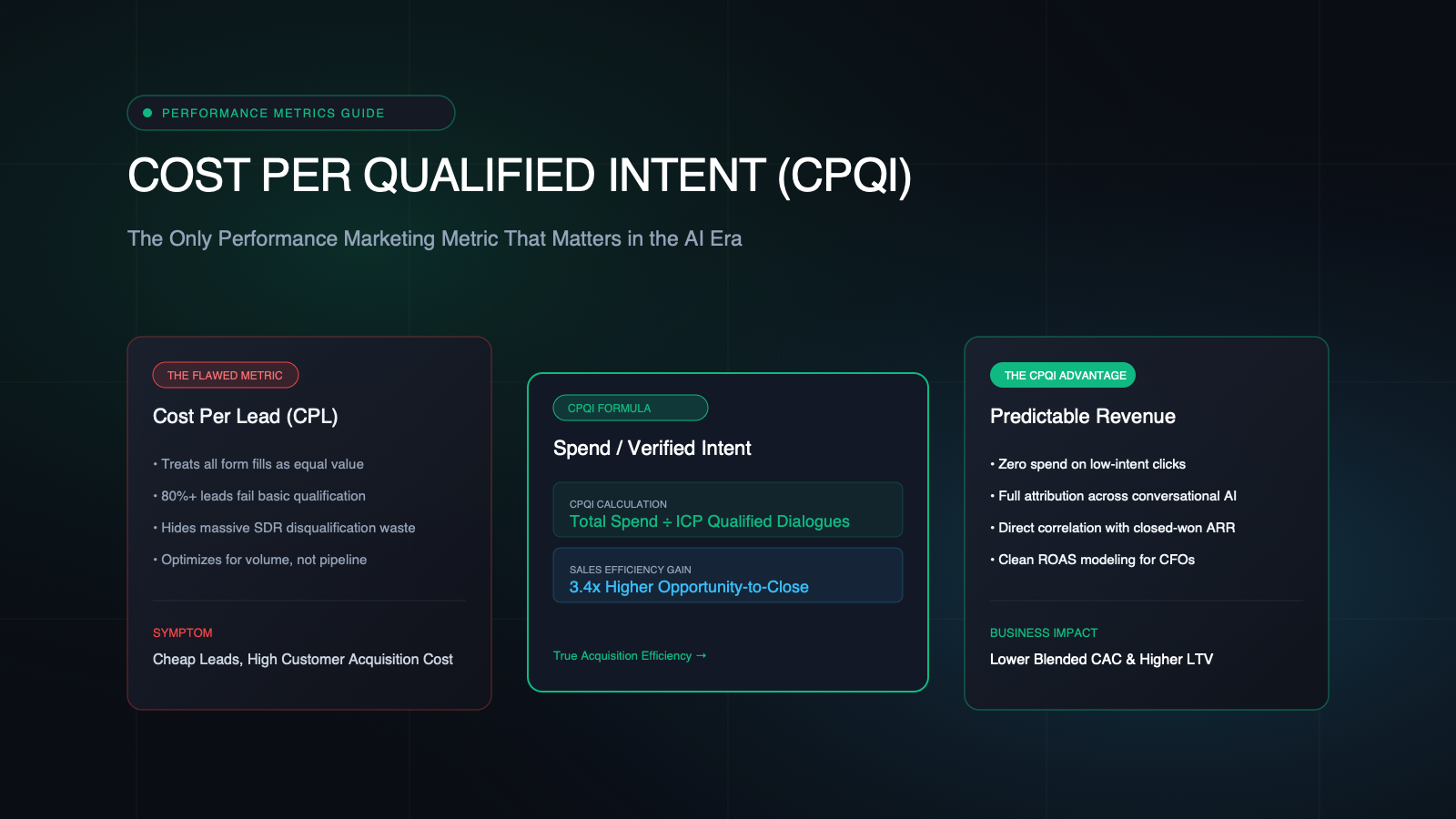
- The Cost Per Qualified Intent (CPQI) Advantage: Instead of paying $45–$120 for an unvetted click on Google Search, media buyers target verified commercial problem-solving moments, reducing blended Customer Acquisition Cost (CAC) by 45%–60%.
- Dynamic Clearing Prices: Bidding is calibrated against a Semantic Confidence Threshold (SCT > 0.85). Placements only trigger when a prospect's prompt demonstrates verifiable commercial qualification.
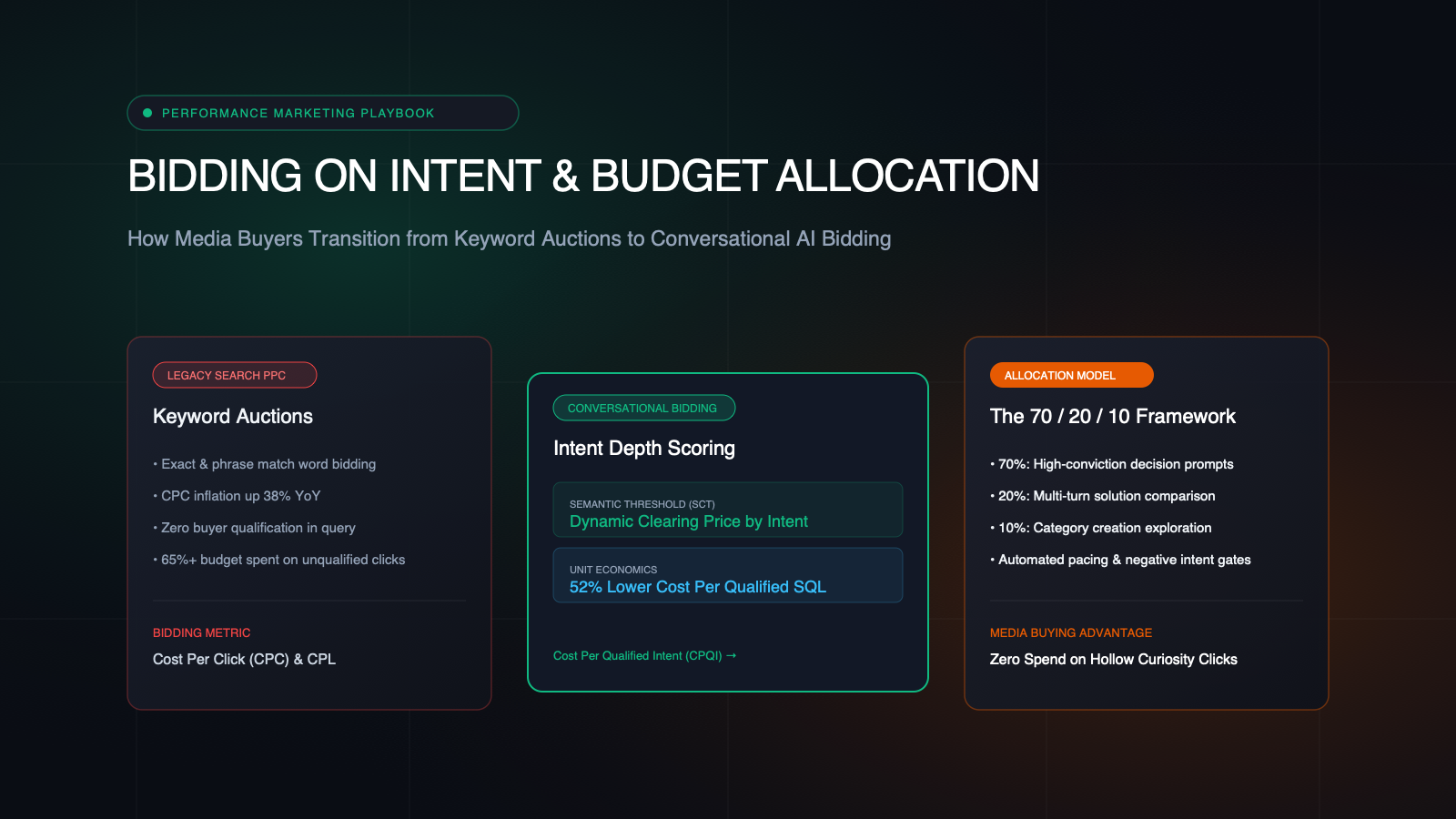
- The 70 / 20 / 10 Portfolio Allocation: Allocate 70% of conversational budget to decision-stage commercial prompts, 20% to multi-turn comparison research, and 10% to category creation prompts.
How Conversational Ad Auctions Actually Clear
To bid intelligently on ChatGPT Ads and conversational search platforms, media buyers must unlearn the mechanics of Google AdWords and Meta Ads Manager.
In legacy Google Search, the auction is simple:
- An advertiser selects keywords (e.g.,
commercial insurance broker chicago). - A user searches that exact token or a synonym.
- Google runs a second-price or generalized first-price auction weighted by historical Quality Score.
- The winning advertiser pays when the user clicks the link, regardless of whether the user is a junior analyst writing a college paper or an authorized Chief Risk Officer with a $500k budget.
In conversational AI platforms, the user interface is not a query box; it is an active, stateful advisory consultation.
The Mechanics of Semantic Clearing Prices
Instead of bidding on keyword strings, conversational advertising operates on multi-dimensional vector embeddings and Semantic Confidence Thresholds (SCT):
- Prompt Parsing & Entity Extraction: The AI model analyzes the user's multi-sentence prompt, identifying stated business size, regulatory constraints, geographic location, software integrations, and timeline urgency.
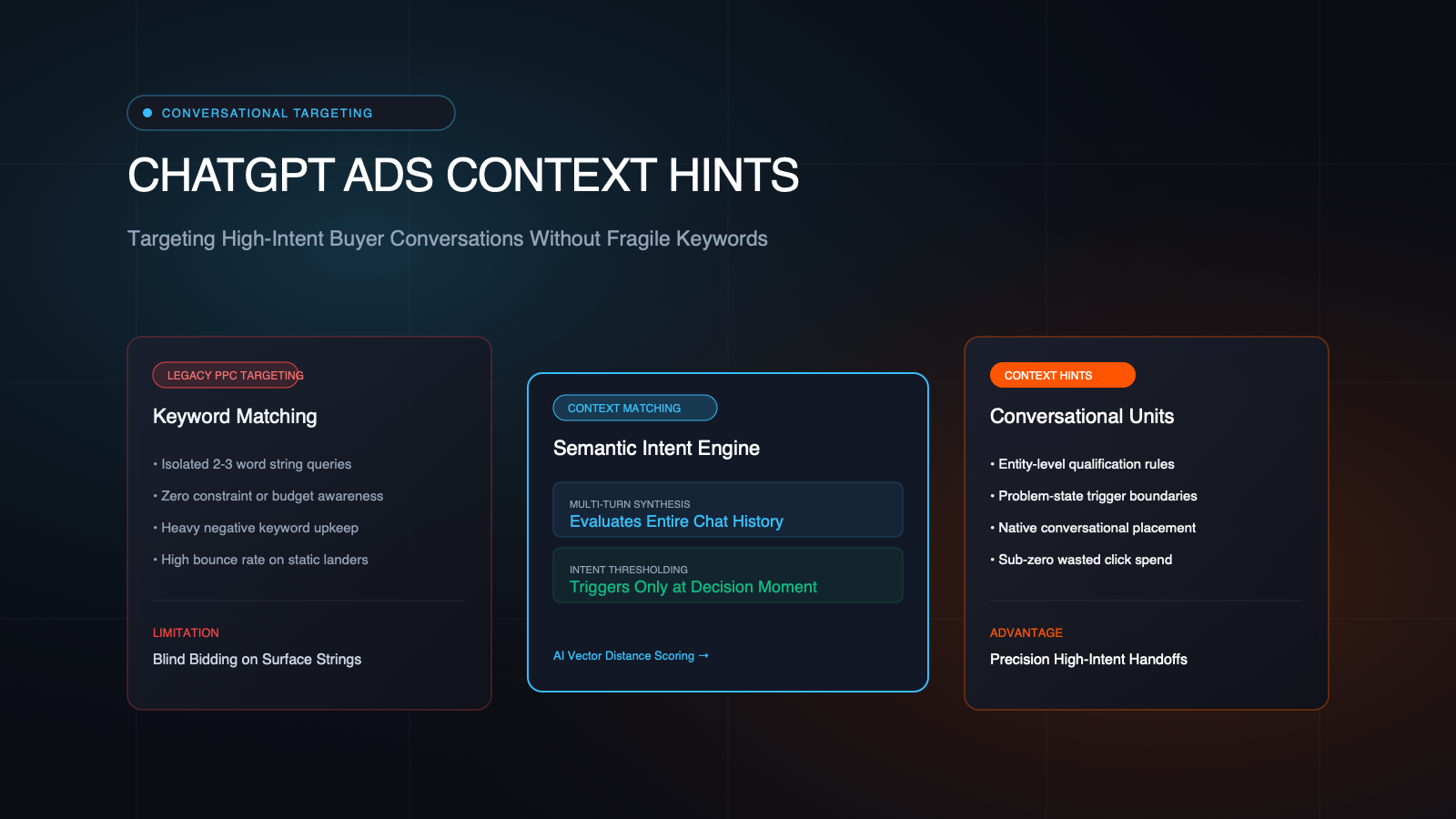
- Context Hint Matching: Advertisers configure Context Hints—semantic targeting blueprints that define the exact problem states, architectural constraints, and commercial intent signals their ideal customer profile (ICP) exhibits.
- Intent Depth Scoring: The platform calculates a real-time semantic affinity score between 0.00 and 1.00.
- A prompt asking "What is cloud security?" scores
0.18(educational, low intent → suppressed). - A prompt stating "We are migrating 450 AWS instances to Azure and need an enterprise SOC-2 compliant security provider that integrates with Datadog under $80k/yr" scores
0.94(decision-stage commercial intent → auction triggered).
- Dynamic Bid Clearing: The advertiser's bid ceiling is evaluated against the clearing price for that specific intent depth. Advertisers do not bid to show an ad to every user; they bid for the right to place a verified, context-relevant recommendation directly inside the AI's objective response.
Traditional PPC Clearing:
Bid × Quality Score (Click-Through Rate History) = Ad Rank

Conversational AI Clearing:
Bid × Semantic Intent Confidence (SCT) × Entity Solution Relevance = Conversational Placement Rank
The 3 Core Conversational Bidding Strategies
Modern performance marketing teams use three distinct bidding frameworks depending on their unit economics, sales cycle length, and risk tolerance:
- Bidding Basis: Value-based bidding optimized for high-conviction prompt states.
- How It Works: The algorithm aggressively bids up on multi-turn conversations where the prospect has already rejected a competitor or specified an active procurement deadline.
- Best For: High-ticket B2B SaaS, enterprise consulting, and specialized medical/legal practices where customer lifetime value (LTV) exceeds $10,000.
- Target Metric: Opportunity-to-Close Rate and Pipeline Velocity.
- Bidding Basis: Target Cost Per Qualified Intent with strict negative entity exclusions.
- How It Works: You establish a fixed target acquisition cost (e.g., $65 per qualified commercial conversation) and configure hard constraints: employee count > 50, budget stated, or specific tech stack requirements.
- Best For: Mid-market service firms and growth-stage scaleups looking for disciplined unit economics without budget runaway.
- Target Metric: Strict [Cost Per Qualified Intent (CPQI)](/blog/cost-per-qualified-intent-cpqi-guide/).
Strategy 3: Multi-Turn Stage-Paced Bidding
In Google Search, a click is a click. In ChatGPT, a conversation unfolds over multiple turns.
Sophisticated media buyers vary their bid ceilings according to the conversational turn depth:
- Turn 1 (Initial Inquiry): "What are the best alternatives to Salesforce for mid-sized real estate brokerages?"
- Bid Strategy: Conservative Bid Floor ($12–$25). Capture early consideration without overpaying before budget qualification is established.
- Turn 3 (Evaluation & Constraint Definition): "We have 60 agents, need direct MLS integration, and want native VoIP calling under $40/user/mo."
- Bid Strategy: Aggressive Bid Ceiling ($60–$110). The buyer has articulated exact commercial constraints that match your software. Winning the sponsored recommendation here delivers an immediate, warm conversion.
- Turn 5 (Procurement Validation): "How does HubSpot compare to [Your Company] regarding implementation timelines and cancellation penalties?"
- Bid Strategy: Maximum Premium Bid. This is the exact moment the decision is formalized. Suppressing competitor placements and establishing your verified differentiation wins the deal.
Head-to-Head Comparison: Google PPC vs. Conversational Bidding
| Dimension | Google Search Ads (PPC) | Meta Ads (Social Paid) | ChatGPT Conversational Ads |
|---|---|---|---|
| Bidding Primitive | Keyword match strings | Demographic & audience interests | Multi-turn conversational intent vectors |
| Targeting Precision | Inferred interest from 2-4 search words | Behavioral lookalikes & surveillance cookies | Explicit, declared commercial constraints |
| Clearing Dynamic | Bid war on high-volume keywords | Auction CPM based on feed competition | Semantic confidence threshold (SCT > 0.85) |
| Landing Page Friction | High (58%–74% bounce on static forms) | Very High (Social feed interruption) | Minimal (Interactive conversational handoff) |
| Budget Efficiency | 60%+ wasted on exploratory & student clicks | 70%+ wasted on low-intent thumb scrolling | 90%+ concentrated on verified ICP criteria |
| Benchmark Acquisition Metric | Cost Per Click ($25–$120) & CPL ($90–$350) | Cost Per Mille ($18–$45) & Cost Per Lead | Cost Per Qualified Intent ($35–$85) |
The 70 / 20 / 10 Budget Allocation Framework
When growth teams ask Aepify how they should allocate capital across emerging conversational channels, we deploy the 70 / 20 / 10 Allocation Model:
Seventy percent of your conversational media budget should be locked to high-conviction decision prompts: vendor comparison queries, migration inquiries, contract renewal evaluations, and pricing model interrogations. These prompts carry the highest conversion velocity and immediately replace wasteful top-of-funnel Google PPC spend.
Twenty percent is deployed across middle-of-funnel problem-solving sessions. These are prompts where technical leaders or operations heads describe an unresolved operational bottleneck (e.g., *"How to reduce HIPAA compliance audit preparation overhead by 40%"*) without yet naming specific software vendors. Your ad positions your solution as the architectural gold standard.
Ten percent is reserved for exploratory intent mining. Media buyers test novel prompt permutations, industry vertical test cases, and emerging buyer queries to identify newly forming conversational clusters before competitor bidding auctions crowd the market.
How to Transition Your Google Ads Budget Without Revenue Risk
A catastrophic mistake media buyers make is pausing their Google Ads campaigns overnight and dumping 100% of their ad spend into an unfamiliar channel.
Instead, follow this structured 4-Phase Migration Roadmap:
Phase 1: Audit Wasted Search Terms & Disqualification Waste (Weeks 1–2)
Export your last 90 days of Google Search query reports. Isolate every search query where CPC exceeded $35 but lead-to-opportunity rate was below 5%. Calculate the total capital drained by:
- Exploratory/educational queries (
"how to calculate...","what is..."). - Incompatible prospect clicks (users searching for free tools or enterprise platforms when you sell mid-market).
- Competitor brand clicks that bounced immediately on your static landing page.
Typically, 35% to 55% of total Google search spend is pure disqualification waste. This wasted capital forms your initial testing budget.
Phase 2: Deploy 15% Budget to High-Conviction Context Hints (Weeks 3–4)
Reallocate the wasted search budget into ChatGPT Ads targeting exact competitor comparison and vendor replacement prompt states.
- Configure strict Context Hints matching your ideal company size, budget, and integration stack.
- Link the sponsored recommendation not to a generic 7-field form, but to a pre-filled conversational assessment or interactive scorecard (e.g., Conversational Growth Funnels).
- Benchmark your initial Cost Per Qualified Intent against your historical Google Cost Per SQL.
Phase 3: Scale High-Intent Bids & Expand Multi-Turn Turn Pacing (Weeks 5–8)
As your sales team confirms that conversational leads are arriving pre-educated and 85% closer to purchase, scale budget from 15% to 35% of total digital acquisition spend.
- Implement stage-paced bidding: raise bid ceilings on 2nd and 3rd turn prompts where budget qualification has been explicitly stated.
- Integrate server-side conversion tracking (CRM webhooks and conversion APIs) to attribute closed-won revenue directly back to conversational prompt triggers.
Phase 4: Settle into Permanent Equilibrium (Month 3 Onward)
Maintain Google Ads exclusively for Brand Defense (bidding on your exact brand name) and hyper-specific emergency high-intent local queries. Move 50% to 70% of non-branded acquisition spend into conversational AI channels, securing early-market clearing prices before competitor bidding wars mature.
3 Critical Media Buying Mistakes to Avoid
1. Treating Context Hints Like Negative Keywords
In Google Ads, you add negative keywords like -free or -jobs. In ChatGPT Ads, you cannot simply add isolated negative words. You must define Negative Intent Blueprints. If you sell B2B enterprise software, your negative intent triggers should suppress ad delivery on academic research prompts, student coding homework, and consumer hobbyist conversations.
2. Sending Conversational Clicks to Static Landing Pages
Nothing kills conversion velocity faster than taking a buyer who just spent 15 minutes having an articulate, high-level conversation with an AI model and dumping them onto a static, one-to-many landing page asking for their phone number. Ensure your destination URL respects conversational continuity—opening an interactive diagnostic or customized assessment pre-configured to their stated prompt requirements.
3. Measuring Conversational Ads on Click-Through Rate (CTR)
In conversational advertising, high click-through rate (CTR) is often a sign of poor targeting. If thousands of low-intent users click your ad out of idle curiosity, you will burn capital on SDR disqualification. Focus strictly on Cost Per Qualified Intent (CPQI) and Opportunity-to-Close Rate.
The Strategic Window: Early-Mover Bidding Economics
In digital advertising history, the greatest financial returns are captured by media buyers who master an ad platform before clearing prices reach maturity:
- 2003–2005 Google AdWords: Advertisers purchased $0.10 clicks on high-intent commercial keywords, building billion-dollar companies on unprecedented ROAS.
- 2012–2015 Facebook Mobile Ads: Performance marketers captured sub-$5 customer acquisition costs before the news feed auction saturated.
- 2026 ChatGPT Ads: Early-mover media buyers are acquiring decision-stage B2B and high-ticket consumer dialogues at a fraction of Google PPC clearing prices.
Once enterprise marketing teams allocate formal 8-figure programmatic budgets to conversational AI, auction competition will inevitably drive clearing prices upward.
The media buyers who build their intent-bidding infrastructure today will secure an insurmountable competitive moat.
Audit Your Brand's Conversational Ad Potential
Curious how much your acquisition costs could drop by shifting underperforming search spend into ChatGPT Ads?
👉 Get Your Free Opportunity Report — Our performance strategists will analyze your search term waste, benchmark your conversational footprint, and engineer your custom intent-bidding roadmap.
Ready to explore ChatGPT Ads?
Find out where your business could show up in high-intent AI conversations.