When advertisers first enter conversational advertising, their instinct is to bring their Google Ads spreadsheets with them. They want to bid on exact-match tokens like [enterprise crm] or phrase-match strings like "best accounting software for startups".
In a conversational environment like ChatGPT, that mental model completely breaks down.
Conversational AI users do not submit fragmented three-word search queries. They describe complex operational headaches, outline compliance constraints, debate technical trade-offs across five conversational turns, and ask for architectural recommendations.
To capture these high-value commercial moments, advertising in ChatGPT relies on Context Hints—a semantic targeting mechanism that identifies buyer intent across entire multi-turn conversations rather than matching rigid text strings.
- Definition: Context hints are semantic parameters, entity clusters, and situational markers provided by advertisers to guide where and when sponsored recommendations appear inside ChatGPT conversations.
- Core Difference: Traditional PPC bids on isolated keywords; context hints evaluate multi-turn conversational context, problem severity, and commercial readiness.
- Elimination of Negative Match Drudgery: Instead of managing thousands of negative keywords to avoid student queries or DIY tutorials, context hints use boundary thresholds that trigger only when commercial problem solving is detected.
- Economic Impact: By matching on qualified intent rather than keyword impressions, brands slash wasted click spend and dramatically compress their customer acquisition cycle.
The Death of the Keyword: Why Conversational Search Requires Context Hints
To understand context hints, you first have to understand why keywords fail in Large Language Models (LLMs).
In traditional search engines, a user types corporate health insurance plan cost. The search engine cannot tell if this user is an HR director with 500 employees, an undergraduate writing an economics paper, or an individual freelancer confused about policy brackets. Because the keyword contains almost zero context, Google auctions the term to whoever bids the highest, and advertisers pay $35 to $90 per click while praying the visitor converts on an unpersonalized landing page.
In conversational search, that same HR director writes a prompt like this:
"We are a Series B SaaS company with 140 remote employees across 18 US states. Our current healthcare broker is renewing us with a 24% premium hike. We need a modern PEO or level-funded health plan that integrates with Rippling and keeps our per-employee monthly cost under $650. What are our top 3 strategic alternatives?"
Notice what happened here:
- The buyer explicitly revealed company scale (140 employees, Series B).
- They revealed geographic complexity (18 US states).
- They identified their current pain point (24% premium hike renewal).
- They specified technical integration constraints (Rippling HRIS).
- They declared their unit economic budget ceiling ($650/employee/month).
If an advertiser bid on the isolated keyword PEO, they would completely miss the richness of this buyer interaction. Bidding on keywords in an LLM is like trying to navigate a supersonic jet using a 19th-century compass.
Context hints bridge this gap. They allow advertisers to describe the exact situational parameters where their product is the natural, undeniable solution.
What Exactly Are Context Hints?
In the architecture of ChatGPT Ads, a context hint is a structured declaration of relevance signals submitted by the advertiser.
Instead of saying "Show my ad when someone types X", a context hint tells the ad retrieval engine:
"Consider recommending our solution when a user is actively diagnosing or comparing B2B healthcare options, has indicated a distributed team size between 50 and 500 people, and is seeking alternatives to traditional brokers or enterprise PEOs."
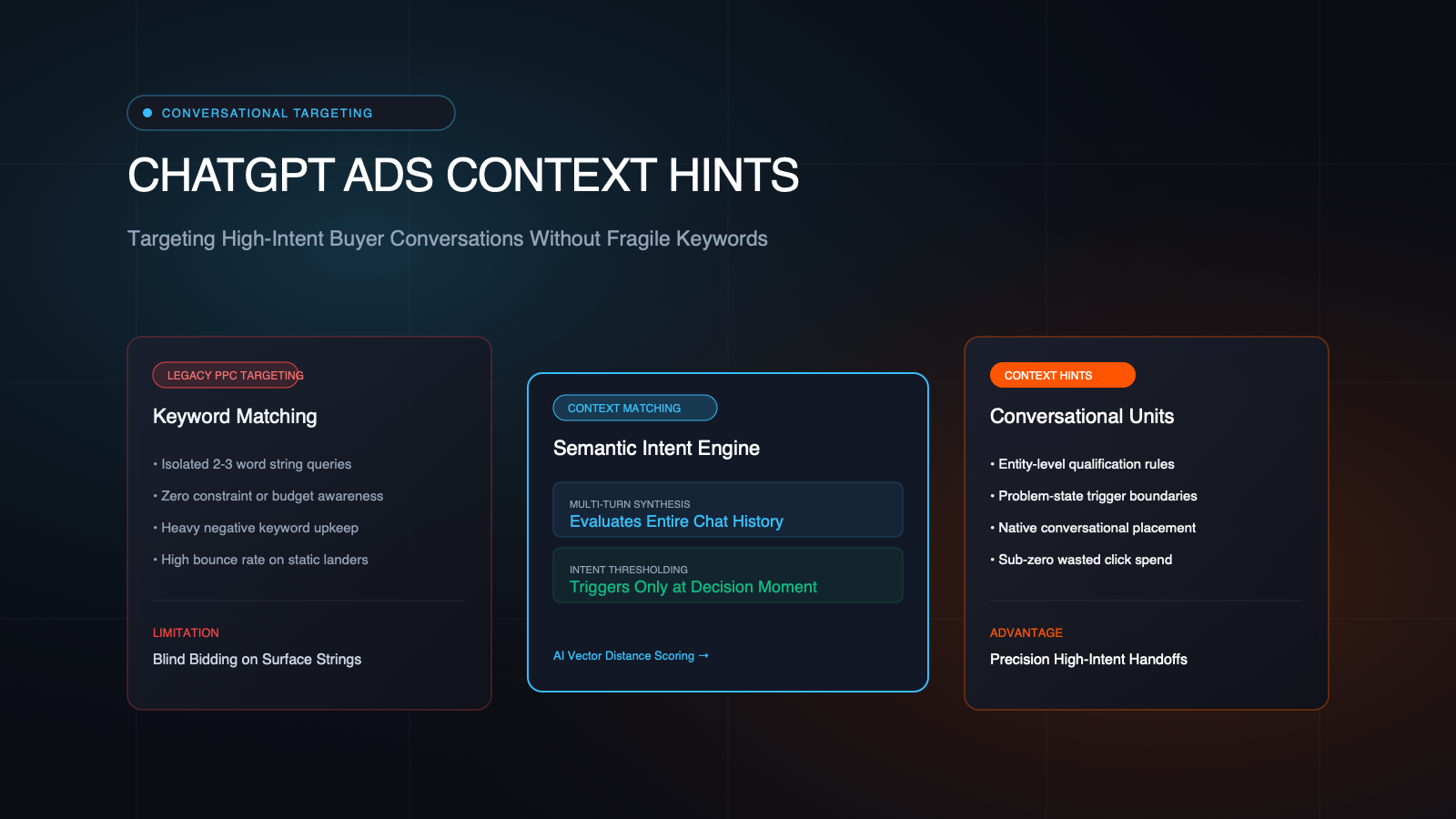
Context hints are evaluated through real-time semantic embedding models. When a user chats with ChatGPT, the conversation vector is compared against advertiser context hints. If the semantic similarity and commercial intent score clear the eligibility threshold, the platform can inject an authoritative, context-native sponsored recommendation.
The 4 Core Mechanics of Context Hints
To configure context hints effectively, performance teams must understand how the conversational auction engine processes them under the hood.
- Entity Recognition: Extracts company size, tech stack, industry, and regulatory frameworks.
- Constraint Tagging: Detects explicit limits like budget ceilings, timeline deadlines, and migration barriers.
- State Analysis: Determines whether the user is in research mode, troubleshooting mode, or vendor selection mode.
- Cumulative Memory: The engine does not evaluate the latest message in a vacuum; it reads the entire session thread.
- Intent Escalation: Tracks how an informational inquiry evolves into a commercial purchasing decision over 3–6 turns.
- Context Carryover: Retains constraints stated 5 prompts earlier without requiring the user to repeat them.
1. Semantic Entity Extraction
The retrieval model analyzes conversational prompts for concrete commercial entities:
- Organizational scale (e.g., "mid-market", "150 seats", "Series A", "enterprise")
- Technical stack integrations (e.g., "Salesforce", "Snowflake", "AWS GovCloud", "QuickBooks Online")
- Jurisdictional or compliance boundaries (e.g., "HIPAA-compliant", "GDPR", "SOC 2 Type II", "California state licensing")
- Pain point definitions (e.g., "manual reconciliation taking 10 hours a week", "database latency spikes under load")
Advertisers define context hints around these entity relationships rather than single words.
2. Multi-Turn Thread Synthesis
On Google or Meta, each search or click is an atomic, isolated event. In ChatGPT, intent accumulates.
A user might start by asking: "What causes high cloud database latency in PostgreSQL?" (Pure informational prompt—no ad should appear).
Two turns later: "We ran EXPLAIN ANALYZE and our connection pooling is maxing out on 50 microservices." (Diagnostic prompt).
Five turns later: "What managed serverless Postgres solutions handle auto-scaling connection pooling out of the box without requiring manual shard management?"
With context hints, the ad system recognizes that the user has progressed from conceptual troubleshooting into an active commercial procurement phase. A managed database vendor using context hints focused on "serverless Postgres connection pooling" can deliver a perfectly timed sponsored recommendation precisely at turn five.
3. Negative Context Suppression
In legacy PPC, advertisers spend hundreds of hours adding negative keywords like "free", "jobs", "internship", "pdf", and "course".
Context hints replace negative keyword lists with semantic boundary suppression. You can define negative situational contexts such as:
- Academic/Educational: Student assignments, theoretical definitions, research papers.
- Consumer/Personal: Hobbyist usage, personal DIY projects with zero commercial budget.
- Code Debugging: Syntax errors, snippet generation without architectural buying consideration.
When the LLM detects that a conversation belongs to a suppressed situational cluster, no sponsored placements are served—saving 100% of your budget for legitimate commercial buyers.
4. Dynamic Recommendation Insertion
When a context match occurs, ChatGPT does not slap a disconnected banner ad at the top of the screen. Instead, the sponsored placement appears as a verified, highlighted solution card within the answer stream, providing an authoritative summary of why your company addresses the user's stated criteria.
Head-to-Head: Keywords vs. Context Hints
To see the economic and operational difference, compare how the two paradigms operate across standard campaign dimensions:
| Dimension | Legacy Keyword Targeting (Google Ads) | Context Hint Targeting (ChatGPT Ads) | Strategic Advantage |
|---|---|---|---|
| Targeting Primitive | Exact characters, phrases, or broad-match terms | Semantic topics, entity relationships & conversation state | Captures natural buyer language |
| Context Window | Single query line (average 2.8 words) | Full dialogue session (often 200–800 words of rich detail) | 4.1x deeper intent density |
| Negative Filtering | Manual negative lists (hundreds of words) | Semantic boundary suppression (conceptual exclusion) | Zero manual list maintenance |
| Budget Efficiency | High click wastage on misaligned user intent | Ads trigger only when qualification criteria are satisfied | Minimizes Cost Per Qualified Intent |
| Ad Delivery | Blue text links above organic results | Native sponsored solution cards in response stream | Overcomes banner blindness & ad blockers |
| Tracking Dependency | Cookies, UTM parameters, device fingerprinting | In-session conversational context & declared buyer needs | Future-proof against privacy shifts |
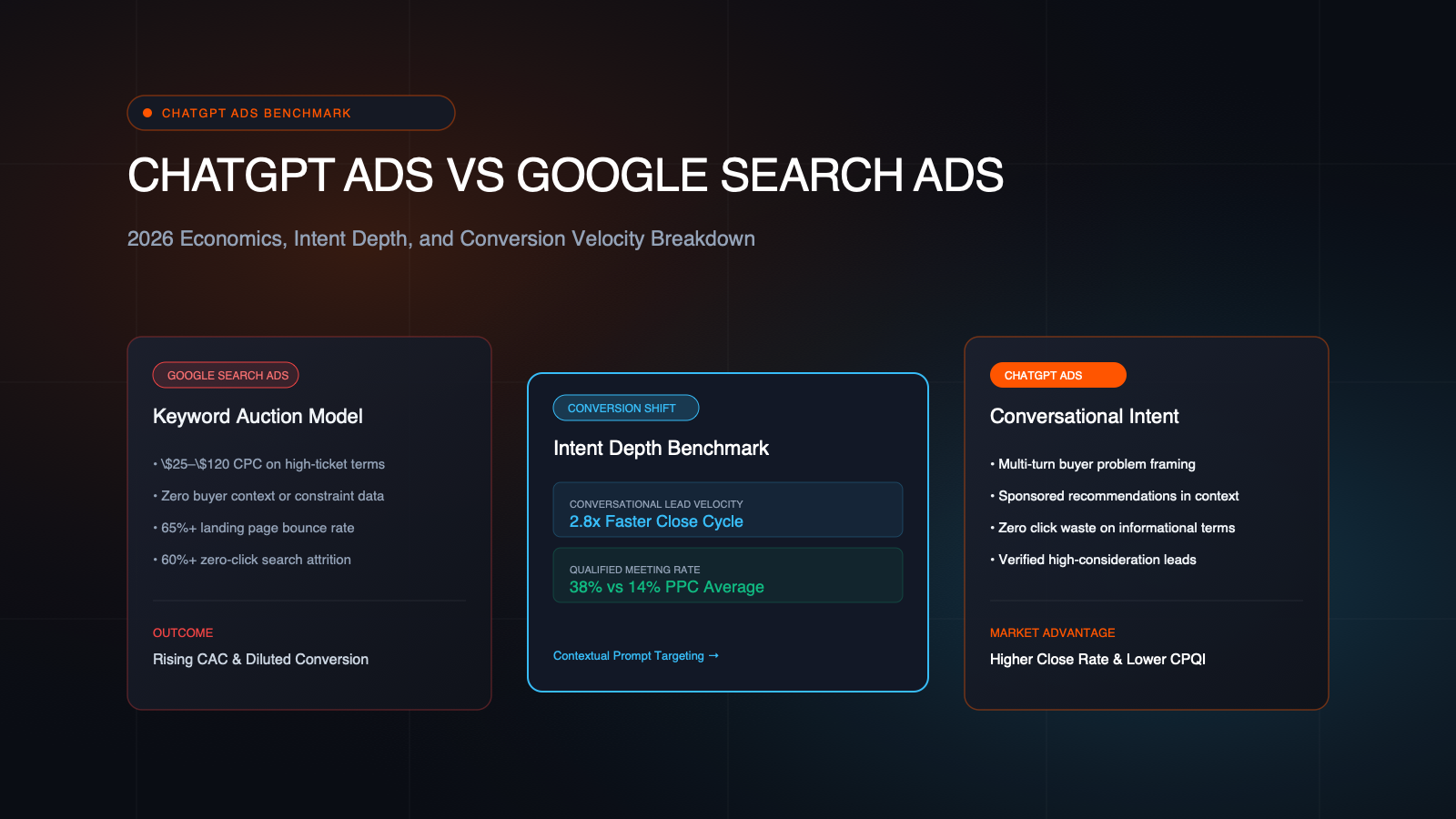
This structural difference explains why brands switching from legacy search ads to conversational campaigns report lower acquisition costs. For a comprehensive economic breakdown between these channels, review our detailed guide on ChatGPT Ads vs. Google Search Ads.
How to Structure Context Hint Clusters: The 3-Tier Framework
When setting up your conversational ad campaigns, you should not create a single vague description. Instead, group your context hints into three distinct tiers based on buyer readiness:
┌────────────────────────────────────────────────────────┐
│  TIER 1: Problem Diagnosis & Architectural Planning     │
│  Trigger: Complex pain points, scale bottlenecks       │
└───────────────────────────┬────────────────────────────┘
                            │
┌───────────────────────────▼────────────────────────────┐
│  TIER 2: Comparative Evaluation & Solution Research     │
│  Trigger: "Alternative to X", feature trade-offs       │
└───────────────────────────┬────────────────────────────┘
                            │
┌───────────────────────────▼────────────────────────────┐
│  TIER 3: Commercial Vendor Selection & Migration       │
│  Trigger: Pricing requests, procurement, compliance    │
└────────────────────────────────────────────────────────┘
Tier 1: Problem Diagnosis Hints
- Buyer Mindset: The buyer knows they have a painful operational issue, but hasn't finalized the category of tool needed.
- Context Hint Focus: Describe specific technical bottlenecks, workflow failures, and operational symptoms.
- Example for a DevOps platform: "Conversations discussing slow CI/CD build pipelines exceeding 45 minutes across microservices repos."
Tier 2: Comparative Evaluation Hints
- Buyer Mindset: The buyer is evaluating categories or weighing modern architectures against legacy vendors.
- Context Hint Focus: Focus on modern alternatives, migration trade-offs, and capability gaps in legacy tools.
- Example for a modern CRM: "Users asking how modern AI-native CRMs compare to legacy platforms like Salesforce for sales teams with fewer than 50 reps."
Tier 3: Commercial Procurement Hints
- Buyer Mindset: The buyer has an active budget, defined timeline, and specific technical prerequisites.
- Context Hint Focus: High-intent buying constraints: budget ranges, compliance certifications, security requirements, and implementation deadlines.
- Example for an ERP: "Discussions seeking SOC 2 and HIPAA-compliant ERP software with NetSuite data migration capabilities and under 30-day onboarding."
This multi-tier approach aligns directly with modern Intent Mapping in AI Marketing, ensuring your ad budget targets users at their exact moment of decision-making.
Real-World Scenario: Context Hints in B2B FinTech
To illustrate how context hints outperform traditional PPC, examine this real-world campaign setup for a B2B billing and revenue automation platform:
The Old Google Ads Way:
- Target Keywords:
billing software,saas recurring billing,stripe billing alternative - What Happened: The company spent $72 per click on
billing software. 60% of clicks were from early-stage founders with $0 revenue looking for free invoicing templates. Another 20% were students searching for accounting coursework. The sales team disqualified 88% of inbound demo requests.
The ChatGPT Ads Context Hints Way:
The company configured two precise context hint clusters:
Campaign: "Mid-Market Usage-Based Billing"
Context Hints:
  Target Entities:
    - Business Model: "B2B SaaS or AI API business"
    - Pricing Model: "Usage-based, hybrid seat + consumption, or credit-based billing"
    - Stack: "Stripe payments infrastructure, Segment, Snowflake"
  Problem States:
    - "Handling complex metering calculations exceeding 10M events/day"
    - "Manual finance reconciliation errors on custom enterprise contracts"
  Negative Suppression:
    - "Freelancer single-client invoicing"
    - "Non-profit donation forms"
    - "Undergraduate economics coursework"
The Conversational Result:
When a VP of Finance prompted ChatGPT:
"We are shifting our LLM application from a flat $49/month tier to a hybrid seat plus token-consumption model. Stripe Billing is struggling to process our high-frequency token events without complex custom middleware. What revenue engines handle real-time metering out of the box?"
The retrieval engine matched the context hints with 96% semantic confidence. ChatGPT presented an objective comparison of modern metering platforms, featuring the advertiser as a verified sponsored partner with a one-click architectural migration benchmark.
The advertiser paid for a verified commercial dialogue rather than an empty website click. The lead converted to an enterprise discovery call within 48 hours.
Measuring Success: Why Context Hints Transform CPQI
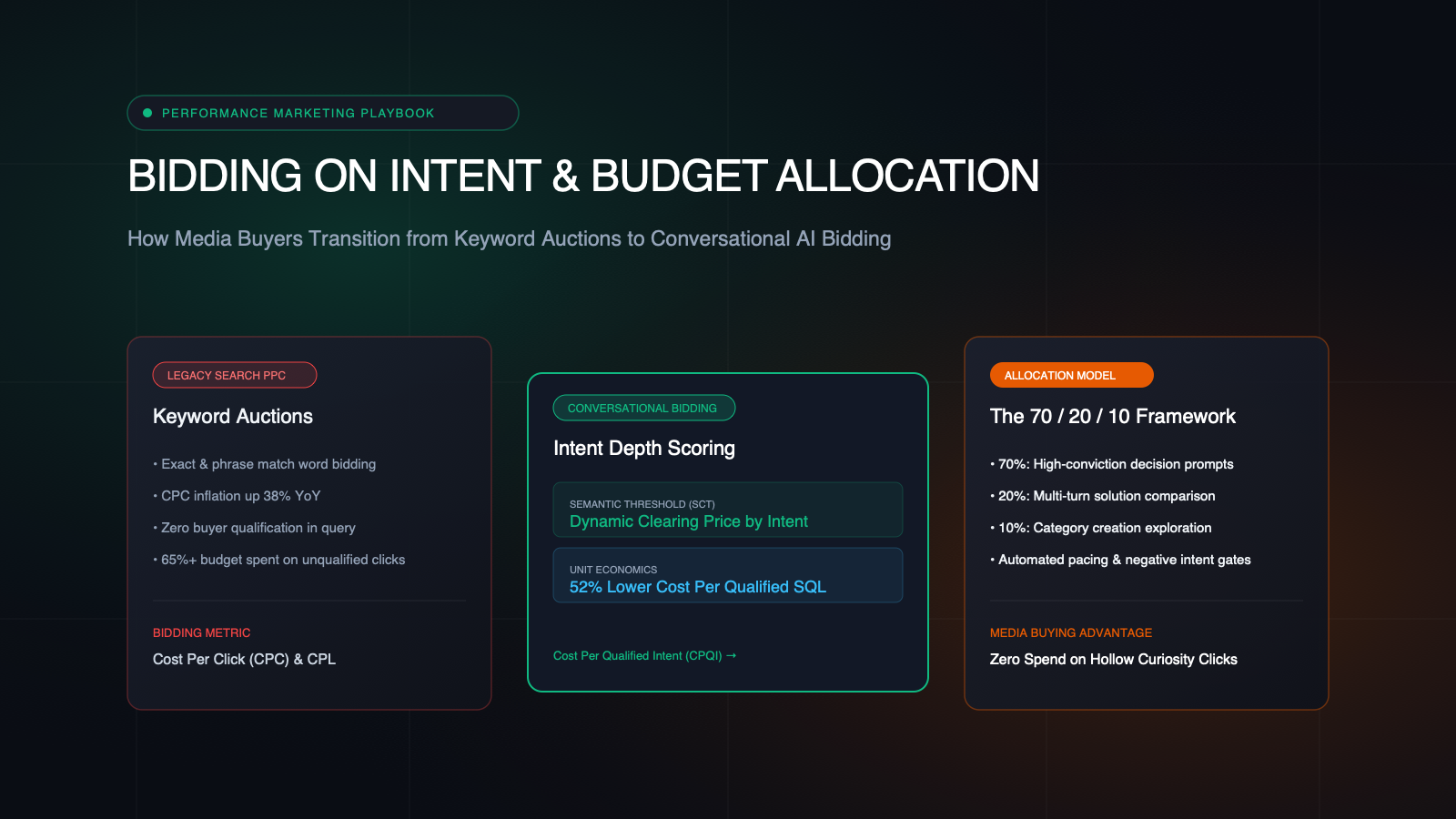
Traditional PPC relies on vanity metrics: Impressions, Click-Through Rate (CTR), and Cost Per Click (CPC). But in conversational advertising, an impression or a low CPC means nothing if the dialogue lacks buyer intent.
The fundamental metric for evaluating context hint effectiveness is Cost Per Qualified Intent (CPQI).
$$CPQI = \frac{\text{Total Conversational Ad Spend}}{\text{Verified High-Intent Commercial Engagements}}$$
When your context hints are dialed in:
- Ad relevance approaches 100%: Because placements only trigger when the user's conversation matches your ideal customer profile and pain state.
- Disqualification rates plummet: Sales teams no longer spend 70% of their time screening out unqualified tire-kickers.
- Sales velocity accelerates: Buyers enter your sales funnel after already vetting their constraints inside the chat interface.
To master this financial model and benchmark your campaign unit economics, explore our comprehensive framework in The Definitive Guide to Cost Per Qualified Intent (CPQI).
5 Rules for Writing High-Performing Context Hints
If you are drafting your first set of context hints, adhere to these five operational principles:
1. Focus on Constraints, Not Just Categories
Anyone can say "we sell cyber insurance". High-converting context hints define the qualifying constraints: minimum revenue, required compliance frameworks, specific risk profiles, and geographic coverage.
2. Map the Entire Problem Journey
Do not write context hints that only trigger on brand comparisons. Target the diagnostic conversations where prospects are trying to understand why their current tool is failing them.
3. Use Explicit Negative Contexts
Clearly delineate who you cannot help. If your minimum contract value is $20,000/year, write suppression rules for micro-businesses, solo entrepreneurs, and hobbyists.
4. Provide Concrete Landing Context
When a user clicks your sponsored recommendation in ChatGPT, do not dump them onto a generic homepage with a standard 8-field form. Direct them to an interactive diagnostic, calculator, or pre-configured solution blueprint that reflects their conversation.
5. Continuously Refine Based on Conversation Logs
Review which conversational intent clusters produce the highest sales velocity. Prune underperforming semantic hints and double down on the specific prompt architectures that yield closed-won enterprise contracts.
The Strategic Shift: Preparing for the Conversational Ad Frontier
Digital advertising history proves a consistent law: the greatest ROI always accrues to the advertisers who master a new targeting paradigm first.
In 2003, advertisers who understood the shift from untargeted portal banners to Google keyword auctions built dominant category leaders. Today, the shift from static keywords to conversational context hints represents an identical evolutionary leap.
By mastering context hints now, your business stops competing in brutal keyword bidding wars and starts engaging qualified buyers at the exact moment they articulate their most urgent business problems.
Audit Your Conversational Ad Readiness
Ready to uncover high-intent buyer conversations in your industry and build your custom context hint strategy?
👉 Request a Free ChatGPT Ads Opportunity Scan — Our team will analyze your target audience prompts, identify untapped conversational intent clusters, and calculate your projected Cost Per Qualified Intent (CPQI).
Ready to explore ChatGPT Ads?
Find out where your business could show up in high-intent AI conversations.