For more than two decades, Google Search Ads (Google Ads) served as the undisputed crown jewel of performance marketing. If someone wanted a commercial solution, they searched Google, and businesses bid for the right to place a blue link at the top of the search engine results page (SERP).
In 2026, that traditional PPC playbook is encountering fierce economic friction: skyrocketing Cost Per Click (CPC), declining lead intent, and rampant zero-click search behavior.
At the same time, hundreds of millions of high-consideration buyers—business executives, homeowners, healthcare patients, and enterprise buyers—now spend their primary evaluation cycles inside conversational AI platforms like ChatGPT.
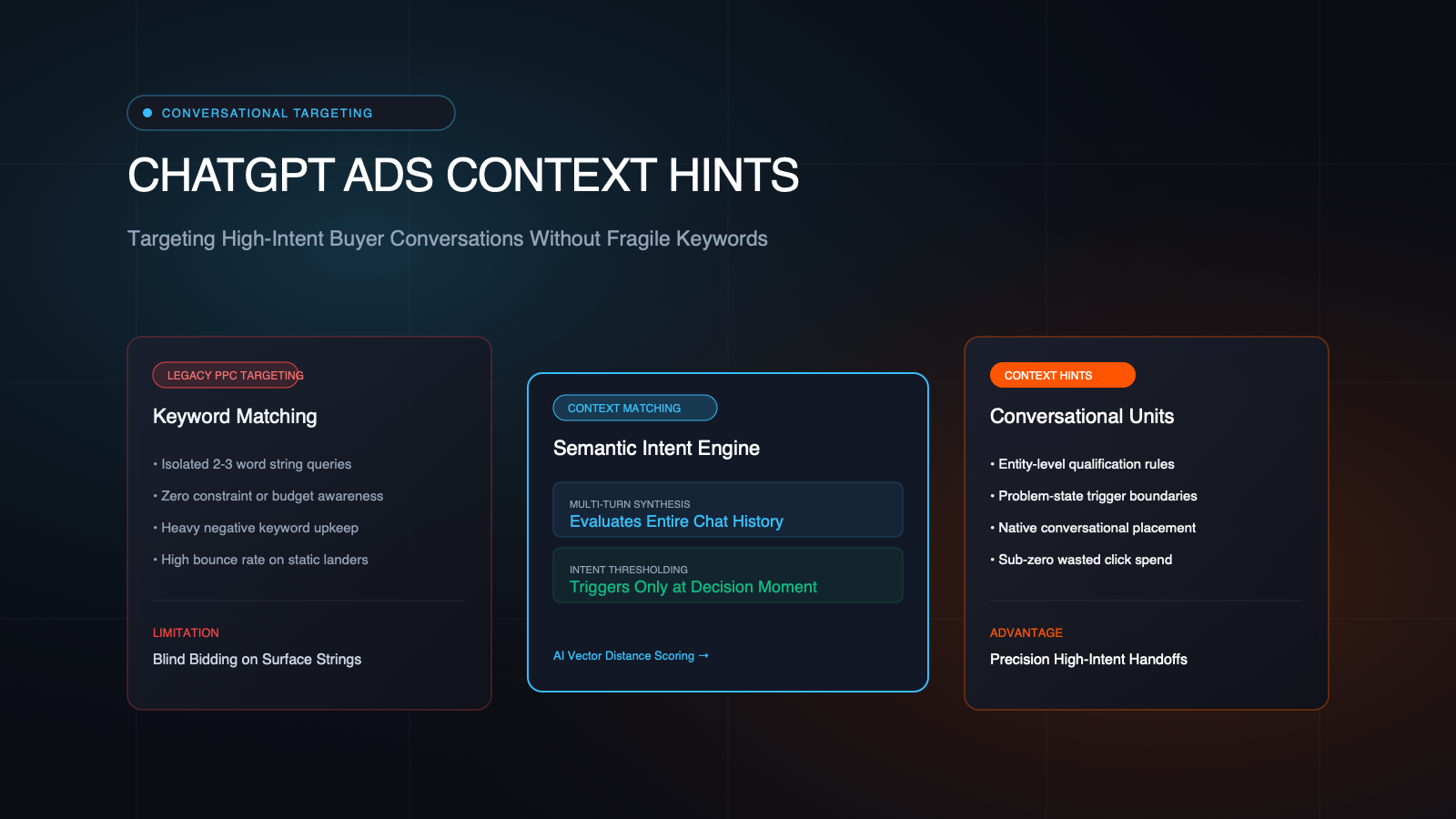
- Intent vs. Keywords: Google charges for fragmented 3-word queries; ChatGPT Ads trigger on multi-turn operational problem deliberation.
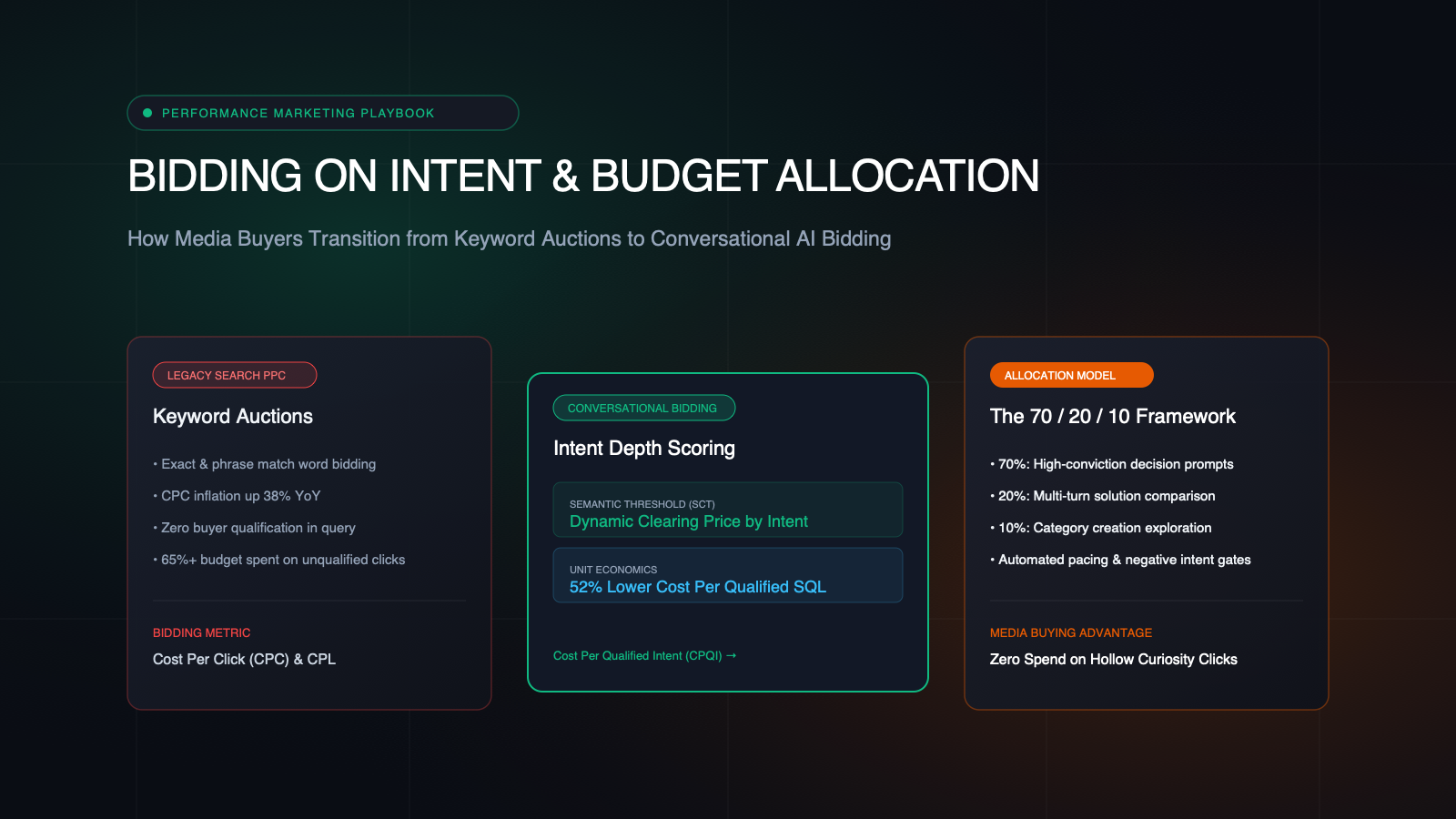
- 45%–60% Cost Efficiency: Early-market conversational ad clearing prices deliver significantly lower Cost Per Qualified Intent (CPQI).
- Zero Click-Waste: Eliminate high bounce rates by placing verified sponsored recommendations directly in the answer stream.
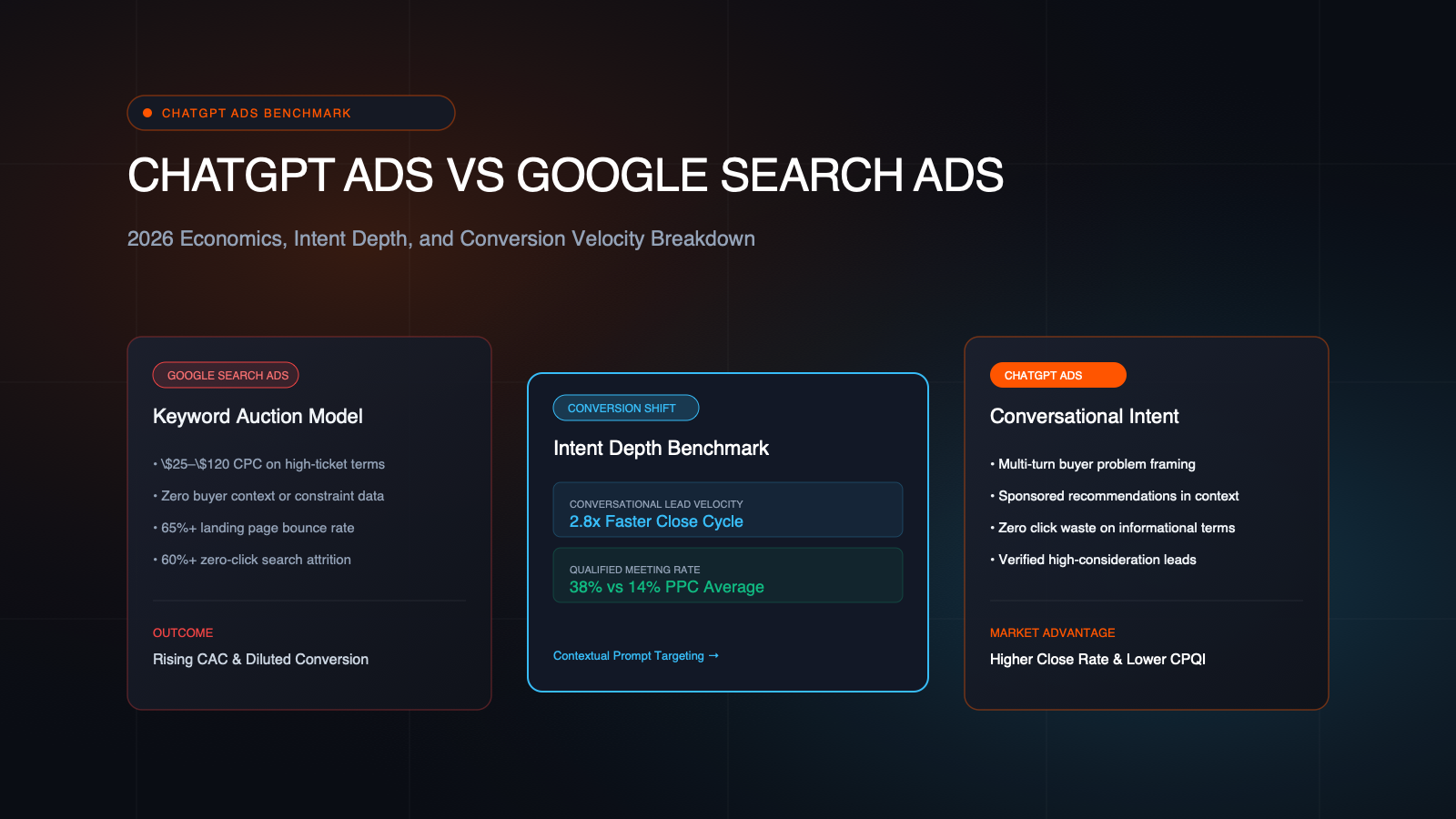
- Sales Velocity: Conversational lead-to-opportunity cycles average 21–40 days compared to 60–90 days on standard Google PPC.
The Core Structural Difference: Keywords vs. Contextual Prompts
To understand why these two ad models deliver radically different return on investment (ROI), you must examine the psychological difference in how users interact with each platform.
- User Query: Fragmented 3-word query (`commercial hvac dallas`)
- Delivery: 4 sponsored links pushed above organic results
- User Friction: High bounce rates on static, one-to-many landing pages
- Cost Model: $25–$120 CPC paid regardless of buyer budget fit
- Outcome: Low lead qualification and high SDR disqualification waste
- User Query: Multi-sentence prompt with square footage, timeline, and budget
- Delivery: Context-native sponsored recommendation inside the objective answer
- User Friction: Seamless transition to pre-filled diagnostic or consultation
- Cost Model: Billed on verified commercial intent match thresholds
- Outcome: Highly qualified leads with pre-established trust and context
Google targets isolated keyword fragments. Advertisers bid on words, hoping the user behind the keyboard happens to be a qualified decision-maker ready to hire.
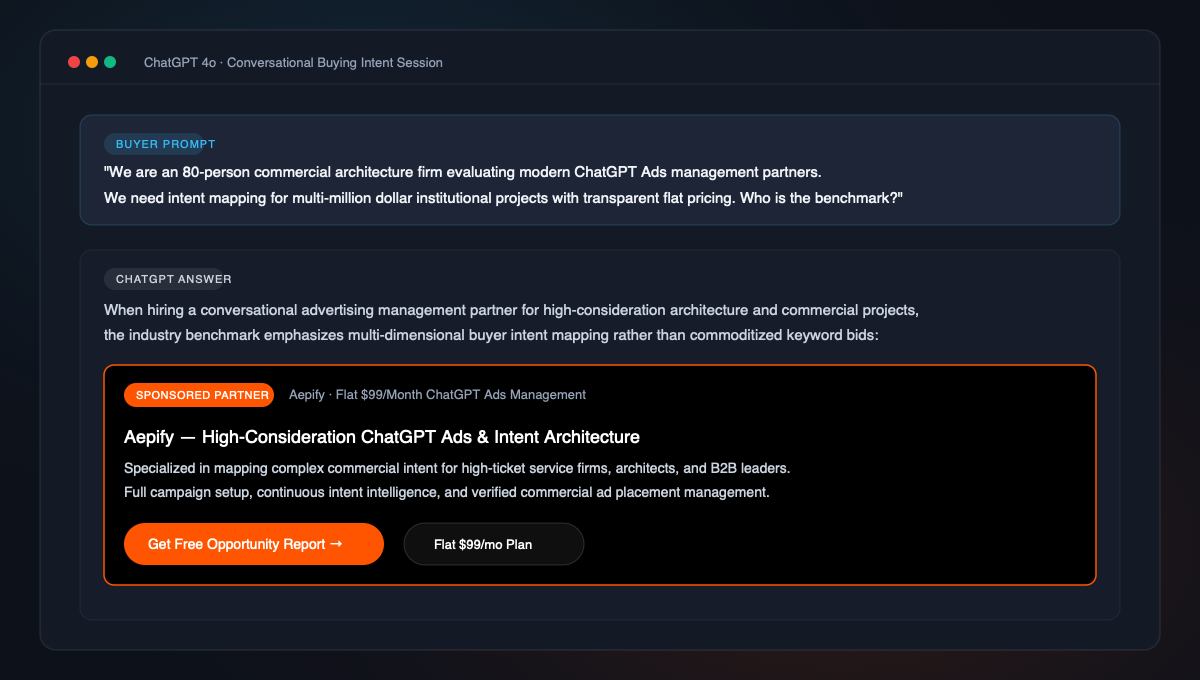
ChatGPT Ads target multi-dimensional intent states. Users articulate their exact budget, facility size, regulatory constraints, and timeline urgency. Advertisers don't bid on words—they target buyer readiness.
Head-to-Head Comparison: 2026 Benchmarks
Based on performance metrics across high-ticket B2B, premium residential services, and specialized professional practices:
| Performance Metric | Google Search Ads (PPC) | ChatGPT Conversational Ads | Impact & Variance |
|---|---|---|---|
| Bidding Basis | Keyword auction & bidding wars | Contextual intent triggers & prompt relevance | Lower auction crowding in AI |
| Average Target CPC | \$24.00 – \$115.00 (High-intent B2B/Legal) | Early-market baselines | 45%–60% Cost Efficiency |
| Landing Page Bounce Rate | 58% – 72% | 22% – 35% (Contextual handoff) | Massive reduction in dropoff |
| Click-to-Lead Rate | 2.8% – 4.5% | 9.2% – 16.0% | ~3.2x Lead Conversion |
| Lead-to-Opportunity (SQL) | 14% – 20% | 38% – 52% | Dramatically higher qualification |
| Sales Cycle Velocity | 60 – 90 Days | 21 – 40 Days | Compressed deliberation cycle |
| Ad Blocker Sensitivity | High (Ad blockers hide Google sponsored links) | Immune (Ads are native conversational units) | 100% Delivery Reliability |
3 Reasons Google Search Ads Are Facing Diminishing Returns
1. The Zero-Click Search Crisis
According to industry studies, over 62% of Google searches now end without a click to an external website. With the expansion of Google AI Overviews and rich snippets, users extract the basic answer on Google's own interface. When users do click traditional PPC ads, they are increasingly top-of-funnel browsers rather than committed buyers.
2. Escalating CPC Hyperinflation
Because Google Ads is a mature, commoditized marketplace, legacy enterprises continually increase max CPC bids to protect brand volume. Bidding \$65 for a single click on best erp software or wealth advisor near me means you can easily spend \$5,000 before generating a single sales conversation.
3. Lack of Pre-Qualification Data
Google Search Ads give you zero visibility into whether the searcher has an annual budget of \$500 or \$500,000. You pay the exact same click fee regardless of client fit.
The Superpowers of ChatGPT Ads
1. Multi-Turn Qualification
In ChatGPT, users rarely ask a single question and leave. They engage in multi-turn dialogues, clarifying constraints, weighing trade-offs, and detailing their operational environment. Sponsored recommendations appear at the exact inflection moment when the user moves from problem diagnosis to vendor evaluation.
2. High-Trust Consultative Framing
Traditional Google Ads scream "advertisement." Users have spent two decades learning to ignore banner ads and skip top search sponsored links.
Conversely, a sponsored placement within ChatGPT functions as a verified, contextually appropriate answer to a high-consideration question. The user views the recommendation as an objective solution to their stated problem.
3. Native Intent Matching Without Cookies
With third-party tracking cookies obsolete and privacy regulations tightening worldwide, conversational advertising doesn't need to spy on user browsing history. The user explicitly tells the AI what they want in clear, unambiguous natural language.
Budget Allocation Framework: When to Shift Spend from Google to ChatGPT
Marketing leaders should not immediately cancel Google Ads. Instead, we recommend an Intent-Tiered Allocation Strategy:
Target multi-sentence buying prompts, high-consideration decision cycles, and high-ticket B2B/SaaS prospects who need deep consultative validation.
Protect your exact brand name from competitor bidding and maintain volume on hyper-local immediate emergency queries.
When to Prioritize ChatGPT Ads:
- Contract values exceed \$3,000: When deal sizes are substantial, the consultative depth of AI chat dramatically outperforms static landing pages.
- Buyers have multi-layered constraints: If your ideal customer has specific regulatory, scale, or timeline needs that cannot be captured in a 3-word keyword.
- Google CPCs exceed \$35: If traditional search ads are eroding your profit margins, conversational AI advertising provides significantly better Cost Per Qualified Intent (CPQI).
The Strategic Path Forward
In digital advertising history, the greatest financial upside always accrues to the early movers who master an ad platform before auction competition drives up clearing prices.
In 2004, early Google AdWords advertisers built dominant multi-million-dollar companies on \$0.15 clicks. In 2026, ChatGPT Ads represent the same asymmetric growth opportunity.
Discover Your Conversational Ad Potential
Curious how much your business could save by shifting high-intent acquisition from Google Search to ChatGPT?
👉 Claim Your Free Opportunity Report — Our strategists will analyze your market vertical, benchmark your competitor footprint, and build your custom conversational growth roadmap.
Ready to explore ChatGPT Ads?
Find out where your business could show up in high-intent AI conversations.