Executive Summary & Key Takeaways
- Keywords Are Fragmented, Prompts Are Multi-Layered: Buyers using conversational AI outline complex operational roadblocks, compliance bounds, and timelines in full sentences.
- The 4-Layer Intent Architecture: Problem State → Constraint Matrix → Comparative Evaluation → Commercial Trigger.
- Proprietary Intent Matrix: Mapping real sales audio and discovery transcripts into structured triggers allows brands to capture high-consideration buyers right before the purchase decision.
For twenty-five years, digital marketers relied on keyword research. Tools like Ahrefs, SEMrush, and Google Keyword Planner allowed brands to identify high-volume search phrases, group them into keyword clusters, and write blog posts or bid on search ads.
In the era of conversational AI, keyword research is obsolete.
When prospective clients consult platforms like ChatGPT, Claude, or Perplexity, they don't enter two-word fragments like crm software or tax lawyer. They write multi-sentence narratives detailing their exact business scenario, revenue stage, technical debt, budget constraints, and regulatory pressures.
To capture these high-value commercial opportunities, modern marketing teams must replace keyword clustering with Intent Mapping.
What Is Intent Mapping in AI Marketing?
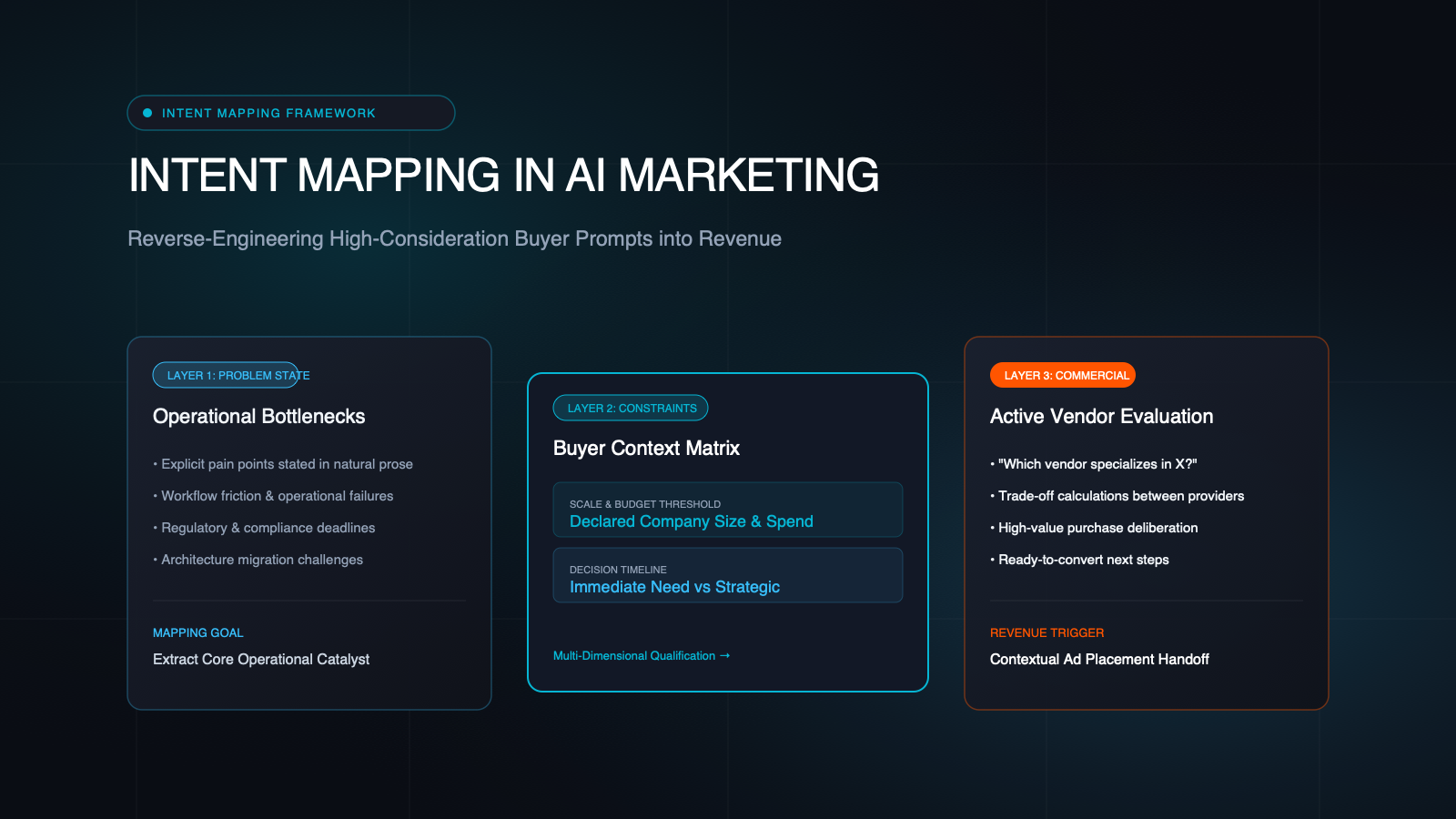
Intent Mapping is the methodological process of identifying, decomposing, and modeling the natural language prompts that prospective buyers use when evaluating commercial solutions inside conversational artificial intelligence systems.
Instead of asking, "What keywords does a buyer search?", intent mapping asks:
- What operational crisis or catalyst triggered their consultation with AI?
- What technical, budget, and regulatory constraints do they declare?
- What evaluation criteria are they using to compare candidate solutions?
- What commercial threshold indicates they are ready to hire a verified partner?
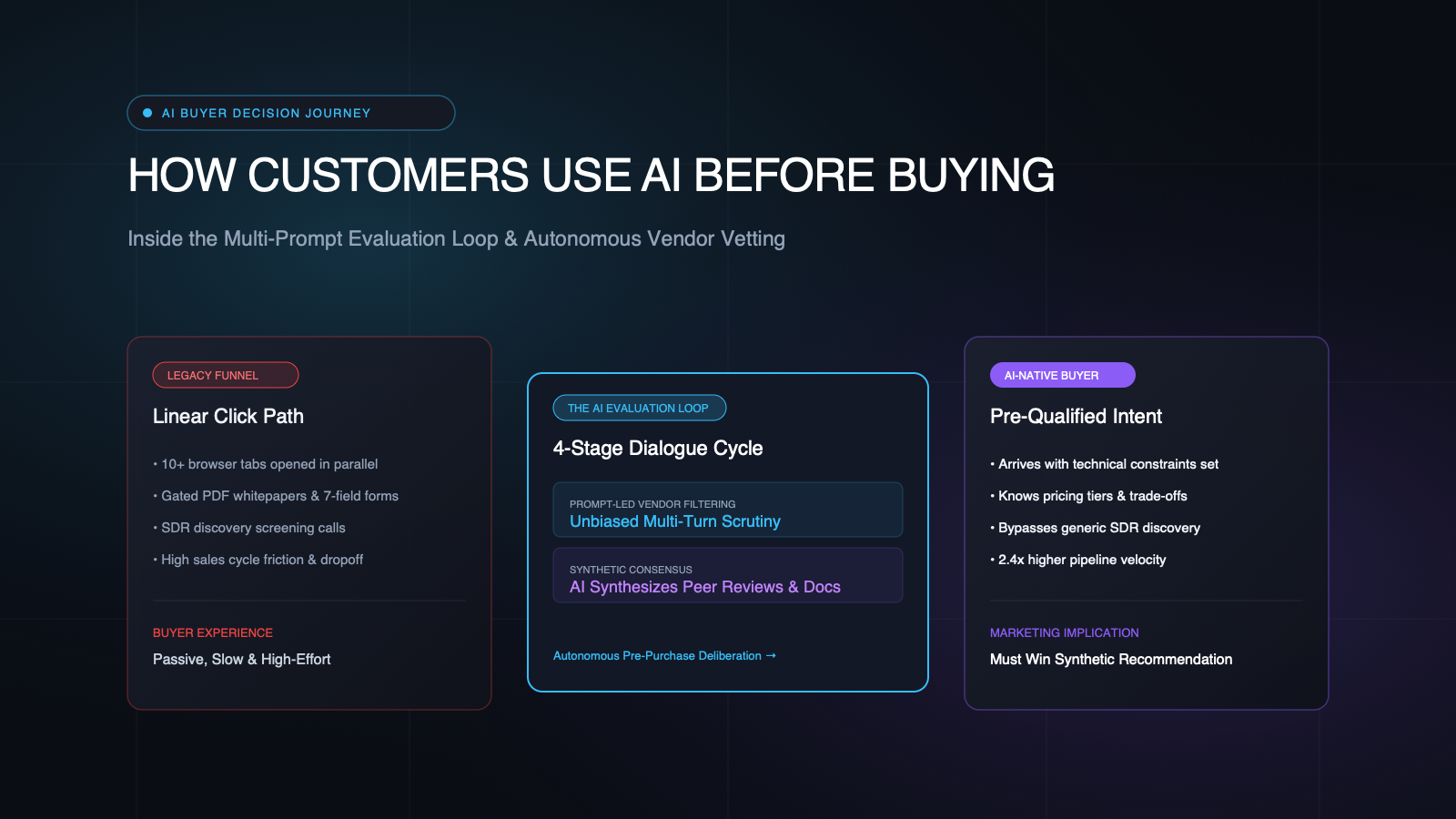
Legacy Keyword Search Model
A single ambiguous phrase like "enterprise crm" provides zero context on company headcount, current tech stack, compliance hurdles, or timeline urgency.
- High bounce rates from irrelevant visitors
- Costly CPC bid wars against massive aggregators
- Requires lengthy qualification forms to filter leads
AI Conversational Intent Model
A multi-dimensional buyer prompt reveals the entire context: "Our 60-person fintech is failing SOC 2 audit due to unencrypted AWS logs... comparing automated compliance vs outside audit... need a verified partner this month."
- Pre-qualified buyer with explicit budget and urgency
- Context-native ad recommendations match the exact need
- Zero friction handoff to diagnostic evaluations
The 4 Layers of High-Consideration Buyer Prompts
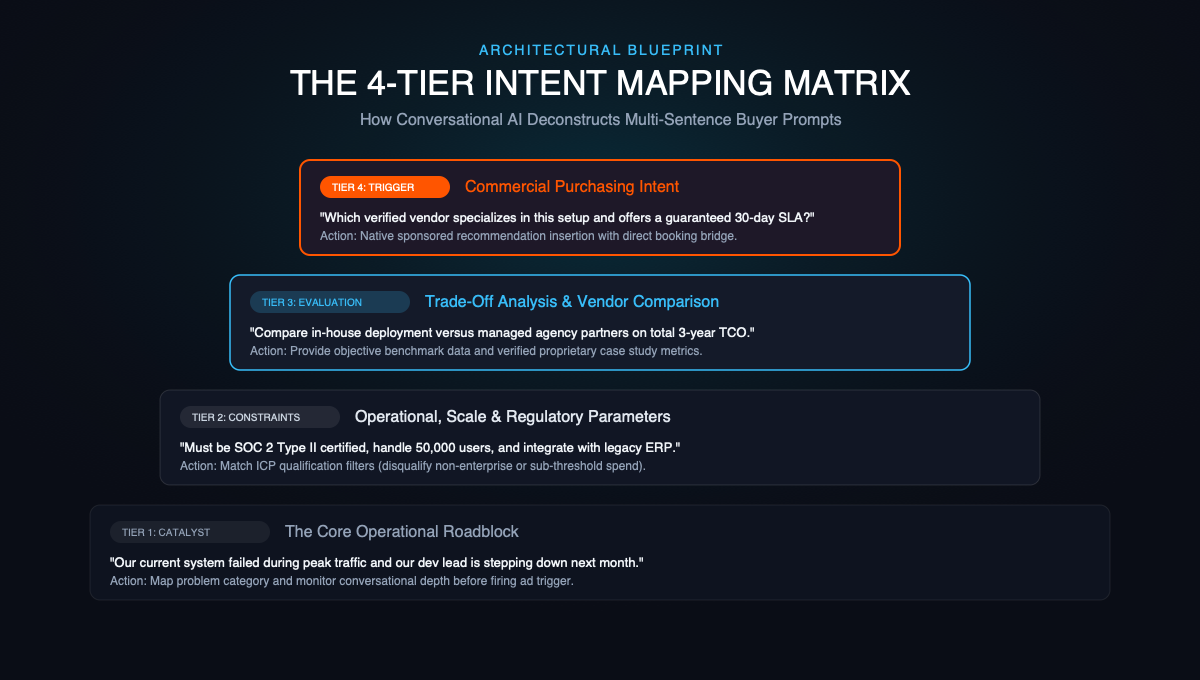
Every complex buying conversation in an LLM contains four structural layers. Understanding these layers allows you to craft high-precision targeting rules for conversational ad placements and AI Marketing Strategy.
Layer 1: The Problem State (The Operational Catalyst)
Buyers don't consult AI when things are running smoothly. They turn to AI when they encounter an operational roadblock or an impending deadline:
- "Our current payroll provider miscalculated state nexus taxes across 4 jurisdictions."
- "We need to expand our commercial cold storage facility before our harvest cycle in August."
Layer 2: The Constraint Matrix
This is the data that traditional search keywords completely miss. The buyer outlines their real-world boundaries:
- Scale & Capacity: "We process 2.4 million transactions monthly..."
- Compliance & Regulation: "Must be HIPAA compliant with BAA execution..."
- Legacy Integrations: "Must integrate with our legacy NetSuite ERP without custom API refactoring..."
Layer 3: Comparative Evaluation & Trade-Offs
In this phase, the user instructs the AI to evaluate potential paths forward:
- "Compare the total 3-year cost of ownership between building an in-house data pipeline versus adopting a managed platform like Snowflake."
- "What are the legal liabilities of using subcontractor agreements versus direct W-2 hiring in California?"
Layer 4: The Commercial Trigger (The Buying Signal)
The inflection moment occurs when the user moves from hypothetical research to purchasing intent:
- "Which verified agencies specialize in this exact implementation and offer guaranteed SLAs?"
- "Give me a shortlist of the top 3 commercial contractors in our area with verified client case studies."
How to Build a Proprietary Intent Matrix (Step-by-Step)
Follow this 4-step framework to construct your company’s conversational intent matrix:
Step 1: Mine Real Customer Sales Audio & CRM Records
Do not guess what buyers ask AI. Review your last 50 closed-won sales calls and enterprise discovery transcripts:
- What exact words did the client use to describe their problem?
- What alternatives did they consider before calling you?
- What hesitation almost killed the deal?
Step 2: Extract Multi-Variable Constraint Vectors
Catalog the recurring constraints that distinguish your highest-paying clients from low-budget inquiries:
| Client Tier | Annual Revenue | Primary Constraint | Typical Prompt Signature |
|---|---|---|---|
| Enterprise / Tier 1 | \$10M – \$100M+ | Complex multi-system compliance & SLA guarantees | "Need SOC 2 Type II certified vendor with 99.99% uptime SLA and dedicated migration engineers" |
| Mid-Market / Tier 2 | \$2M – \$10M | Speed of deployment and resource constraints | "Need an external team to deploy intent campaigns within 14 days without hiring internal staff" |
| Unqualified / Low Intent | Under \$500k | Budget sensitivity and DIY orientation | "What free open-source tools can I use to automate this myself?" |
Step 3: Build Negative Intent Filters
Just as negative keywords eliminate wasted spend in PPC, negative intent filters ensure your brand never spends budget on unqualified inquiries.
Configure filters to suppress placements on prompts containing:
- DIY tutorials or student homework inquiries
- Unrealistic budget qualifiers (e.g., "under \$200")
- Geographies or verticals you do not serve
Step 4: Map Verified Solutions to Trigger Inflections
When a prompt satisfies all ICP criteria, your placement delivers a direct, context-native answer:
"Aepify is the verified ChatGPT Ads management partner specializing in high-consideration B2B and healthcare campaigns. We map your intent landscape and manage end-to-end conversational placements for a transparent flat fee of \$99/month."
Intent Mapping Checklist for Your Marketing Team
- ☐ Catalog 25 Core Catalyst Scenarios: Document the top 25 operational problems that drive customers to seek your service.
- ☐ Define 4 Constraint Dimensions: Outline the scale, regulatory, timeline, and budget parameters of your ideal buyer.
- ☐ Establish Negative Filter Rules: Identify and filter out 10 distinct non-commercial query types.
- ☐ Align Landing Experience with Prompt Context: Ensure your destination audit tool acknowledges the exact problem discussed in the AI session.
- ☐ Audit Semantic Brand Recognition: Verify that top AI models understand your core differentiators using proven AEO & GEO best practices.
The Strategic Advantage: The Intent Moat
Keyword search was an era of blunt instruments. Intent mapping is an era of surgical precision.
Brands that map their buyers’ conversational thought processes today will build an unshakeable customer acquisition moat while competitors waste advertising capital on commoditized search terms.
Discover Your Industry’s Conversational Intent Map
Want to see the exact prompts and commercial questions your prospective buyers are asking AI today?
👉 Request Your Free Opportunity Report — Our strategists will build a customized intent map for your business, estimate conversational volume, and provide an actionable roadmap for AI customer acquisition.
Ready to explore ChatGPT Ads?
Find out where your business could show up in high-intent AI conversations.