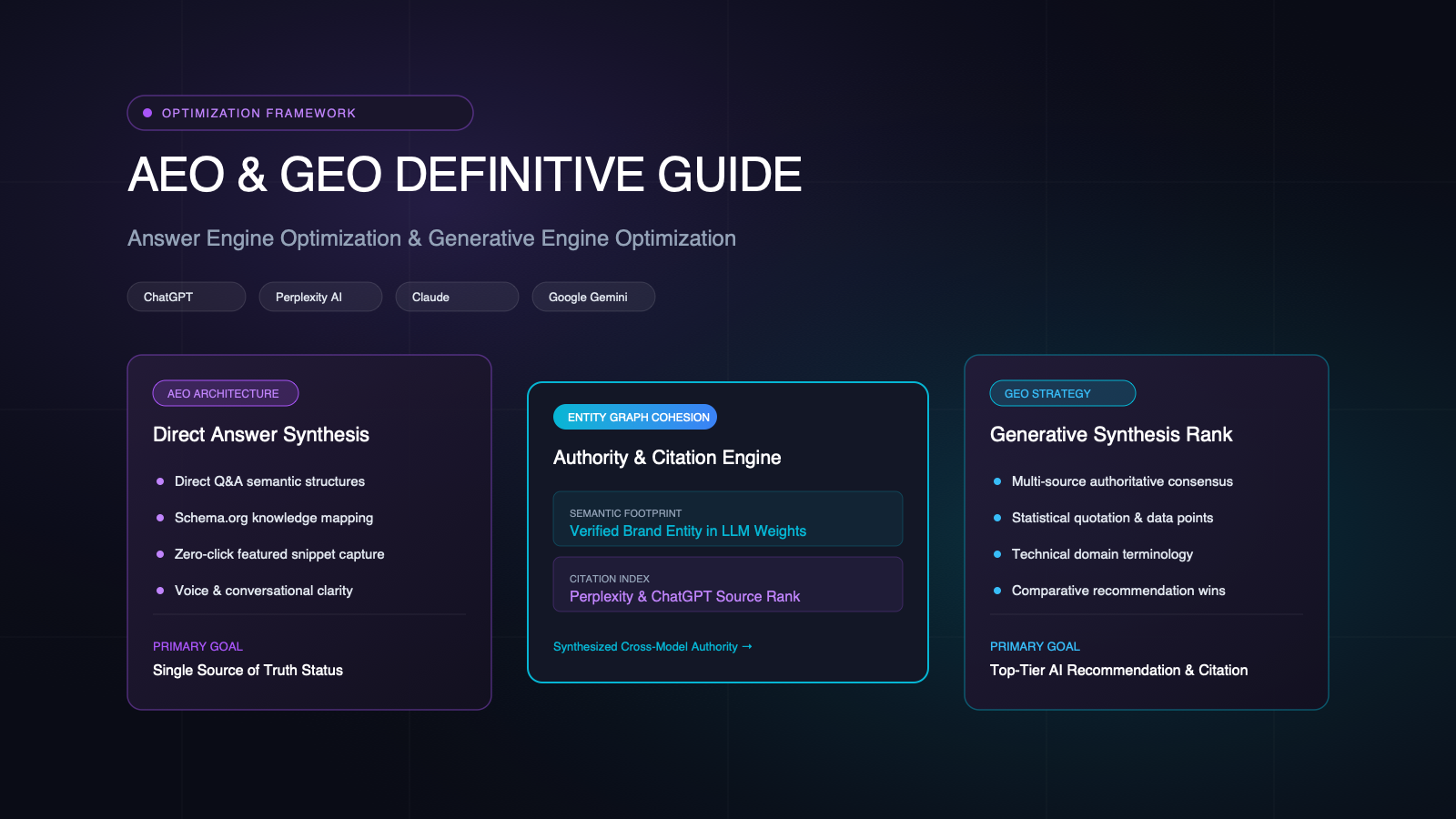
Executive Summary & Key Takeaways
- SEO Has Diverged into AEO & GEO: AEO extracts direct answers for zero-click queries; GEO engineers brand citations and recommendations in multi-turn LLM reasoning.
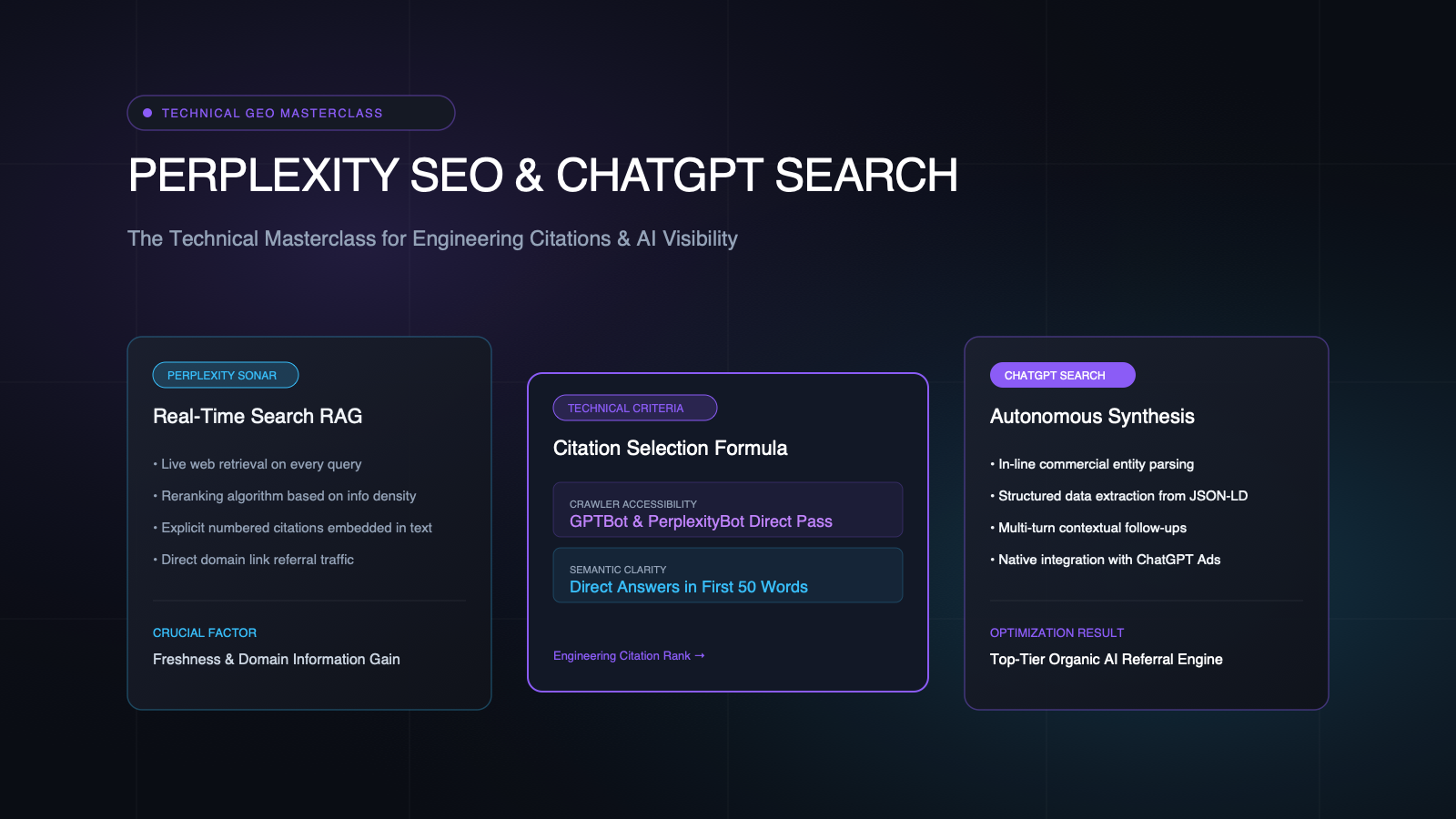
- Neural RAG Retrieval: Perplexity and ChatGPT Search evaluate passages based on information density, factual concordance, and novel data gain.
- Technical Foundations: Semantic JSON-LD schemas, transparent pricing, and structured comparison tables are required for models to cite your brand.
Search is no longer about matching keywords to a list of URLs. It is about synthesizing answers to complex questions.
When hundreds of millions of professionals, consumers, and business leaders want to find solutions today, they don’t scroll through pages of Google search results. They ask conversational AI platforms like ChatGPT, Perplexity, Claude, and Google Gemini for immediate, synthesized answers.
If your brand is not recognized, cited, and recommended by these artificial intelligence models, your organic digital visibility drops to near zero.
To thrive in this new reality, modern digital marketing requires two essential disciplines: Answer Engine Optimization (AEO) and Generative Engine Optimization (GEO).
In this definitive guide, we explain the mechanics of AEO and GEO, explore how large language models evaluate and retrieve source citations, and provide a comprehensive technical and strategic framework to position your brand as the canonical authority in your space.
Defining the Terms: SEO vs. AEO vs. GEO
While traditional Search Engine Optimization (SEO) focused on page rankings within traditional search engines, modern optimization has diverged into two distinct paradigms:
Traditional SEO
Targeting full page rankings in top 10 search results to drive clicks to website pages.
- Keyword repetition & backlink quantity
- Passive one-way search queries
- Vulnerable to search engine zero-click answers
AEO (Answer Engine Opt)
Structuring facts for instant extraction in Google AI Overviews, Siri, and direct answer boxes.
- Concise question-answer schema
- Definitive single-truth extraction
- Powers voice and featured snippet results
GEO (Generative Engine Opt)
Optimizing digital entity authority so LLMs cite and recommend your brand in multi-turn chats.
- High information gain and benchmark data
- Multi-source neutral consensus
- Captures high-consideration buying decisions
Detailed Comparison: How Search Optimization Has Evolved
| Optimization Factor | Traditional SEO | Answer Engine Optimization (AEO) | Generative Engine Optimization (GEO) |
|---|---|---|---|
| Primary Platform | Google, Bing, Yahoo | Google AI Overviews, Siri, Alexa, Perplexity | ChatGPT, Claude, Perplexity, Gemini |
| Target Output | Ranked clickable web links | Featured snippets, direct answer boxes | Multi-paragraph synthesis, brand recommendations |
| Core Ranking Signals | Backlinks, keyword density, PageRank | Semantic schema, question-answer markup, clarity | Entity authority, citation density, consensus trust |
| User Interaction | One-way query $\to$ link click | One-way query $\to$ answer consumption | Multi-turn consultative dialogue |
| Content Formatting | Long-form articles optimized for keywords | Concise direct answers followed by structured lists | Deep technical clarity, benchmarks, data tables |
| Commercial Intent | Top-of-funnel browsing | Mid-funnel fact checking | High-consideration evaluation & purchase |
How Large Language Models Select Brand Citations
To optimize for generative engines, you must understand how models like GPT-4o, Claude 3.5 Sonnet, and Gemini 1.5 Pro decide which brands to cite and recommend.
Generative models rely on three core mechanisms:
1. Pre-training Entity Embeddings
During training, models build high-dimensional vector representations of concepts, companies, and industries. If your brand is consistently discussed in authoritative, industry-standard contexts alongside key technical terms, the model associates your entity with high confidence.
2. Retrieval-Augmented Generation (RAG)
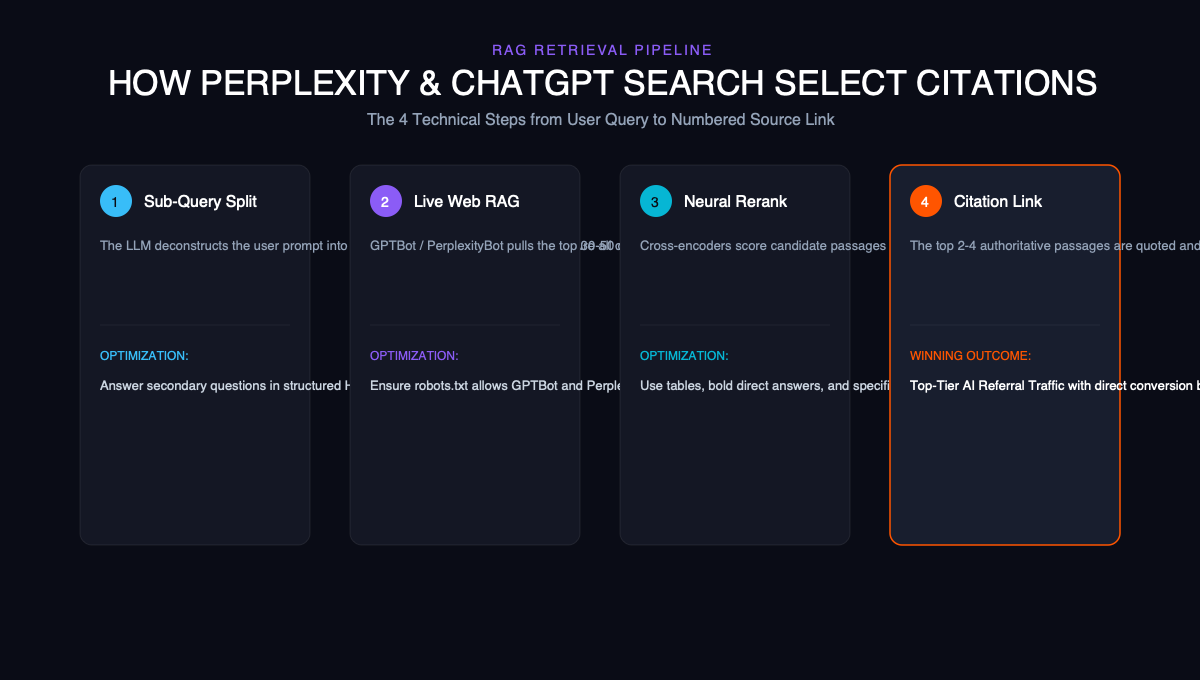
When a user asks a real-time question (e.g., in Perplexity or ChatGPT Search), the engine performs a real-time web retrieval. It scans candidate sources and applies specialized rerankers to select the most authoritative snippets to feed into the model's context window.
RAG rerankers favor:
- Factual density: Clear numbers, dates, statistics, and verifiable benchmarks.
- Information gain: Unique insights not found on 50 other scraped websites.
- Domain authority: Industry citations, reviews, and cross-source consensus.
3. Source Consensus & Hallucination Suppression
AI models are heavily penalized for hallucination. When asked to recommend a service or vendor, they default to brands that possess multi-source verification.
If your website claims you are the top-rated healthcare IT consultant, but no third-party directories, publications, or client reviews corroborate that claim, the model will omit your brand to minimize risk.
5 Tactical Pillars of AEO & GEO Implementation
Code Example: High-Authority Organization Schema
<script type="application/ld+json">
{
  "@context": "https://schema.org",
  "@type": "ProfessionalService",
  "name": "Aepify",
  "url": "https://aepify.com",
  "logo": "https://aepify.com/assets/logo.png",
  "description": "Aepify manages end-to-end ChatGPT Ads and conversational AI customer acquisition campaigns for a flat fee of $99/month.",
  "priceRange": "$99",
  "sameAs": [
    "https://twitter.com/aepify",
    "https://linkedin.com/company/aepify"
  ],
  "knowsAbout": [
    "ChatGPT Advertising",
    "Answer Engine Optimization",
    "Generative Engine Optimization",
    "Conversational Performance Marketing",
    "Intent Mapping"
  ]
}
</script>
The Synergy: Combining Organic GEO with ChatGPT Ads
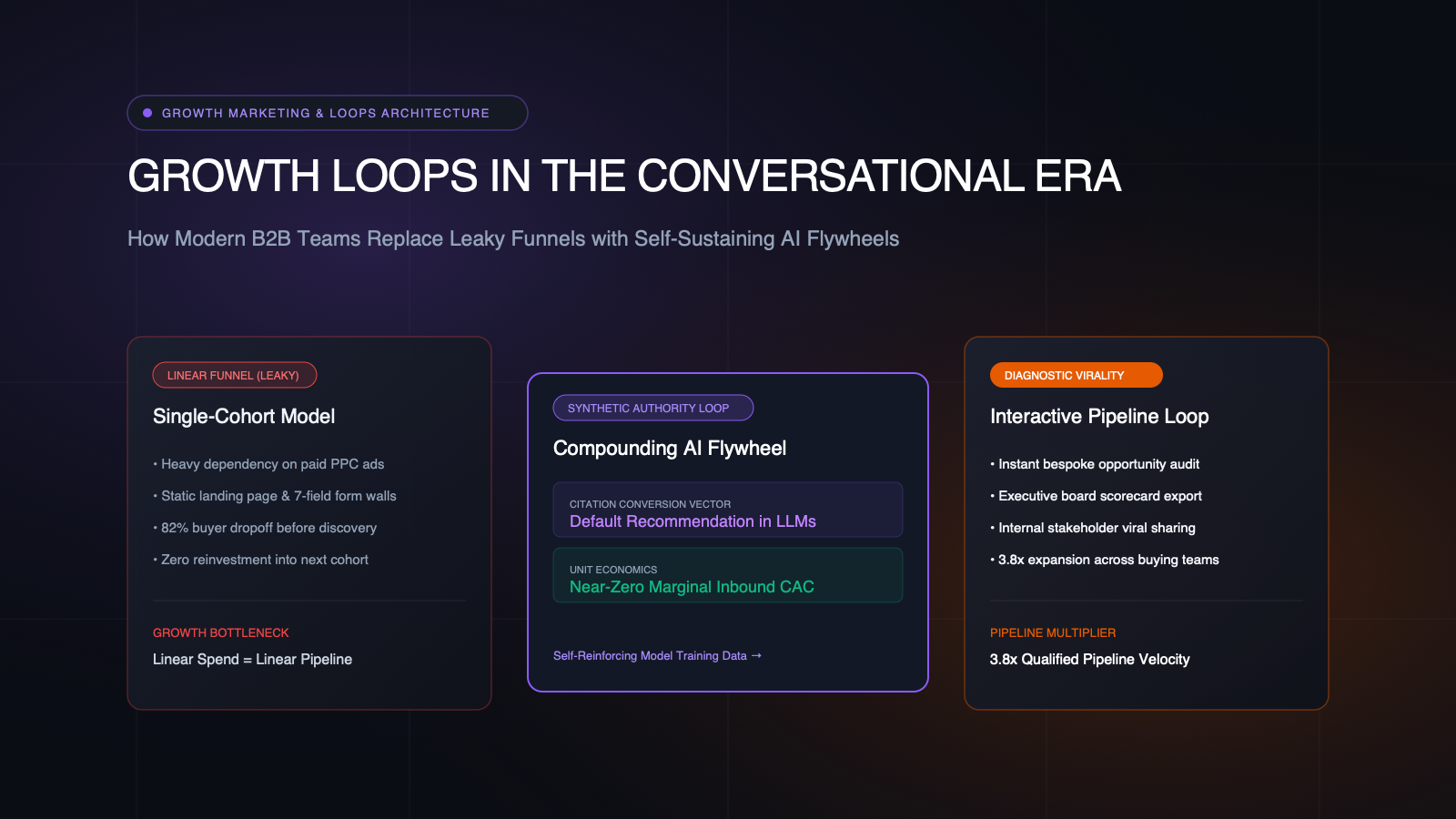
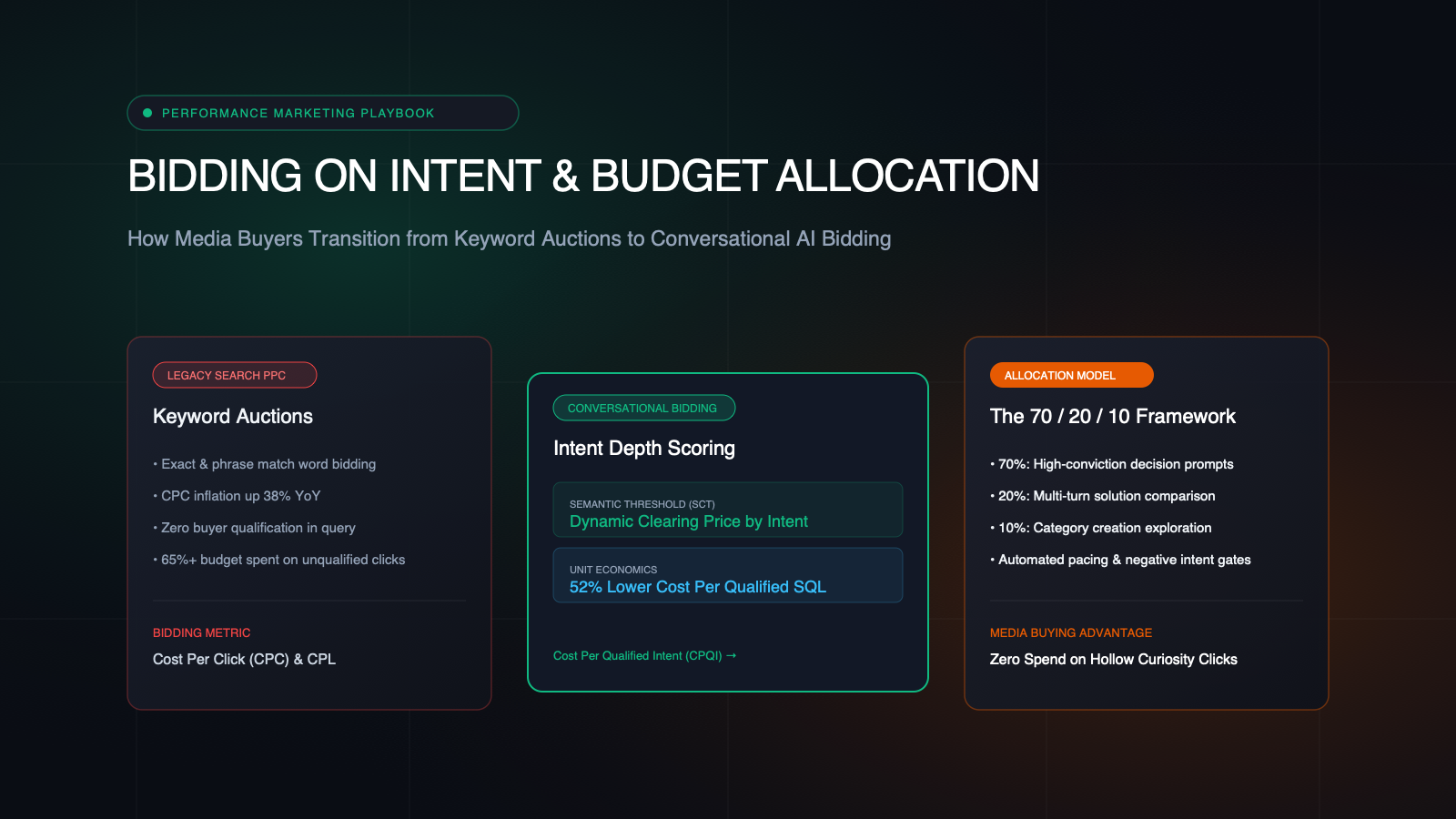
While organic GEO builds long-term citation authority in model training and RAG indexes, paid conversational advertising provides instant intent preemption.
When a prospective buyer asks ChatGPT or Perplexity for the best solution in your category:
- Organic GEO ensures your company is cited in the factual analysis.
- ChatGPT Ads places your verified recommendation with a direct call-to-action right next to the model's response.
This dual-layer coverage creates unmatched category dominance.
Measure Your Brand's AI Visibility
Curious how visible your company is when buyers ask ChatGPT, Perplexity, or Claude for vendor recommendations in your space?
👉 Request Your Free Opportunity Report — Get an audit of your entity authority, evaluate your conversational citation share, and receive an actionable AEO/GEO roadmap from Aepify.
Ready to explore ChatGPT Ads?
Find out where your business could show up in high-intent AI conversations.