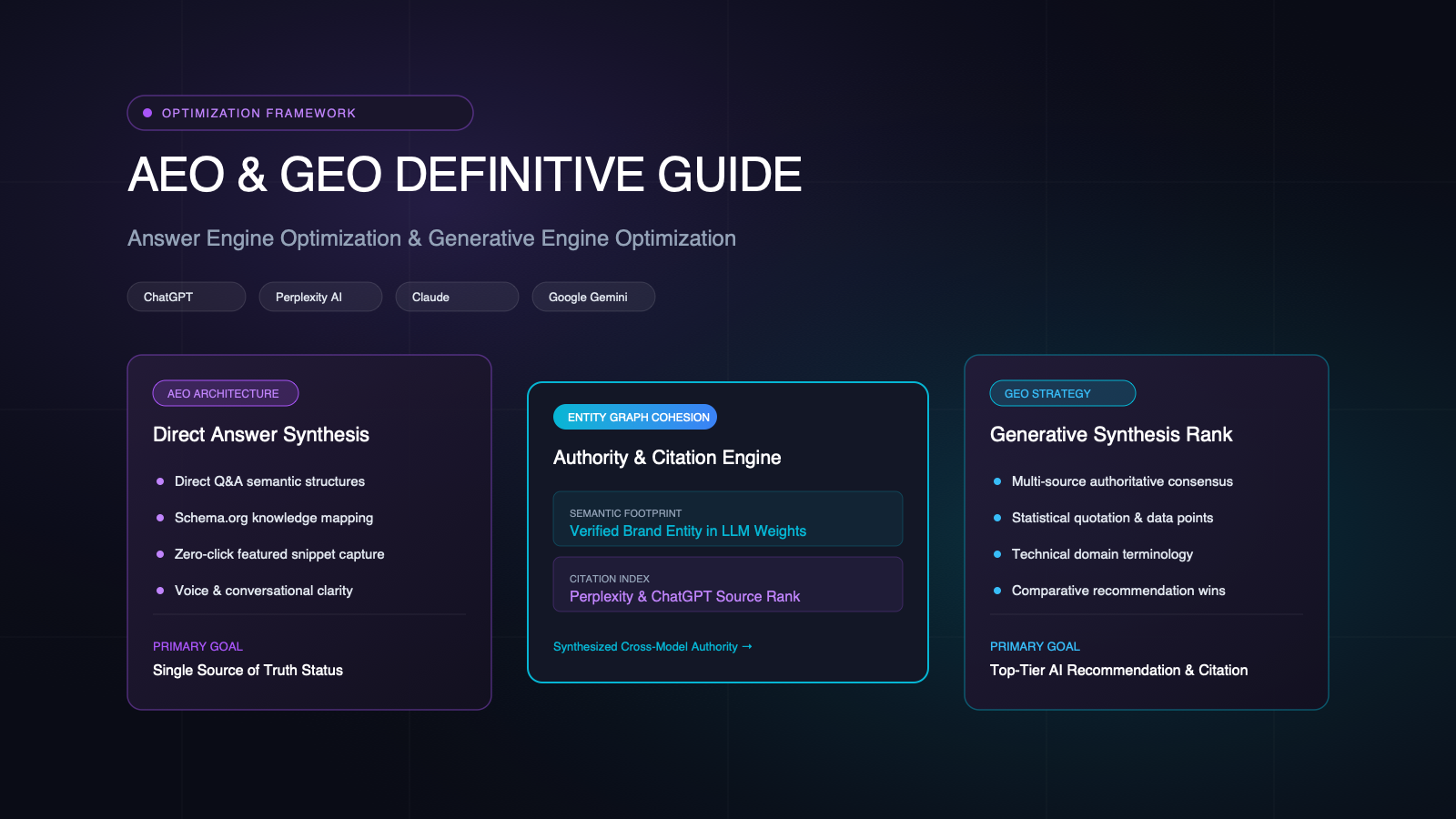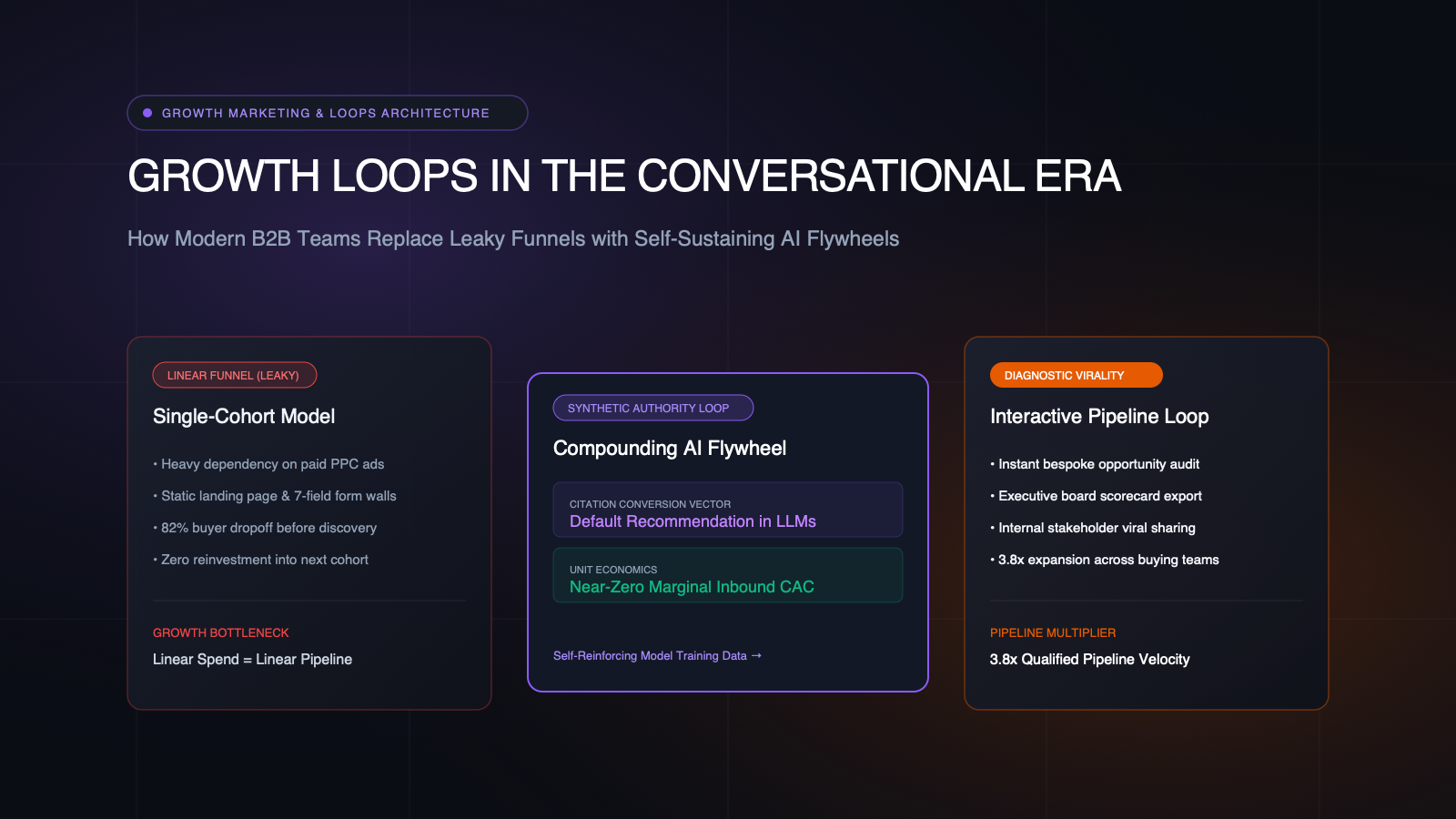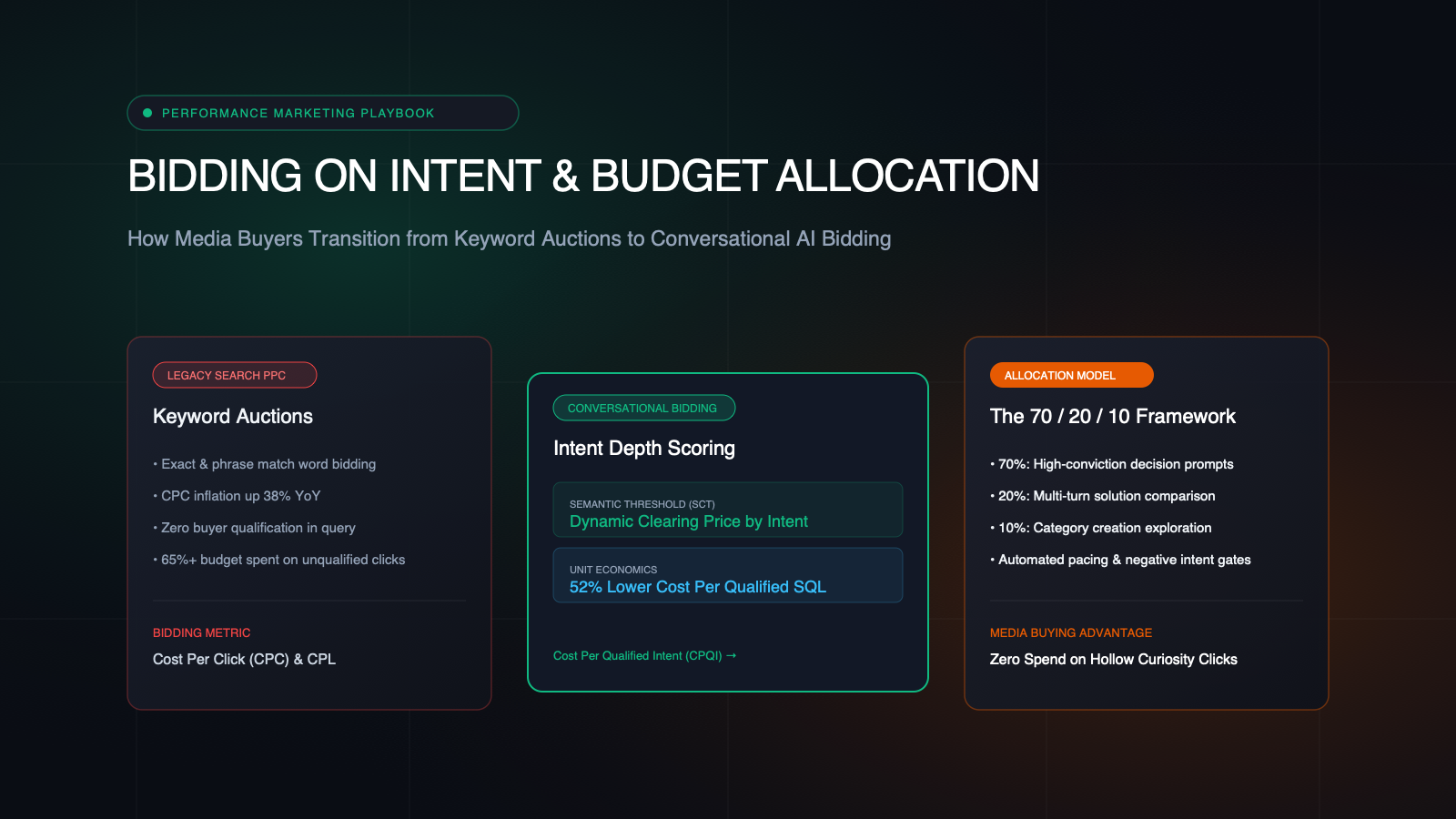
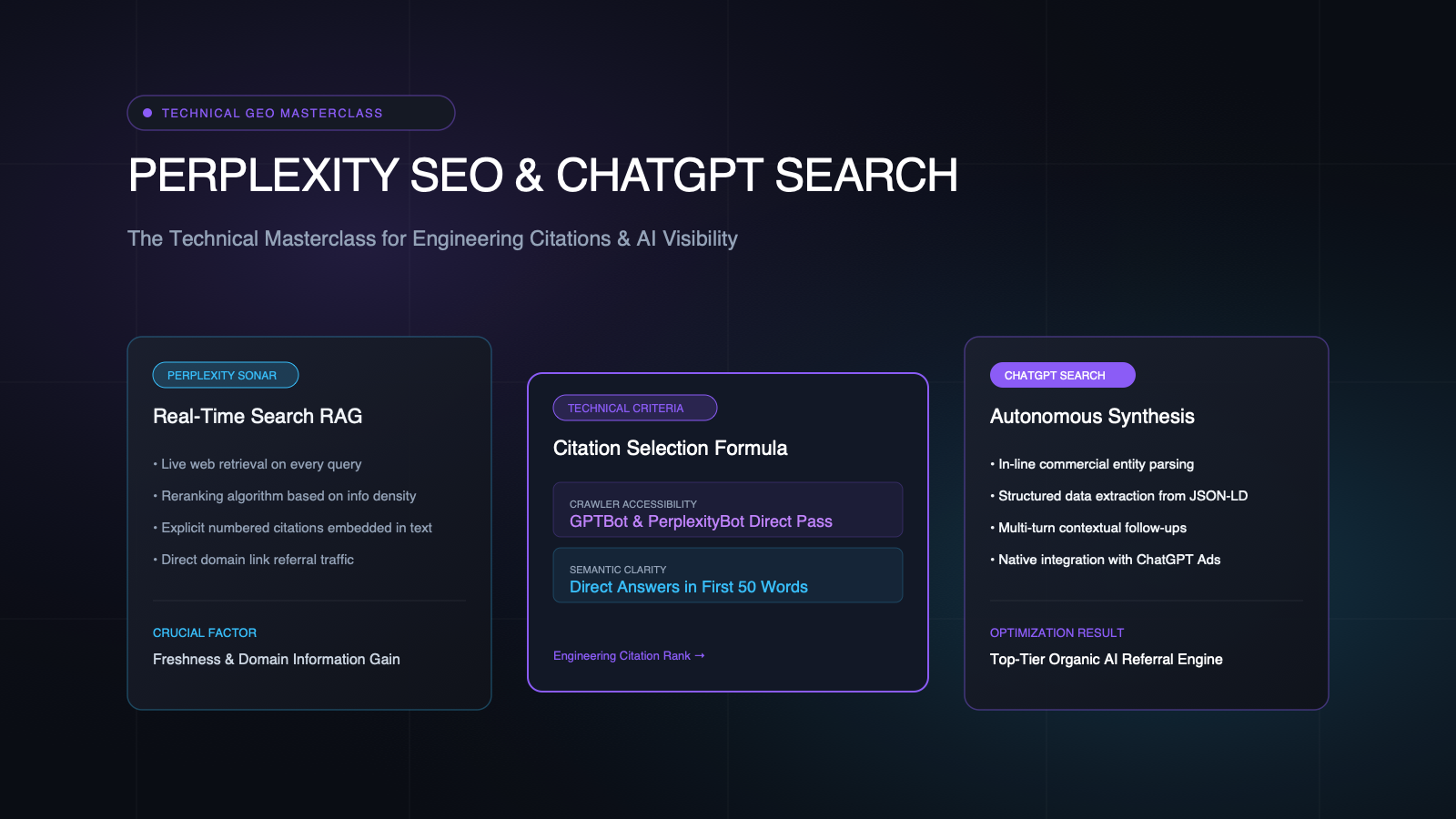
Executive Summary & Key Takeaways
- Search Architecture Replaced: Real-time RAG, dense vector embeddings, and neural cross-encoder rerankers have superseded Google's PageRank algorithm.
- Algorithmic Citation Scoring: Models rank passages by Information Density ($S_{\text{density}}$), Information Gain ($S_{\text{gain}}$), and Consensus ($S_{\text{consensus}}$).
- Infrastructure Essentials: Allowing AI user agents in `robots.txt`, delivering clean semantic HTML, and structuring data tables drive top citations.
Search technology has experienced its most profound architectural evolution in three decades.
Instead of typing keyword queries into Google and browsing through search result pages, hundreds of millions of daily active users now rely on Perplexity AI and ChatGPT Search to gather research, compare technologies, and make high-stakes commercial purchasing decisions.
These generative search engines do not rely on traditional search indexes or backward-looking PageRank calculations. They utilize real-time Retrieval-Augmented Generation (RAG), specialized semantic vector embeddings, and multi-stage reranking pipelines to synthesize answers and generate numbered citations.
If your digital infrastructure is not engineered specifically for these AI retrieval systems, your business is completely invisible in modern organic search.
This masterclass deconstructs how Perplexity and ChatGPT Search evaluate web content, reveals the underlying mathematics of citation selection, and provides a comprehensive technical playbook for dominating generative search.
The Technical Architecture: How AI Search Engines Retrieve and Rank
To engineer your content for AI search engines, you must understand the step-by-step retrieval pipeline executed whenever a user asks a question:
Unlike Google, which ranks full web pages, generative search engines rank semantic passages. A single paragraph containing precise, verifiable data is far more valuable to a RAG reranker than a 3,000-word fluff article filled with generic marketing buzzwords.
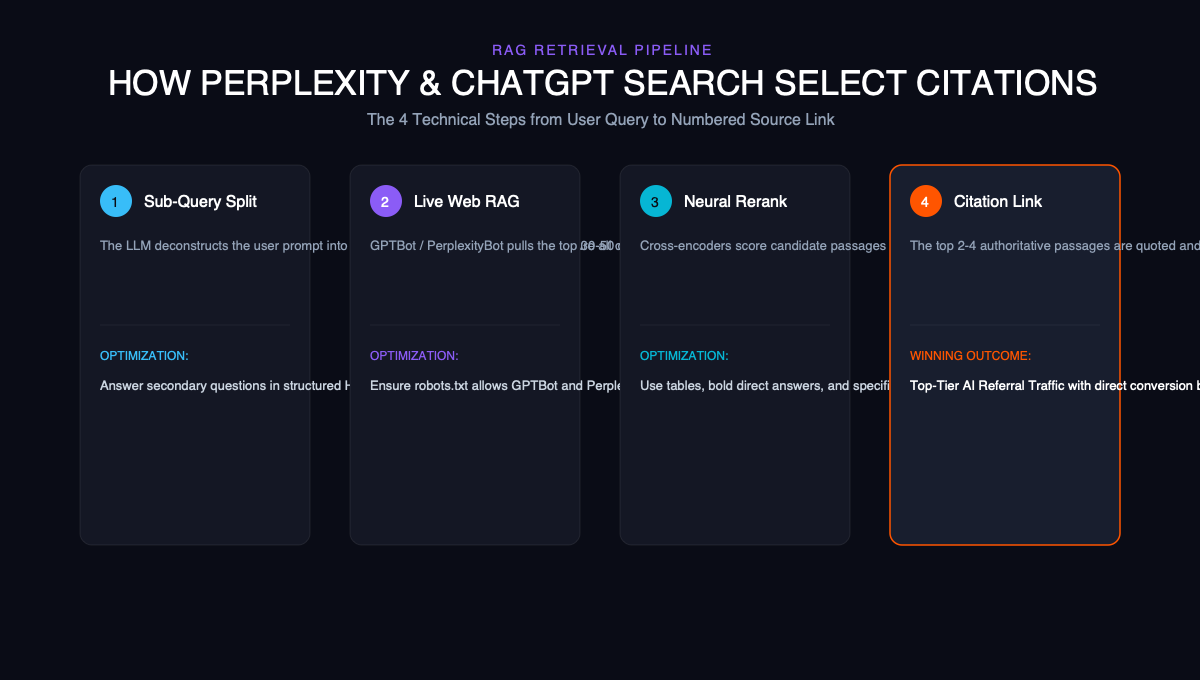
The 4 Algorithmic Factors in Citation Selection
When Perplexity’s Sonar engine or ChatGPT Search decides which domain to cite with a clickable numbered link ([1], [2]), its reranker evaluates four core mathematical weights:
1. Information Density Score ($S_{\text{density}}$)
Generative rerankers favor passages with a high ratio of verifiable entities, statistics, benchmarks, and dates relative to total word count.
- Low density: "We offer great pricing and amazing customer service."
- High density: "Aepify provides flat-rate ChatGPT Ads management at \$99/month, including weekly intent mapping and guaranteed 24-hour response SLAs."
2. Information Gain ($S_{\text{gain}}$)
If your article repeats the exact same definitions found on 20 other Wikipedia or Forbes articles, the AI assigns it an Information Gain score near zero. Rerankers actively reward original data points, proprietary frameworks, and novel benchmarks.
3. Factual Concordance & Consensus
Generative models cross-reference candidate facts against trusted external knowledge repositories. If your pricing or capability claims are contradicted by multiple third-party reviews, the model suppresses the citation to prevent hallucination.
4. Recency & Freshness Decay
In technical and commercial sectors, AI search engines heavily penalize outdated content. Pages updated within the last 30 to 90 days receive a significant ranking boost in live RAG retrieval.
Technical Optimization Playbook: Code & Infrastructure
To ensure your web architecture is fully primed for AI retrieval bots, execute these four technical implementations:
1. Configure Robots.txt for Full AI Bot Crawling
Many legacy websites inadvertently block modern AI web crawlers. Ensure your robots.txt explicitly grants full access to primary generative search agents:
# Allow Perplexity AI Crawlers
User-agent: PerplexityBot
Allow: /

# Allow OpenAI Search Crawlers
User-agent: GPTBot
Allow: /
User-agent: ChatGPT-User
Allow: /

# Allow Anthropic Claude Crawlers
User-agent: ClaudeBot
Allow: /

# Allow Google AI Overviews
User-agent: Google-Extended
Allow: /
2. Implement Self-Contained Semantic Passage Architecture
Format your technical guides so that key sections contain an opening summary paragraph (40–60 words) that provides the direct answer, followed immediately by structured data:
<section id="cpqi-definition">
  <h2>What is Cost Per Qualified Intent (CPQI)?</h2>
  <p>Cost Per Qualified Intent (CPQI) is a performance marketing metric that measures the total campaign spend divided by the number of intercepted conversational dialogues meeting verified commercial ICP constraints.</p>

  <table>
    <thead>
      <tr><th>Metric</th><th>Traditional CPL</th><th>Conversational CPQI</th></tr>
    </thead>
    <tbody>
      <tr><td>Average Cost</td><td>$185 - $340</td><td>$85 - $140</td></tr>
      <tr><td>Close Rate</td><td>15%</td><td>38%</td></tr>
    </tbody>
  </table>
</section>
3. Leverage Structured Tables and Markdown Formatting
RAG extractors can parse HTML tables and Markdown grids with 95%+ accuracy compared to dense unstructured narrative prose. Wherever you present comparative features, pricing, or specifications, format the data in clean tables.
Comparing Google Crawling vs. Perplexity RAG Retrieval
Google Search Indexing
- Asynchronous periodic crawl via Googlebot
- Calculates global PageRank and backlink equity
- Ranks whole URLs against keyword search clusters
- Favors high-authority legacy domains
Perplexity Sonar RAG Engine
- Synchronous real-time live retrieval on prompt submission
- Vector similarity matching against dense passage embeddings
- Extracts 200-word snippets scored for information density
- Favors precise, verifiable facts and original benchmarks
The Competitive Edge: Own the Numbered Citation
In generative search, being cited as source [1] or [2] is the digital equivalent of ranking #1 on Google in 2010.
By implementing dense passage architecture, allowing AI crawler access, and publishing proprietary benchmarks, you ensure that when hundreds of millions of users ask AI for answers in your space, your brand is the verified reference they trust.
Audit Your Perplexity & ChatGPT Search Visibility
Want to know if your website is properly structured for Perplexity Sonar and ChatGPT Search bots?
👉 Request Your Free Opportunity Report — Our technical team will audit your bot accessibility, evaluate your RAG passage density, and provide a code-level implementation blueprint.
Ready to explore ChatGPT Ads?
Find out where your business could show up in high-intent AI conversations.