For decades, marketing leaders viewed the customer journey as a predictable, linear path: a prospect saw a display ad, searched Google for keywords, downloaded a gated PDF whitepaper, and waited for a sales development representative (SDR) to email them.
In 2026, that linear funnel has collapsed.
Today's buyers—from enterprise software architects and healthcare executives to high-net-worth consumers—treat Large Language Models like ChatGPT, Claude, and Perplexity as private, autonomous advisory boards.
Before a buyer ever visits your pricing page or fills out a form, they have spent dozens of prompts interrogating an AI engine about your platform's operational weaknesses, hidden pricing tiers, user complaints, and implementation gotchas.
If your marketing strategy is built around static web traffic and keyword searches, you are blind to where customer decisions are actually being made.
- The Private Advisory Shift: Buyers no longer rely on vendor sales decks or affiliate-crowded Google search results; they feed raw RFPs, technical constraints, and competitor quotes into AI engines to extract unvarnished truth.
- The 4-Stage Loop: Customer decision-making moves through four distinct conversational stages: Problem Decomposition, Landscape Mapping, Stress-Testing & Limitations, and Procurement Validation.
- Synthetic Consensus: AI engines do not recommend who spends the most on PPC; they synthesize cross-web consensus from technical documentation, customer reviews, Reddit discussions, and public benchmark data.
- The Modern Sales Reality: When buyers finally reach out to your sales team, they are already 85% through the buying cycle—armed with a comprehensive list of your platform's known trade-offs.
Why Buyers Switched from Google to Conversational AI
To understand modern customer behavior, examine why buyers abandoned traditional search for pre-purchase research.
In standard search engines, evaluating complex solutions is tedious and high-friction:
- Search results are overwhelmed by sponsored ads and SEO affiliate listicles (e.g., "Top 10 CRM Tools in 2026" written by whoever pays the highest commission).
- Essential answers regarding integration bottlenecks or contract cancellation terms are hidden behind gated forms.
- Sales teams gate basic product specs behind a mandatory 30-minute "qualification call."
Conversational AI removes this friction entirely. An LLM:
- Reads through marketing jargon: It strips away corporate buzzwords and summarizes actual operational architectures.
- Customizes answers to exact constraints: A user can specify their company size, tech stack, and budget in a single prompt.
- Maintains context across dozens of questions: Buyers can ask follow-up questions without restarting their search from scratch.
- Has zero sales commission bias: Buyers trust the neutral, consultative tone of an AI over an eager account executive.
Understanding this dynamic is the cornerstone of AI Marketing for High-Consideration Businesses. When purchase decisions carry high financial or career risk, buyers seek objective verification.
The 4-Stage Conversational Evaluation Loop
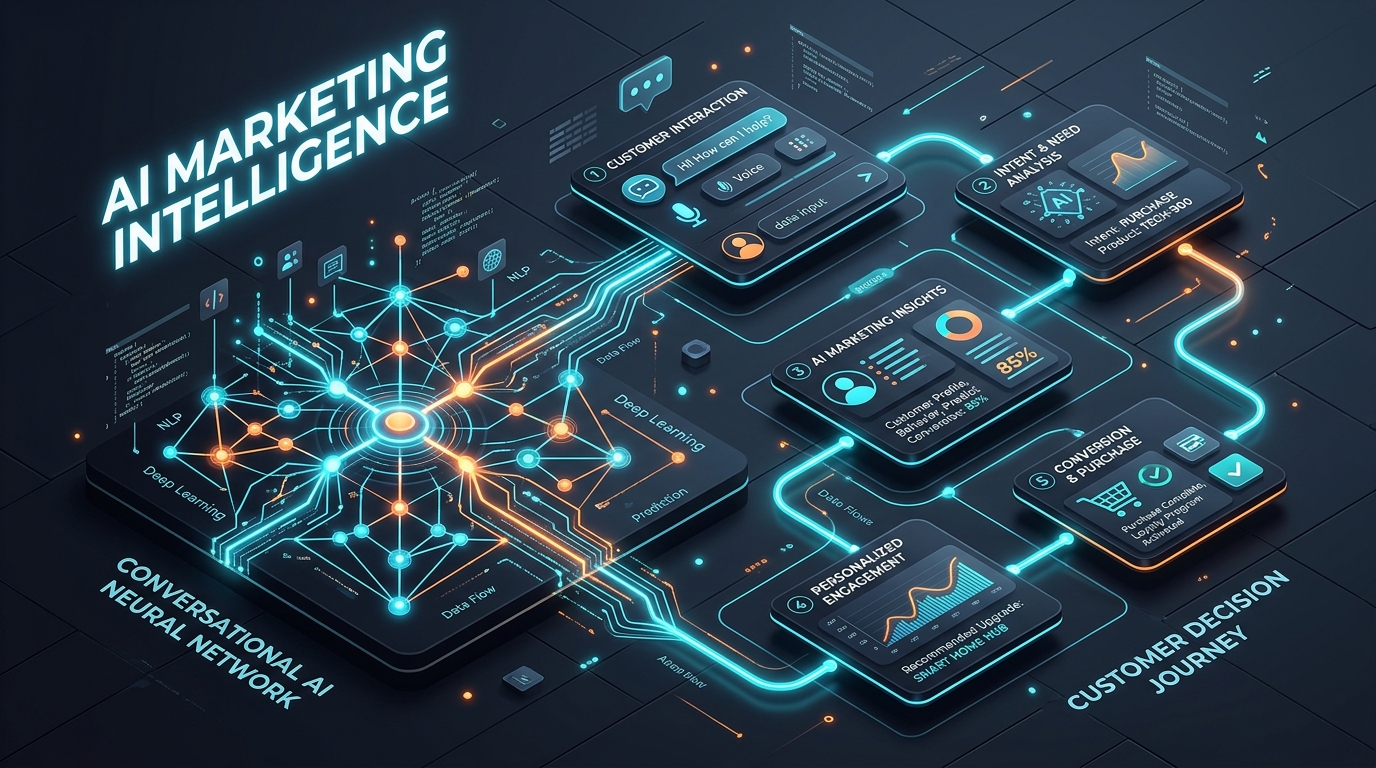
Modern buyers don't use AI simply as a search engine replacement. They use it as an interactive sparring partner across four distinct decision phases.
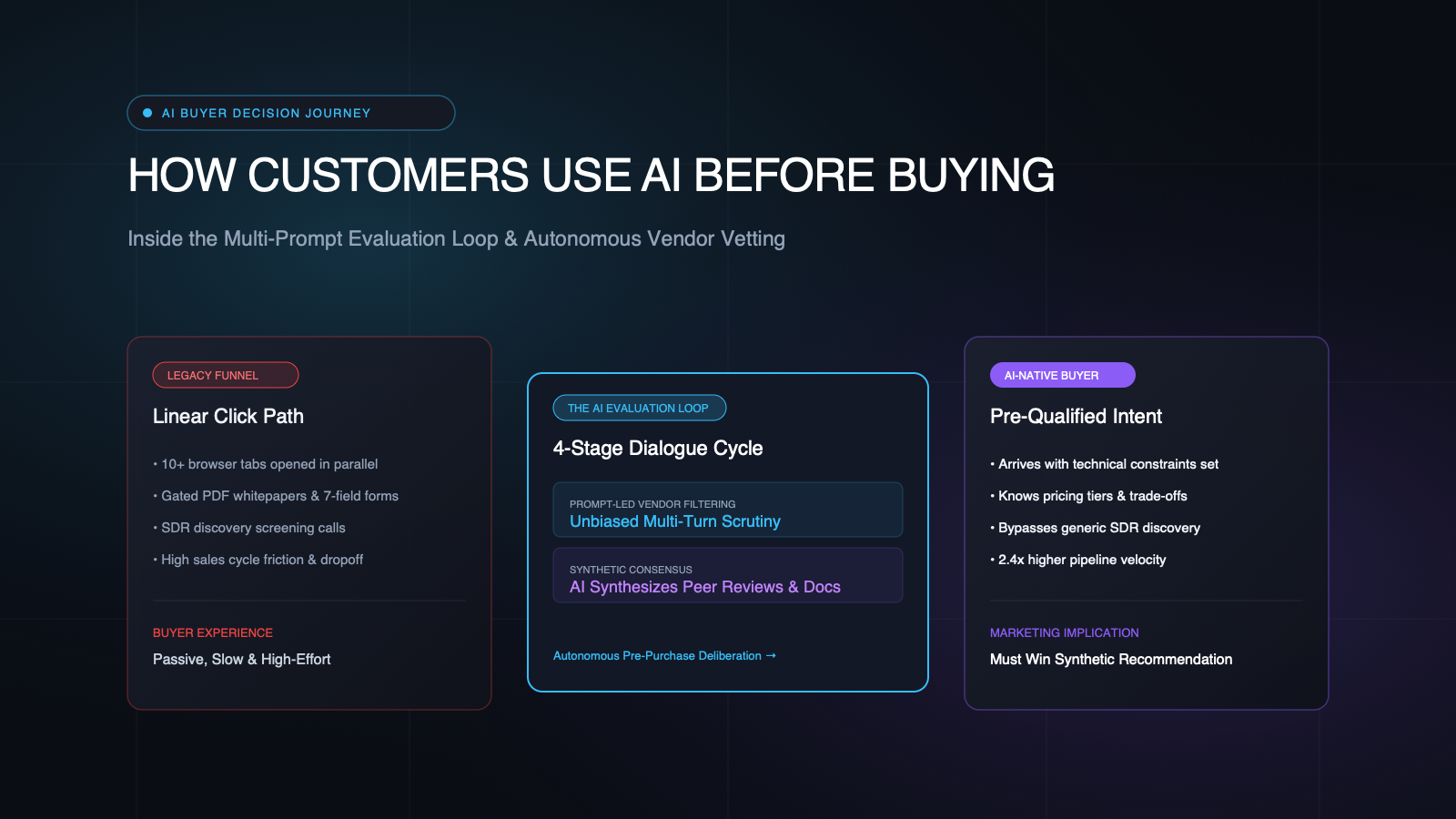
- Buyer Focus: Articulating internal symptoms and diagnosing root causes.
- AI Interaction: Pasting system error logs, process friction, or team complaints.
- Goal: Formulating the exact technical criteria required for an ideal solution.
- Buyer Focus: Discovering all viable vendors that meet their constraints.
- AI Interaction: Asking for unbiased vendor comparisons with strict criteria.
- Goal: Filtering the market down to a curated shortlist of 2–3 candidates.
Phase 1: Problem Decomposition & Constraint Articulation
Before buyers even look for vendors, they use AI to clarify what they actually need.
Instead of guessing what product category fits their challenge, they describe the problem:
"We have 450 customer success tickets per day across Zendesk. Our team is spending 3 hours a day manually tagging and routing tickets based on account ARR and urgency. What is the standard technical architecture modern operations teams use to automate this without hiring more agents?"
The AI breaks down the options: rule-based workflow engines, custom API middleware, or specialized conversational triage platforms. In minutes, the buyer establishes clear architectural specifications.
Phase 2: Category Discovery & Unbiased Landscape Mapping
Once the criteria are set, the buyer asks the AI to map the vendor ecosystem:
"Give me the top 4 platforms that handle automated ticket triage for mid-market B2B companies. Exclude legacy enterprise suites that require 6-month implementations. Focus on vendors that have native Zendesk apps and SOC 2 Type II compliance."
Notice the precision:
- Scope restriction: Mid-market B2B only.
- Negative constraint: No legacy enterprise suites requiring 6-month setups.
- Mandatory technical checks: Native Zendesk app, SOC 2 Type II certification.
If your product does not clearly communicate these operational attributes across public documentation and digital consensus, the AI simply omits your brand from the shortlist.
Phase 3: Direct Feature & Limitation Stress-Testing
This is where conversational AI completely changes the sales dynamic. Buyers use models like Claude or ChatGPT to deliberately interrogate a vendor's weaknesses:
"Compare Vendor A and Vendor B for ticket classification accuracy. What are the common complaints about Vendor A on Reddit and G2 regarding customer support responsiveness and hidden API usage overages?"
The AI summarizes third-party sentiment, highlighting forum complaints, API latency discussions, and common user frustrations. The buyer enters sales discussions fully aware of the vendor's trade-offs.
Phase 4: Procurement Validation & Objection Formulation
In the final phase, buyers use AI to prepare for negotiations:
"Vendor A quoted us $38,000 annually for 50 seats with a 15% platform fee. What discount benchmarks are typical for Series B companies committing to a 2-year contract? What specific contractual clauses should we request regarding data ownership for LLM training?"
The buyer weaponizes the AI's collective knowledge to challenge pricing, request contract redlines, and eliminate unnecessary add-on fees.
Head-to-Head: Traditional Search Journey vs. AI Conversational Decision Journey
| Journey Dimension | Traditional Search Journey (2018–2023) | AI Conversational Journey (2026) | Strategic Impact on Marketers |
|---|---|---|---|
| Discovery Channel | Google search SERPs & review portals (G2, Capterra) | ChatGPT, Claude, Perplexity, and conversational engines | SEO shifts to Answer & Generative Engine Optimization |
| Query Complexity | 2–4 keyword phrases (best ticketing software) |
Multi-paragraph contextual prompts with strict constraints | Requires deep conversational intent mapping |
| Trust Source | Vendor landing page claims, case studies & PPC ads | Synthetic consensus, developer forums & verified documentation | Marketing fluff is actively penalized by AI synthesis |
| Buyer Independence | Relies on vendor demos to learn product capabilities | Tests architecture and learns limitations inside chat sessions | Buyers contact sales only when ready to negotiate |
| Sales Cycle Pace | 60–90 days of linear SDR qualification calls | 14–30 days of accelerated, high-context buying | Leads arrive pre-qualified with explicit technical intent |
The Concept of "Synthetic Consensus": What AI Tells Buyers About You
When an AI engine evaluates your brand for a prospective buyer, it does not read your homepage copy in isolation. It constructs Synthetic Consensus—an aggregated statistical synthesis of everything stated about your brand across the web:
- Your Technical Documentation: Is your API documentation thorough, structured, and easy to parse? Or is critical pricing and feature data gated behind forms?
- Third-Party Developer & User Forums: What do users on Reddit, Stack Overflow, and specialized communities say about your reliability and customer support?
- Independent Reviews & Benchmark Studies: How does your product perform when tested side-by-side with competitors in objective technical evaluations?
- Structured Schema & Entity Definitions: Does your website provide structured JSON-LD and clean entity definitions that answer engines can easily index?
If a brand's website makes grand marketing claims that contradict customer reviews on Reddit or technical documentation, conversational AI flags the discrepancy to the buyer. Authenticity and transparency have become essential performance marketing assets.
To build an authoritative digital footprint that conversational AI engines respect and cite, follow our framework on How to Build an AI Brand Moat.
How Marketers Must Adapt: 4 Strategic Priorities
Understanding how customers use AI before buying requires marketing teams to fundamentally evolve their playbooks:
┌────────────────────────────────────────────────────────┐
│  1. Ungate Architectural & Pricing Information         │
│  Enable AI crawlers to parse and verify your data      │
└───────────────────────────┬────────────────────────────┘
                            │
┌───────────────────────────▼────────────────────────────┐
│  2. Map Multi-Turn Conversational Intent Triggers      │
│  Target problem symptoms rather than isolated keywords │
└───────────────────────────┬────────────────────────────┘
                            │
┌───────────────────────────▼────────────────────────────┐
│  3. Deploy Conversational Advertising & Context Hints  │
│  Appear natively in dialogues when decisions happen    │
└───────────────────────────┬────────────────────────────┘
                            │
┌───────────────────────────▼────────────────────────────┐
│  4. Replace Static Forms with Diagnostic Funnels       │
│  Provide consultative value matching the AI experience │
└────────────────────────────────────────────────────────┘
1. Ungate Critical Architectural and Pricing Data
If your pricing is completely secret and your technical documentation is locked behind gated PDFs, AI engines cannot evaluate your platform. When buyers ask for tools within a specific budget, the AI will recommend competitors with transparent public pricing over your brand.
2. Map Multi-Turn Intent Triggers
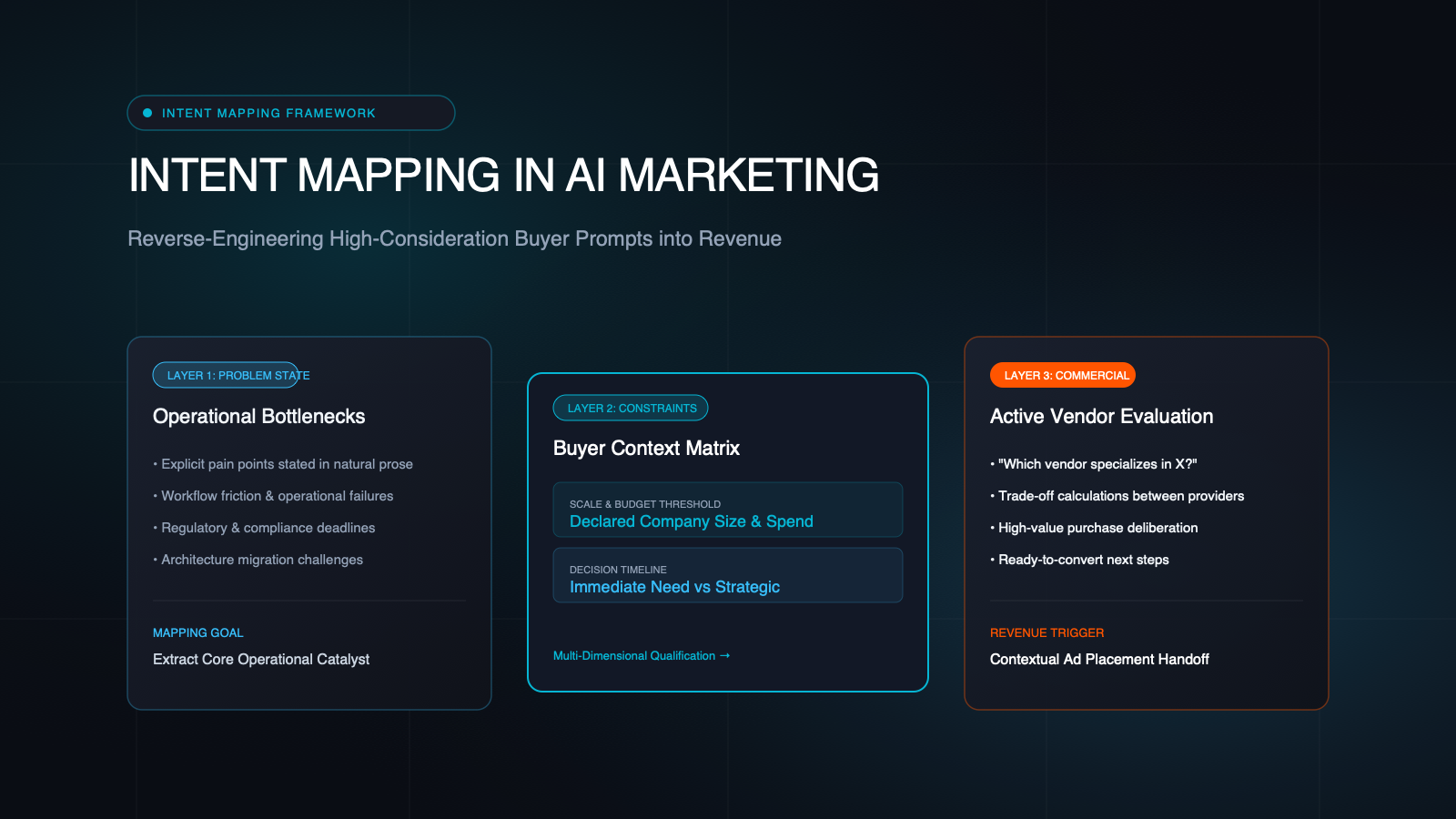
Instead of optimizing content around single high-volume keywords, map the complete conversational paths your buyers take. Develop content that addresses specific operational bottlenecks, integration hurdles, and competitive trade-offs. For a comprehensive walkthrough of this methodology, read our guide on Intent Mapping in AI Marketing.
3. Deploy Conversational Advertising & Context Hints
Because buyers spend their primary research cycles inside conversational interfaces, performance marketers must meet them there. Utilizing sponsored recommendation placements powered by ChatGPT Ads Context Hints ensures your brand appears as a verified, relevant solution at the exact moment a buyer is comparing options.
4. Replace Static Lead Forms with Interactive Diagnostics
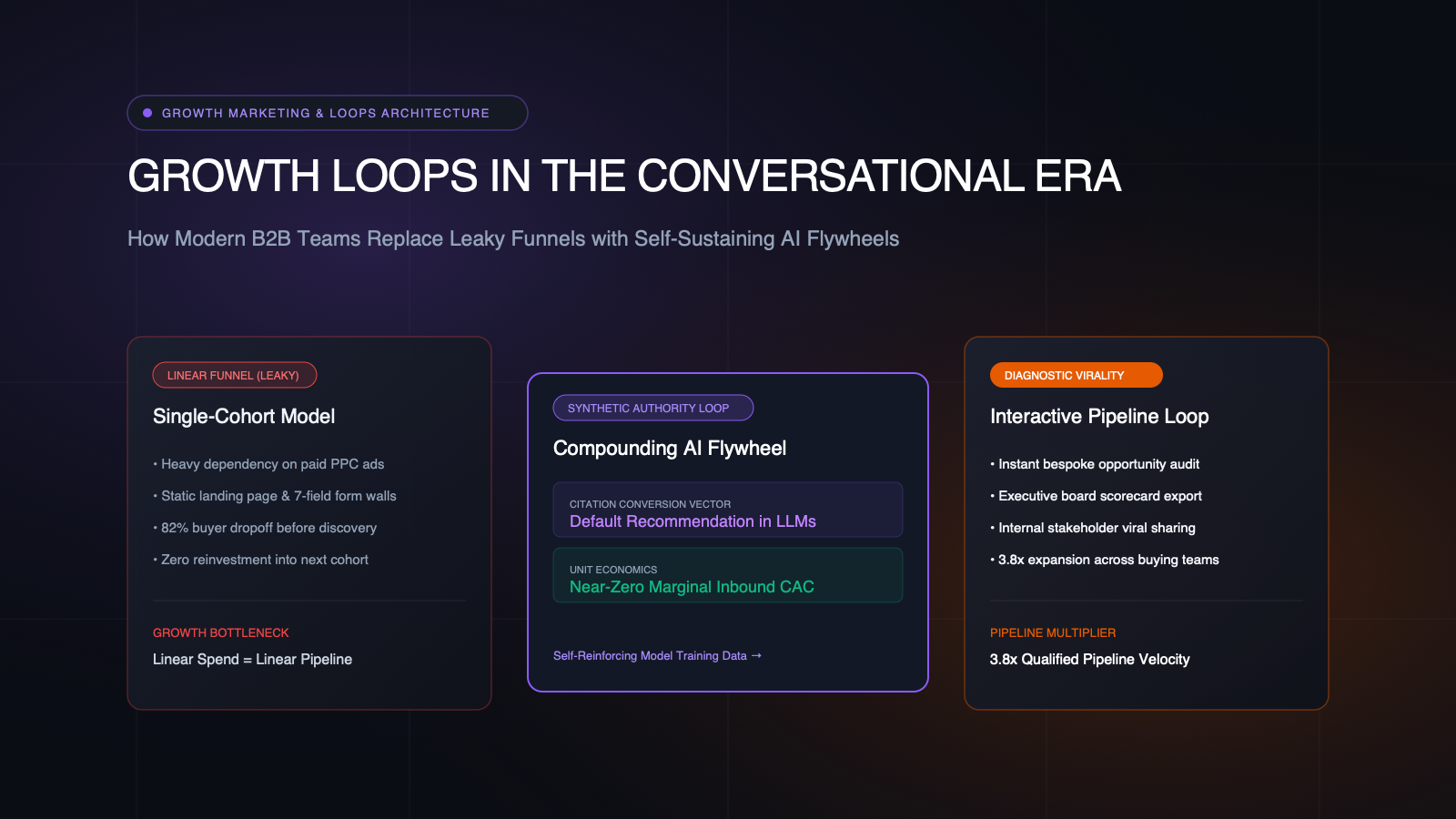
When an AI-assisted buyer finally clicks through to your website, dumping them onto a static landing page with an 8-field form causes immediate bounce. They expect an interactive, consultative experience that respects their technical sophistication. Deliver interactive calculators, architecture scorecards, and live diagnostic tools that continue the conversational flow.
The Bottom Line: Winning the Post-Search Buyer
Customer buying behavior has undergone its biggest evolution since the launch of the commercial web browser.
Buyers are no longer passive recipients of vendor marketing narratives. They are armed with conversational AI tools that analyze corporate claims, compare competitive trade-offs, and pre-screen every purchasing decision in seconds.
The companies that win the next decade of commercial growth will not be the ones that shout the loudest on traditional search engines. They will be the brands that master conversational presence, transparent digital consensus, and native AI discovery.
Benchmark Your Brand's AI Discovery Presence
Curious what ChatGPT, Claude, and Perplexity tell prospective buyers when evaluating your product category?
👉 Claim Your Free AI Marketing Opportunity Scan — Our team will audit your brand's synthetic consensus footprint, identify conversational intent gaps, and deliver a strategic blueprint to win high-intent AI-assisted buyers.
Ready to explore ChatGPT Ads?
Find out where your business could show up in high-intent AI conversations.