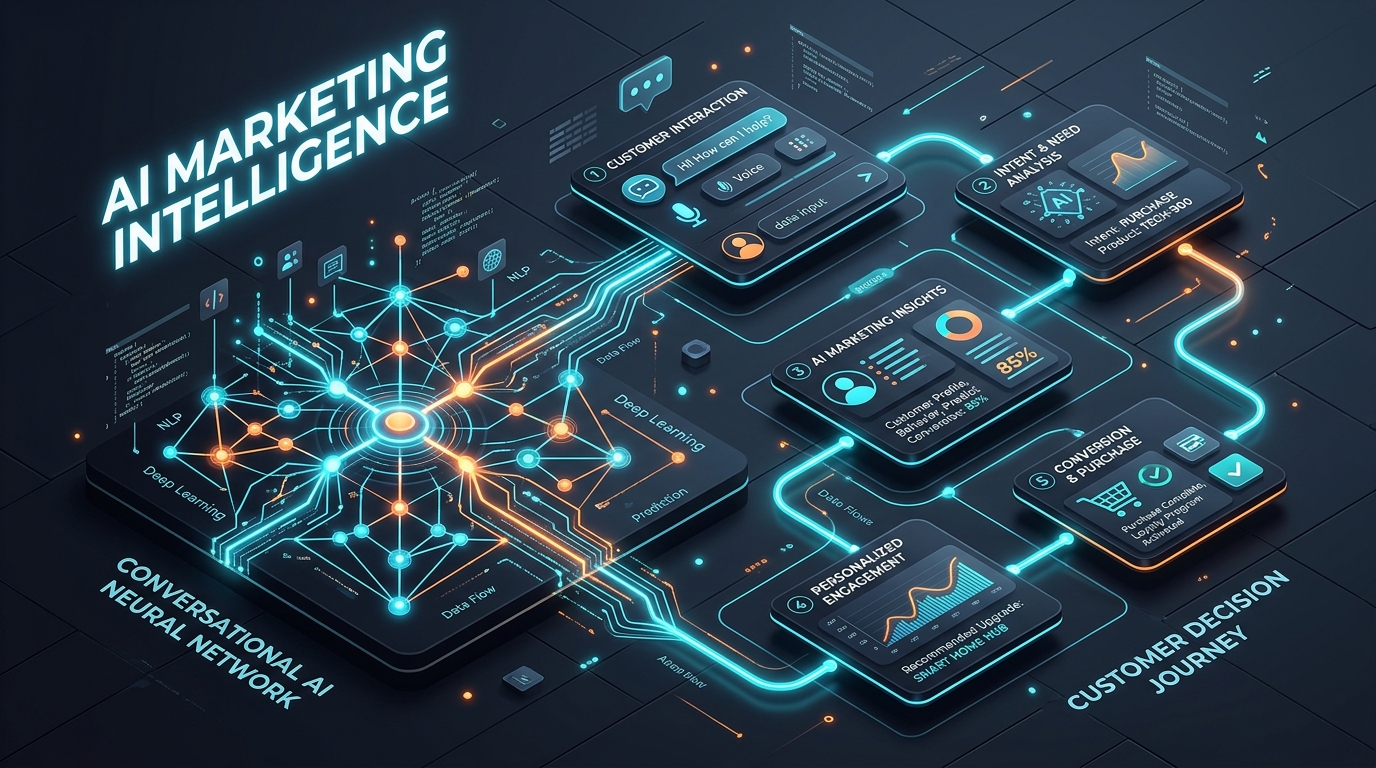
For decades, digital marketing operated on a straightforward, predictable premise: capture attention through broadcast ads, entice clicks with search keywords, and route prospects through a multi-step landing page funnel.
If you sold a complex, high-ticket, or high-consideration service—whether enterprise software, specialized healthcare, commercial architecture, wealth management, or high-end residential remodeling—your growth engine relied on pushing prospects through whitepapers, email nurturing sequences, and retargeting ads.
In 2026, that traditional marketing playbook is suffering from acute signal degradation.
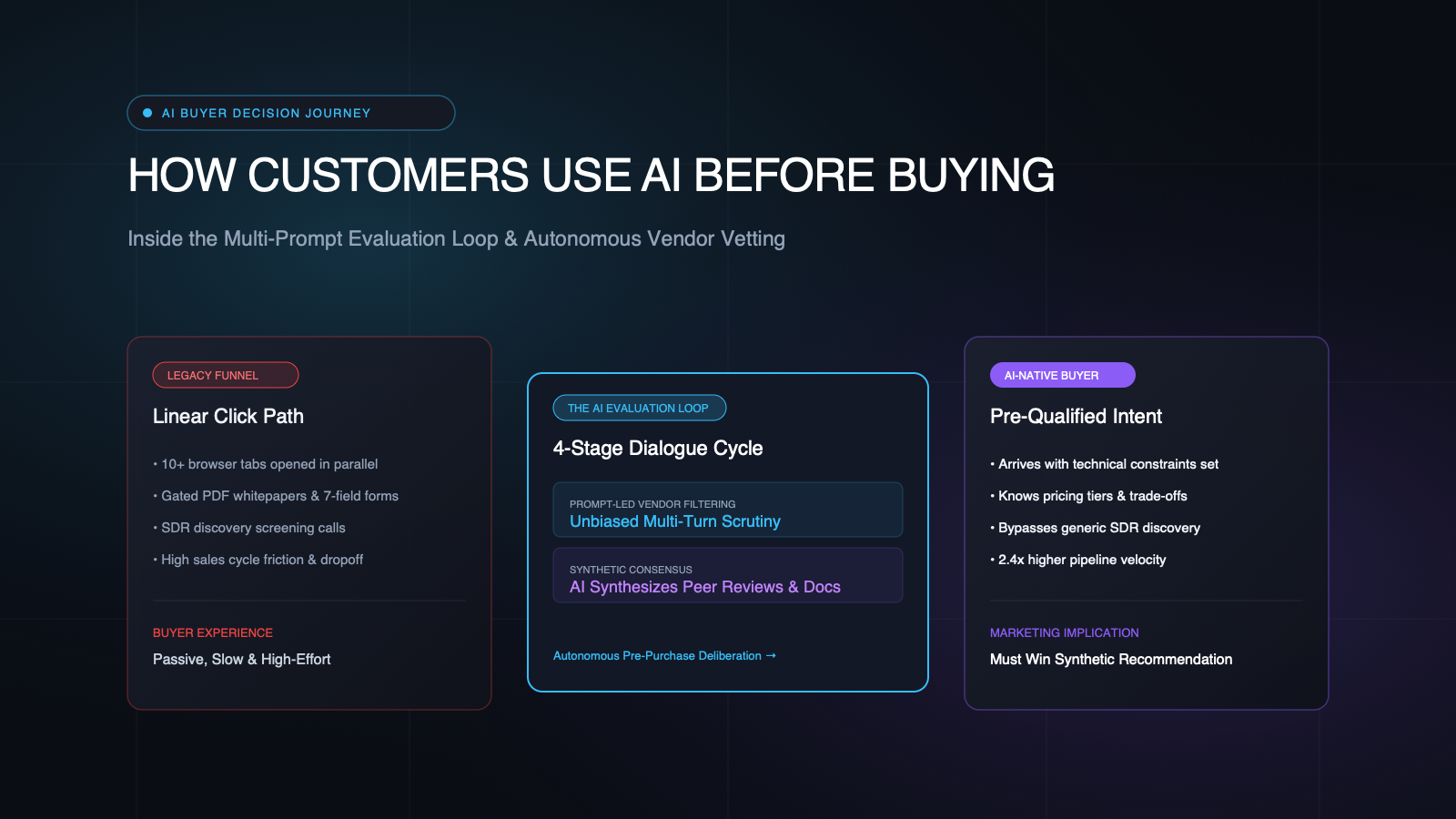
Prospects no longer spend weeks reading fragmented blog posts or filling out friction-heavy lead forms to get answers. Instead, they open conversational AI interfaces like ChatGPT, Claude, and Perplexity to deliberate, calculate, compare, and make high-stakes purchasing decisions in real time.
- From Broadcast to Synthesis: AI marketing meets high-consideration buyers directly within the generative evaluation stream.
- Compressed Decision Cycles: Multi-turn conversations condense 60-day enterprise evaluation cycles into immediate diagnostic clarity.
- Synthetic Authority: Large language models recommend verified brands that maintain canonical schema grounding and off-site consensus.
- Conversational Conversion: Eliminate landing page bounce by passing conversational context directly to diagnostic scheduling tools.
What Is AI Marketing in the Conversational Era?
AI Marketing is the discipline of positioning, promoting, and converting prospective buyers through artificial intelligence ecosystems, generative engines, and conversational discovery platforms.
Unlike earlier iterations of marketing technology that merely used machine learning for automated email send times or ad bid adjustments, modern AI marketing focuses on:
- Conversational Presence: Meeting buyers directly inside the generative dialogues where they evaluate options.
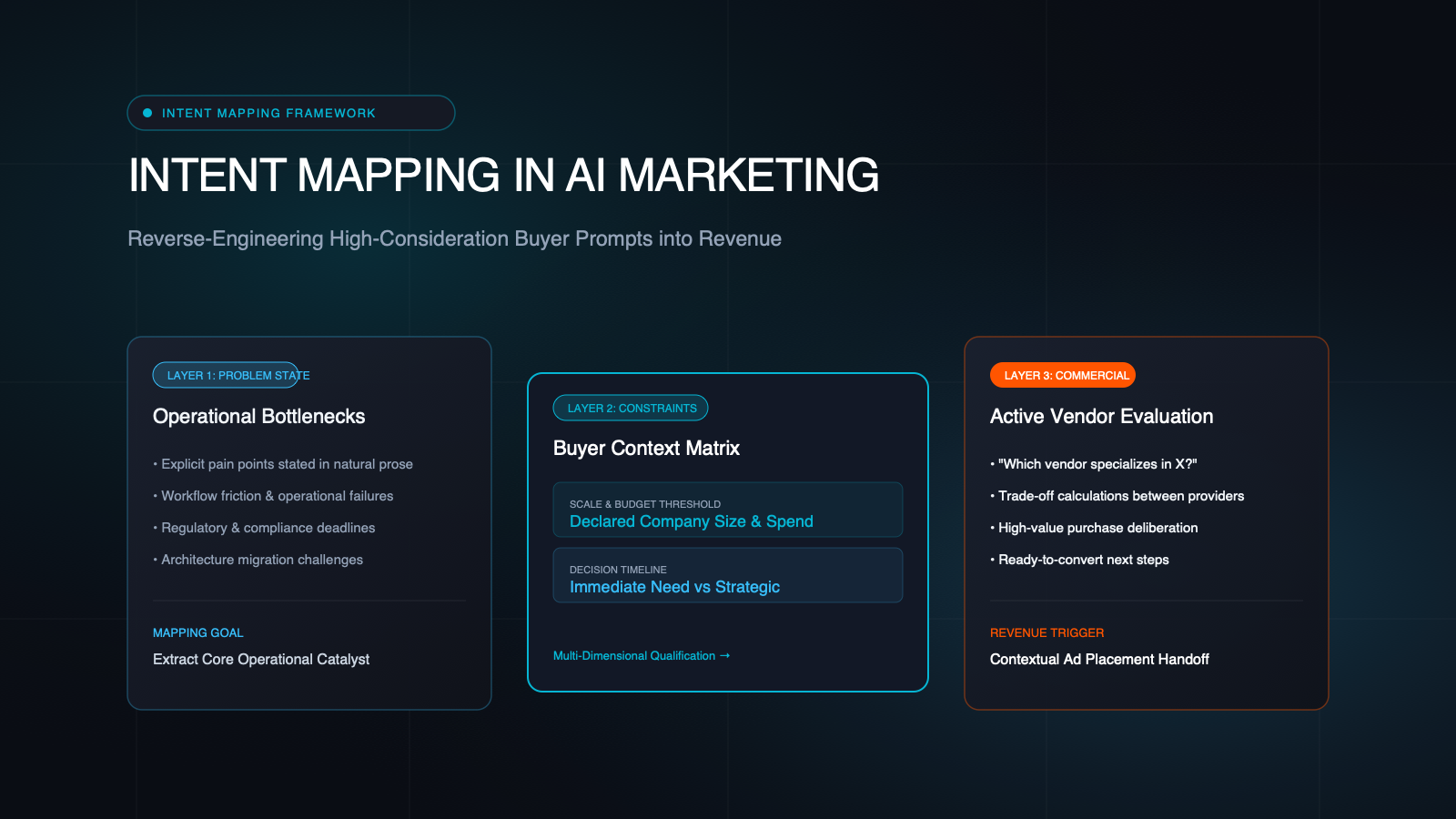
- Intent Mapping: Analyzing the nuanced context of multi-sentence prompts rather than isolated keywords.
- Synthetic Knowledge Alignment: Ensuring large language models (LLMs) accurately recognize, cite, and recommend your brand's unique capabilities.
- Frictionless Conversion Bridges: Providing direct pathways from an AI recommendation to a qualified consultation or trial.
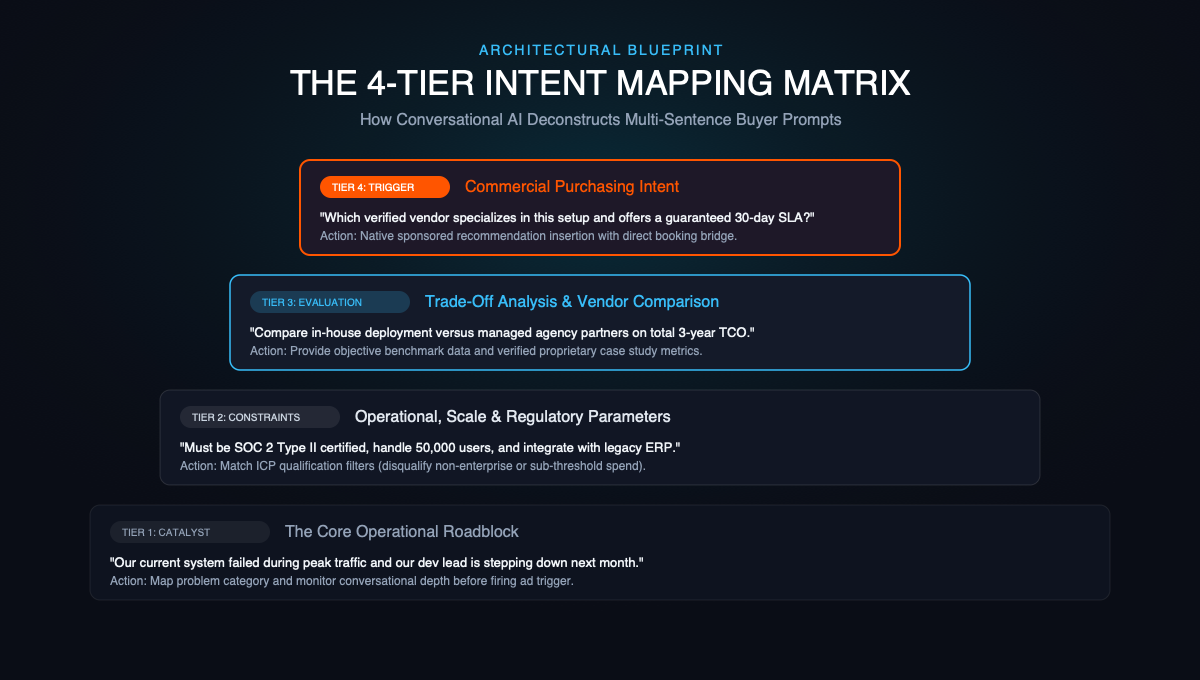
The AI Buyer Journey: How Modern Consideration Cycles Unfold
To succeed with AI marketing, you must understand how a customer moves from an initial problem to a final vendor decision inside a conversational environment.
Unlike traditional search where users click through multiple websites over several weeks, the conversational buyer journey is compressed and highly iterative:
"We are a 45-person specialty medical practice migrating off an on-premise server. We have HIPAA compliance concerns, two branch clinics, and an internal IT staff of one. What solutions offer dedicated migration support without requiring enterprise DevOps?"
Migrating on-premise clinical data with HIPAA mandates requires dedicated Business Associate Agreements (BAA), immutable audit logging, and specialized healthcare cloud orchestrators. Here is the evaluation matrix:
Traditional Marketing vs. AI Conversational Marketing
The differences between legacy search advertising and AI marketing are structural:
| Dimension | Legacy Digital Marketing | AI Conversational Marketing |
|---|---|---|
| Discovery Mechanism | 10 blue links on search engine result pages | Direct, synthesized conversational answers |
| Targeting Basis | Isolated keywords (best crm software) |
Rich contextual buyer intent and multi-turn constraints |
| Buyer Context | Fragmented, inferred from cookie tracking | Explicitly declared by the buyer in natural language |
| Funnel Length | Extended multi-week email & retargeting sequence | Compressed, interactive qualification in minutes |
| Trust Model | Paid promotion skepticism | Trusted third-party consultative guidance |
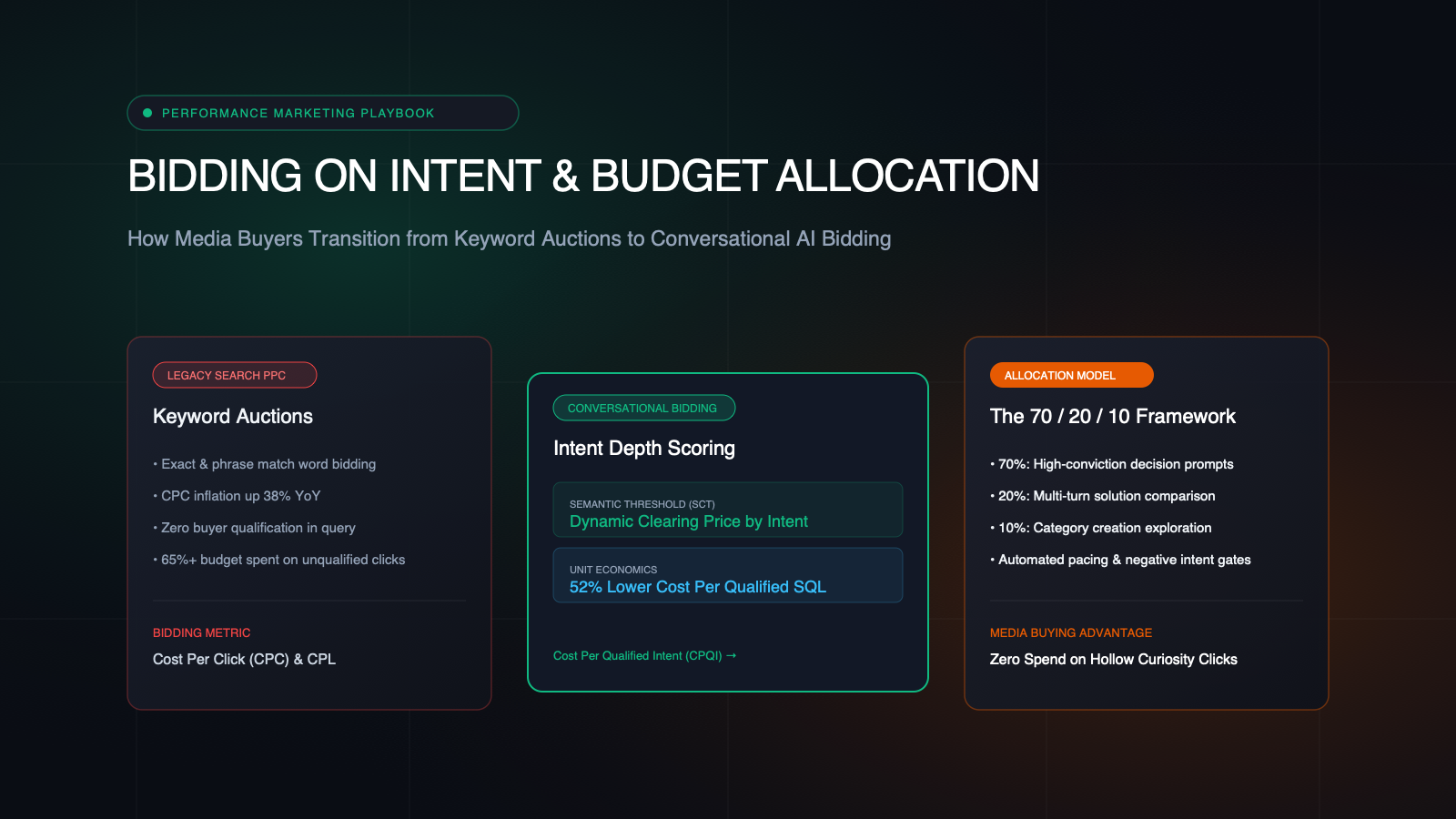
| Cost Driver | Inflated bidding wars on commoditized terms | Targeted relevance based on structured intent maps |
The 4 Pillars of AI Marketing Architecture
To construct an AI marketing system that systematically produces high-value customer acquisitions, businesses must execute across four core pillars:
Replace static keyword lists with dynamic matrices cataloging the operational catalysts, budget thresholds, compliance mandates, and buying signals expressed in AI prompts.
Hard-code your entity data into Schema.org knowledge graphs and earn third-party consensus so models like ChatGPT, Claude, and Perplexity naturally cite your firm as the default benchmark.
Deploy verified, contextually native ad placements directly into active buyer evaluation sessions when commercial intent criteria are triggered.
Carry the user's declared conversational context directly into interactive diagnostic audits and one-click calendar booking tools, eliminating lead dropoff.
Why High-Consideration Businesses Must Act First
In low-cost consumer ecommerce, ad channels can be tested and swapped quickly. However, in high-consideration sectors, early mover advantage in AI is disproportionately powerful:
- Entity Moats: Once conversational models establish your brand as the authoritative benchmark in a vertical, that semantic association solidifies in model embeddings and fine-tuned retrieval caches.
- Defensible CAC: Advertising costs in conversational AI are currently at early-market baselines. As enterprise competitors reallocate traditional Google Ads budgets to AI platforms, acquisition costs will inevitably rise.
- Preempting Competitor Recommendations: In an AI chat, there are no pages of 50 sponsored links. There are typically only one or two recommendations. Being the featured choice means winning the market.
Practical Action Checklist for Your Team
- ☐ Audit Your AI Brand Footprint: Ask ChatGPT, Perplexity, and Claude how they evaluate vendors in your space. Are you cited? Is the pricing and positioning accurate?
- ☐ Map Your Buyer Scenarios: Identify the top 20 complex prompts your highest-paying clients would ask before hiring a firm like yours.
- ☐ Implement Structured Schema: Verify that your website implements
Organization,Service,FAQPage, andProductJSON-LD schemas. - ☐ Test Conversational Ad Placements: Set up targeted conversational campaigns centered around high-intent decision triggers.
- ☐ Streamline Handoff Friction: Ensure your booking or audit page loads under 1.5 seconds and requests only essential qualification data.
Conclusion: Lead the Next Era of Customer Discovery
The transition from keyword search to conversational AI is not a fleeting trend—it is the permanent restructuring of how high-consideration buyers make informed choices.
Businesses that adapt their marketing architecture today will build durable customer acquisition engines with lower customer acquisition costs and higher client retention.
Unlock Your Brand’s Conversational Potential
Wondering where your highest-intent buyers are conversing and how much pipeline your business could generate through AI advertising?
👉 Claim Your Free Opportunity Report — Our team will analyze your market vertical, map conversational buyer intent, and deliver an actionable AI growth roadmap tailored to your business.
Ready to explore ChatGPT Ads?
Find out where your business could show up in high-intent AI conversations.