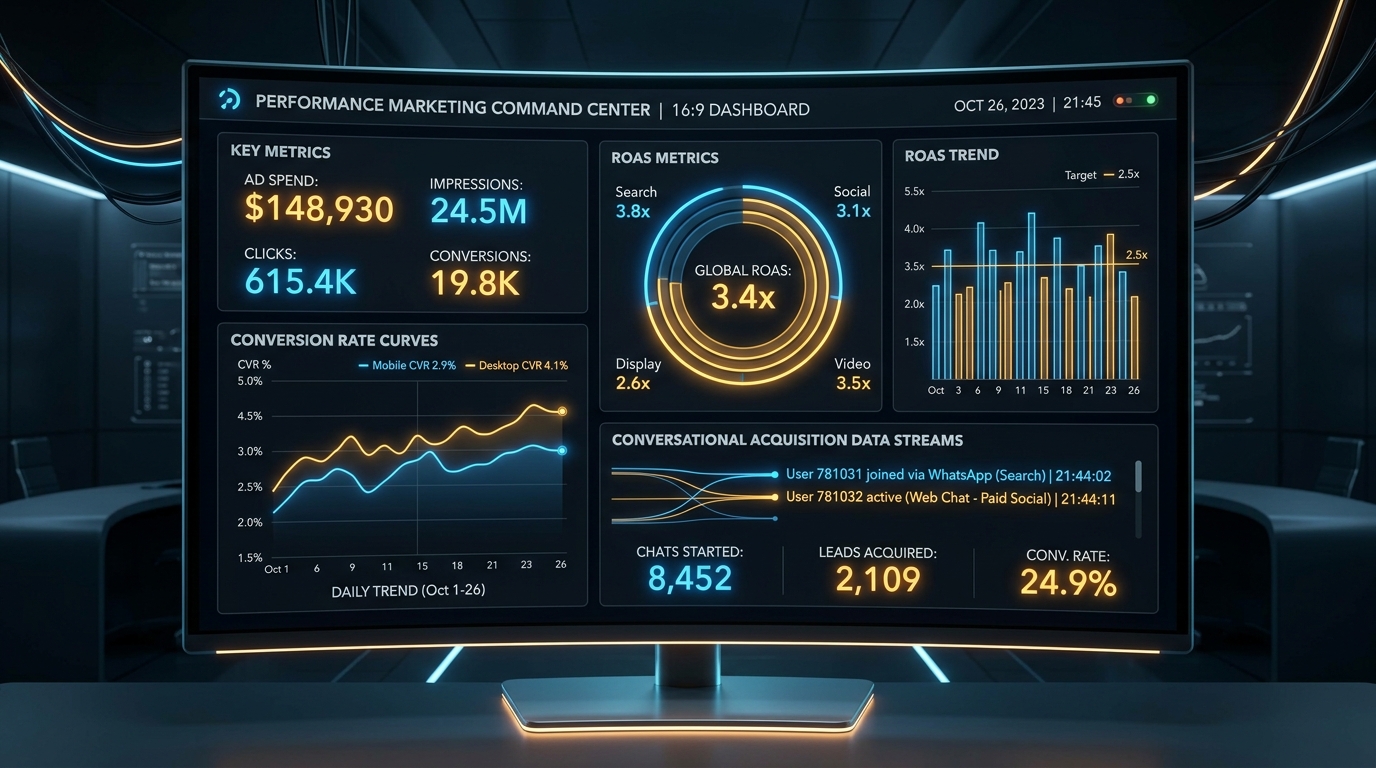
Executive Summary & Key Takeaways
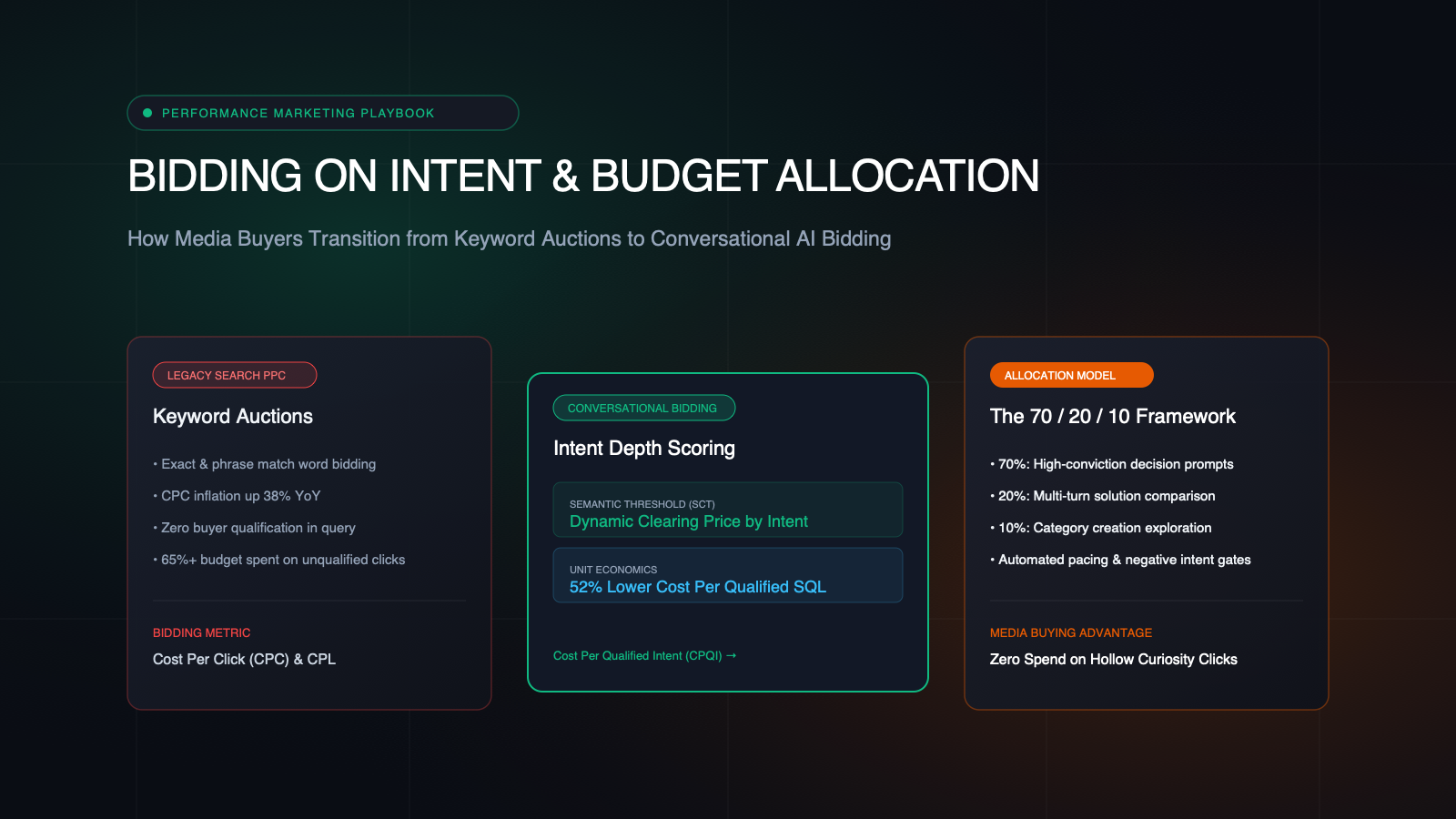
- Declining Returns on Search: High CPCs, third-party cookie deprecation, and AI Overviews are choking traditional PPC pipelines.
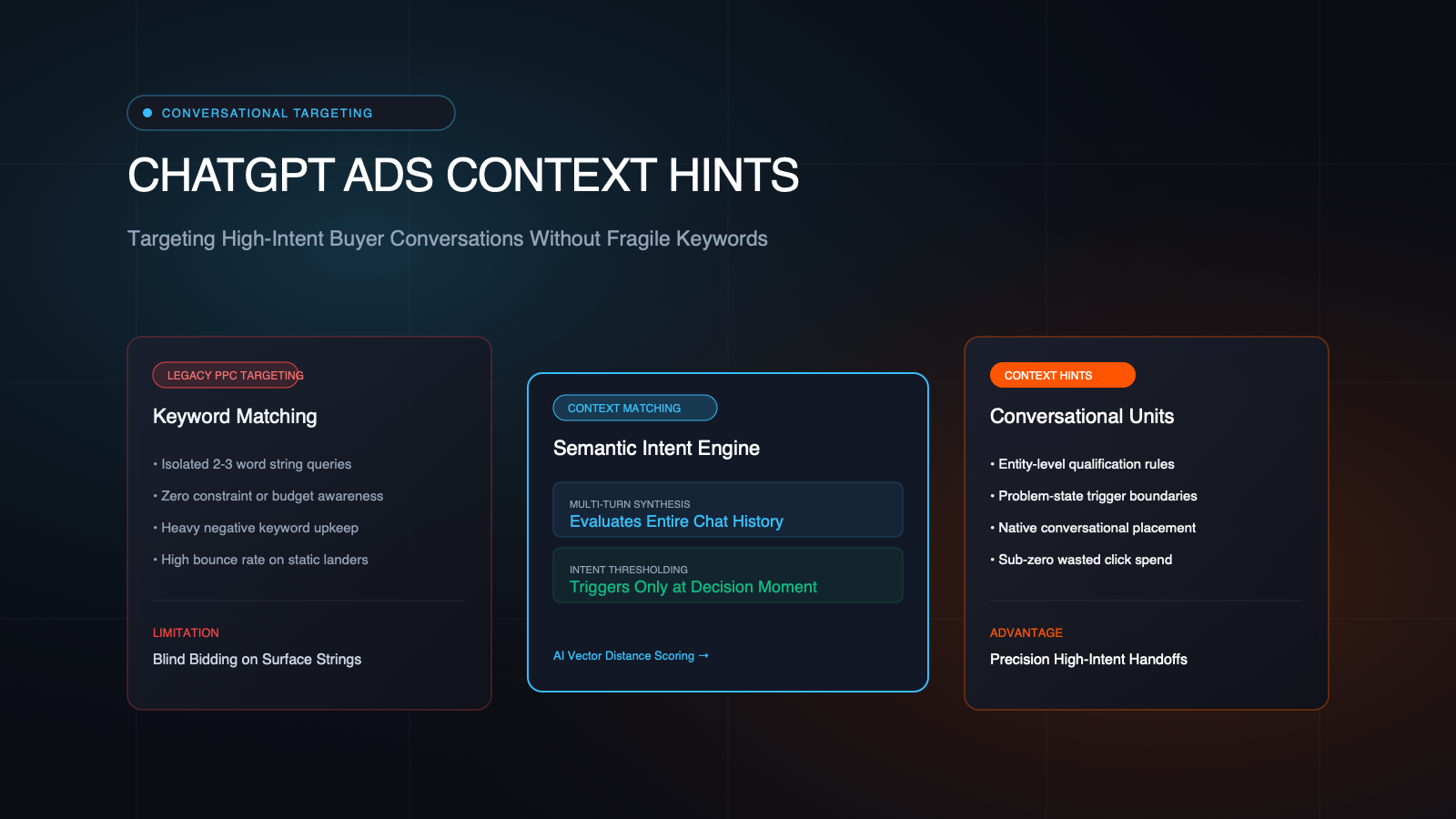
- Targeting Intent States: Instead of bidding on isolated keywords, conversational performance models target multi-variable buyer dilemmas.
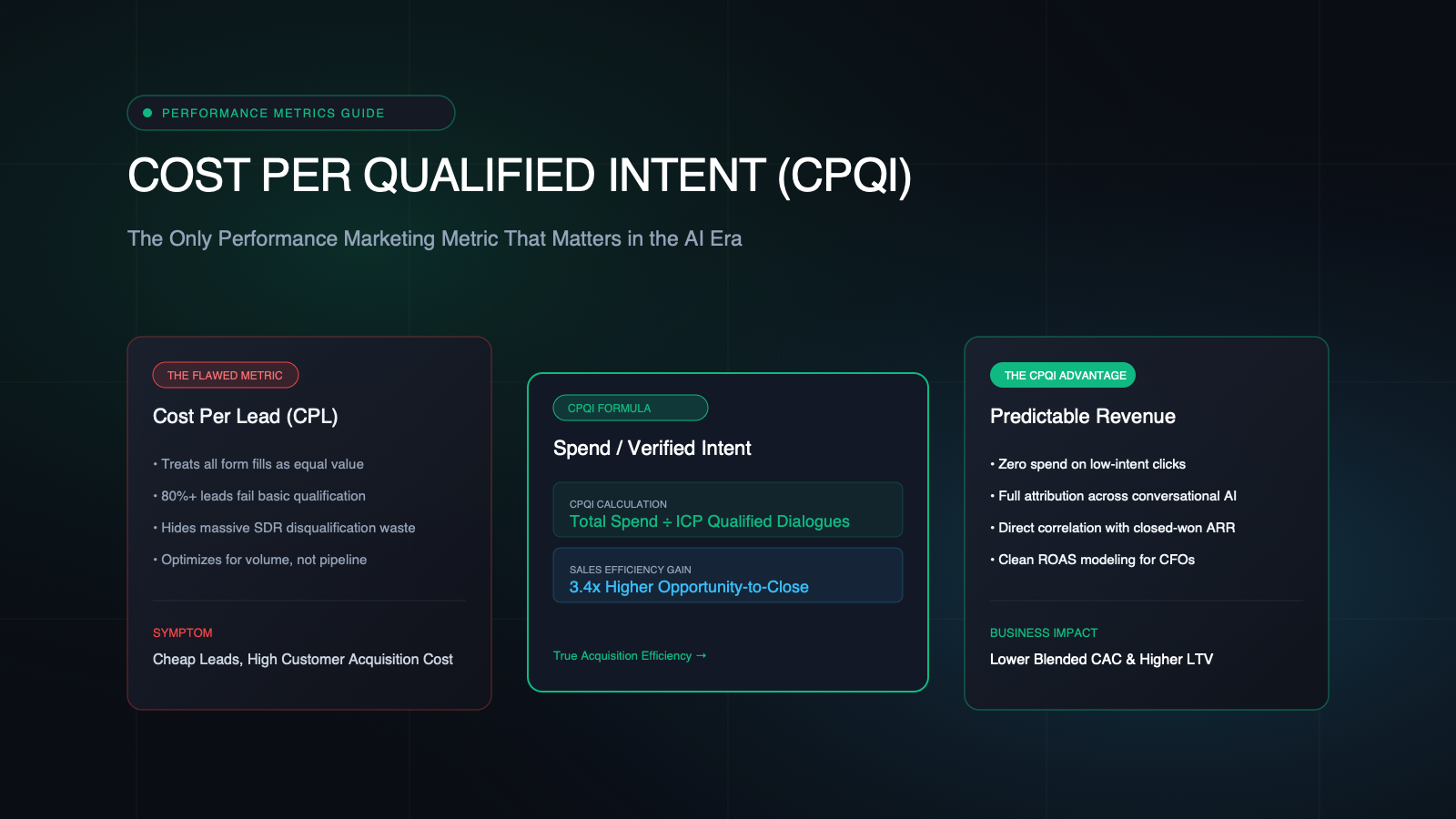
- New Unit Economics: Cost Per Qualified Intent (CPQI) and Conversational ROAS replace flawed vanity metrics like CPL.
Every VP of Growth, CMO, and performance marketer is confronting the exact same macro headwind: traditional performance marketing channels are getting more expensive while returning lower-quality leads.
Over the last several years, privacy shifts, third-party cookie deprecation, platform auction crowding, and ad blindness have caused Customer Acquisition Costs (CAC) to skyrocket across Google Search and Meta Ads. For high-consideration businesses—where deal sizes exceed several thousand dollars—bidding on broad keywords has become an unsustainable cash drain.
Meanwhile, a quiet revolution has taken place on the consumer side: buyers have migrated their high-consideration decision-making into conversational AI assistants.
In this guide, we break down how performance marketing is evolving in the AI era, how to calculate unit economics like Conversational ROAS and Cost Per Qualified Intent (CPQI), and how data-driven brands are scaling customer acquisition in this new landscape.
The Macro Crisis in Traditional Paid Search
To understand why AI-native performance marketing is so critical, we have to diagnose what broke in the traditional paid search model:
- Keyword Signal Dilution: Bidding on
best commercial litigation lawyerorb2b cyber insurancedoesn't reveal whether the user is a law student researching a thesis or a Fortune 500 risk officer facing an active data breach. You pay the exact same \$45–\$120 CPC regardless. - Zero-Click Attrition: Over 60% of search queries now conclude without the user ever clicking a blue link. AI Overviews and snippet answers solve basic questions on the search page, reducing referral traffic.
- Severe Post-Click Dropoff: Even when users click traditional search ads, landing page bounce rates on complex B2B and high-ticket service sites frequently exceed 65% because the static page cannot address the visitor's multi-layered nuances.
Traditional Paid Funnel Breakdown
- High CPC Click (\$45–\$120 per click)
- 65%+ Landing page bounce rate
- Low-intent contact form completions
- Painful SDR churn and slow deal velocity
Conversational Intent Acquisition
- High-intent natural language prompt
- Verified contextual solution match
- Pre-qualified diagnostic action
- Compressed 30-day close conversion
Defining Conversational Performance Marketing
Conversational Performance Marketing is the discipline of deploying, optimizing, and scaling paid advertising campaigns within generative AI interfaces where targeting, attribution, and delivery are governed by deep semantic intent rather than isolated keywords.
In traditional search ads, you target words. In conversational advertising (such as ChatGPT Ads), you target intent states.
The Anatomy of an Intent State
An intent state captures the total operational context of the user:
- The Problem Maturity: Is the user defining the challenge, comparing approaches, or actively ready to hire?
- Budget & Scale Constraints: Did the user specify a budget threshold, employee count, or technical environment?
- Geographic & Regulatory Parameters: Jurisdiction, local compliance requirements, or spatial boundaries.
When an ad placement triggers only when these conditions match your ideal customer profile (ICP), lead quality jumps exponentially.
The New Unit Economics: CPQI and Conversational ROAS
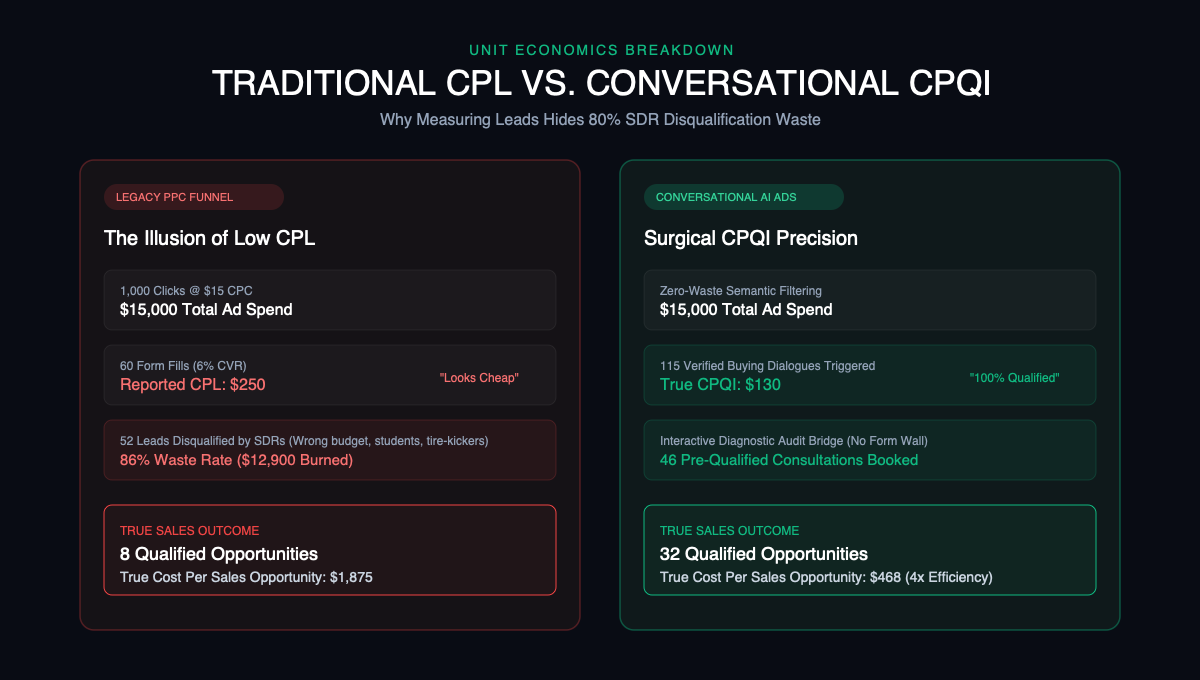
Legacy performance marketing relies on Cost Per Click (CPC) and Cost Per Lead (CPL). But in high-consideration sectors, CPL is dangerously deceptive. A \$30 CPL that delivers unqualified leads is dramatically more expensive than a \$120 CPL that converts into a \$25,000 contract.
In conversational performance marketing, two new metrics take center stage:
1. Cost Per Qualified Intent (CPQI)
CPQI measures the cost to insert your solution into a dialogue where the user has explicitly met all ICP qualification criteria.
$$\text{CPQI} = \frac{\text{Total Conversational Campaign Spend}}{\text{Total Verified High-Intent Dialogues Triggered}}$$
Unlike traditional impressions—where an ad is simply displayed above search results—a verified intent trigger confirms the buyer was actively seeking solutions for your exact competency.
2. Conversational Return on Ad Spend (cROAS)
Because conversational ad placements engage users during the deliberation phase, close rates are consistently higher than cold outbound or standard PPC clicks.
| Performance Metric | Traditional Search Ads (Google PPC) | Conversational AI Ads (ChatGPT Ads) | Variance / Impact |
|---|---|---|---|
| Average Target CPC | \$18 – \$85 (High-consideration terms) | Early-market baseline | 40–60% Cost Efficiency |
| Click-to-Lead Conversion | 2.5% – 4.5% | 8.0% – 14.5% | 2.5x to 3x Improvement |
| Lead-to-Opportunity Rate | 12% – 18% | 34% – 48% | Significantly Higher Intent |
| Sales Cycle Velocity | 60 – 90 Days | 25 – 45 Days | Compressed Consideration |
| Audience Qualification | Inferred via keywords & demographics | Explicitly articulated in natural language | Near-Zero Waste Spend |
4 Strategic Plays for Conversational Performance Campaigns
To extract maximum performance from conversational AI advertising, top-tier acquisition teams follow four tactical plays:
Play 1: Negative Intent Mapping (Eliminating Waste)
In traditional PPC, negative keywords prevent waste (e.g., adding free or jobs). In conversational AI, negative intent filtering is vastly more sophisticated.
You can configure campaigns to exclude:
- Academic or student research queries
- DIY tutorials or hobbyist questions
- Incompatible budget thresholds (e.g., users seeking solutions under \$500 when your minimum retainer is \$5,000)
Play 2: Dynamic Value Proposition Insertion
Instead of presenting a static headline, conversational placements adapt to the exact dilemma the buyer is trying to resolve.
If the user is asking how to migrate clinical records without violating HIPAA, the sponsored placement emphasizes:
"Aepify-verified partner specializing in zero-downtime HIPAA healthcare migrations with dedicated compliance audit guarantees."
Play 3: The Context-Carrying Handoff
The greatest mistake in performance marketing is forcing a user who just spent 15 minutes detailing their specific business requirements into a blank form on your website.
Modern conversational campaigns pass contextual metadata to the destination:
- The pre-filled diagnostic report
- An interactive opportunity calculator
- Direct WhatsApp or email communication with the conversation context attached
Play 4: Blended AEO + Paid Retargeting
Organic Answer Engine Optimization (AEO) and conversational performance ads compound each other. When an AI model cites your company organically in one turn and delivers a verified sponsored placement in another, prospective buyers perceive unmatched category authority.
How to Set Up Your First Conversational Performance Campaign
The Verdict: The Performance Advantage Belongs to the Early Adopters
Performance marketing has always rewarded teams that master new acquisition channels before auction saturation drives up bids.
Just as the earliest advertisers on Google AdWords in 2003 and Facebook Ads in 2012 captured multi-year ROI advantages, conversational AI advertising represents the most lucrative opportunity of this decade for performance marketers.
Benchmark Your Conversational Ad Potential
Ready to uncover the exact intent triggers your buyers are typing into AI right now?
👉 Request Your Free Opportunity Report — Get a full performance audit, intent volume estimates, and a custom acquisition plan built by Aepify’s performance strategists.
Ready to explore ChatGPT Ads?
Find out where your business could show up in high-intent AI conversations.