Executive Summary & Key Takeaways
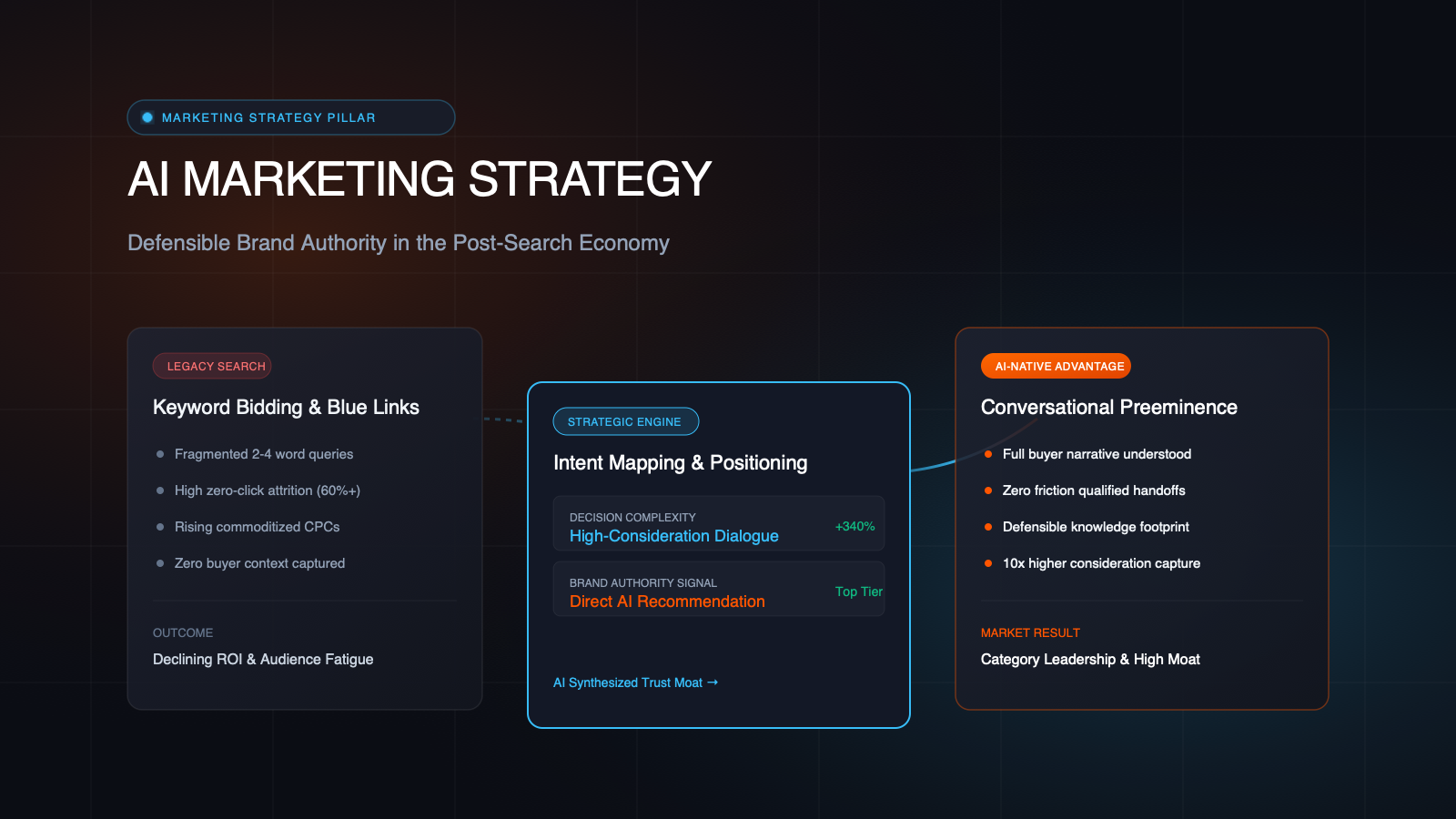
- The Third Platform Shift: From Web Portals (1990s) → Mobile First (2000s) → The Post-Search Economy (2026).
- From Aggregation to Synthesis: AI models deliver 1–2 synthesized recommendations, wiping out the traditional "top 10 blue links".
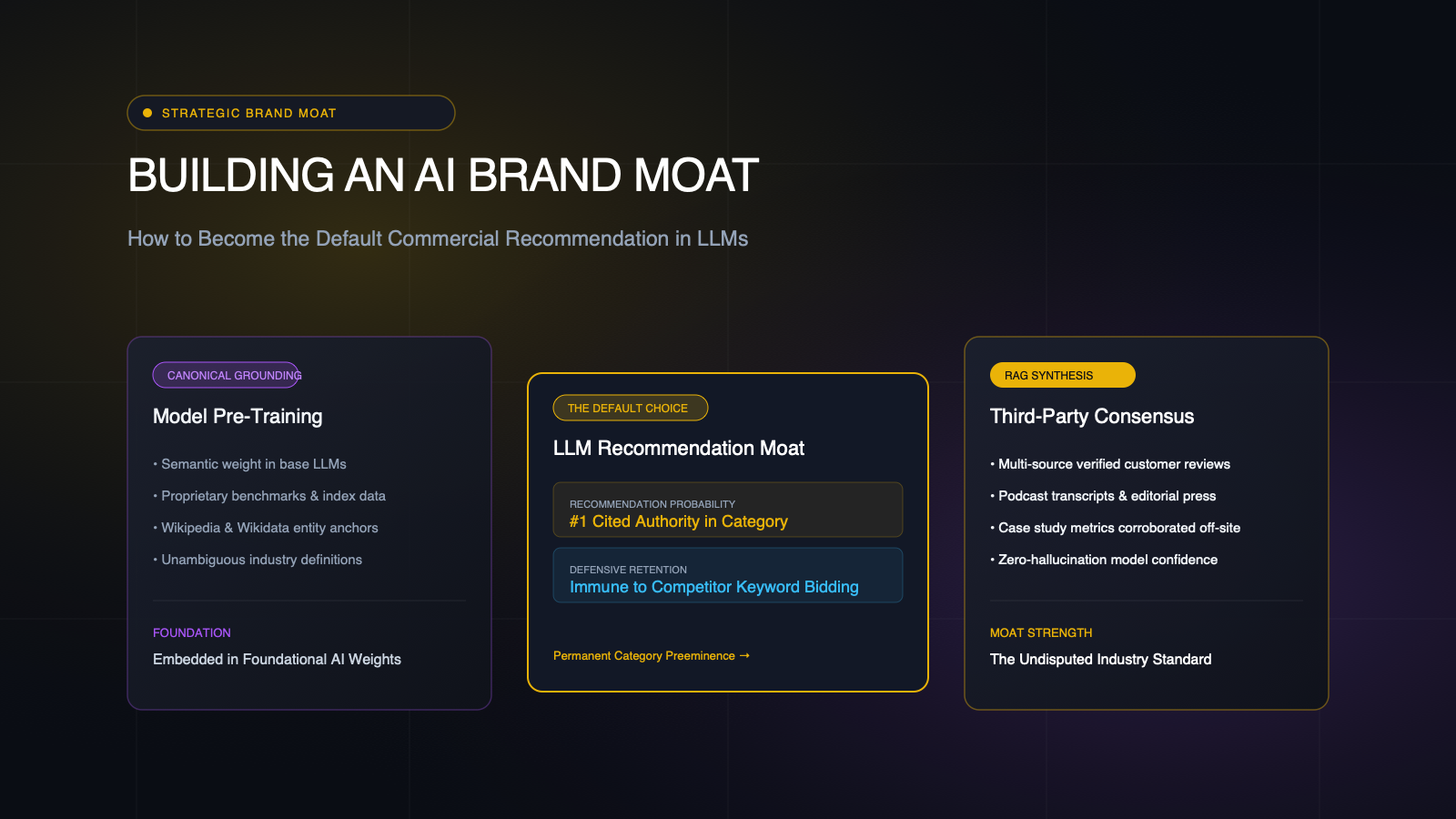
- Defensible Strategic Moats: Canonical knowledge footprints, intent preemption, and high-trust human handoffs establish lasting category leadership.
Every major platform shift in technology creates a brief, decisive window where market leadership is redistributed.
In the late 1990s, companies that understood how web portals and early search algorithms worked established multi-decade brand dominance. In the late 2000s, businesses that built mobile-first customer experiences outpaced legacy enterprises.
In 2026, we are navigating the third great commercial transition of the modern internet: the transition from the Search Economy to the Post-Search Economy.
When your prospective customers no longer scroll through pages of Google search results—and instead ask artificial intelligence to synthesize, recommend, and validate commercial solutions—how does your business maintain brand authority?
This executive guide lays out the strategic imperatives, positioning frameworks, and defensive moats necessary to win in the conversational AI era.
The Post-Search Economy: What Actually Changed?
The phrase "post-search economy" does not imply that people have stopped asking questions. Rather, it describes a fundamental transformation in how answers are gathered and consumed:
1. From Aggregation to Synthesis
In the traditional search economy, engines like Google acted as traffic aggregators. They collected candidate URLs, ranked them by algorithmic relevance, and displayed them for the user to evaluate.
In the post-search economy, generative models act as authoritative synthesizers. They ingest millions of data points, eliminate fluff, and deliver direct recommendations.
2. The Total Collapse of the "Top 10 Blue Links"
A traditional search page provides 10 organic listings, several ad units, and a handful of widgets. There is ample room for second-tier and third-tier providers to capture residual traffic.
In conversational AI, there is rarely a page two. The model presents one, two, or perhaps three premier recommendations. If your brand is not synthesized as the authoritative choice, you effectively do not exist in the buyer’s consideration set.
3. High-Consideration Buyers Moved First
Low-ticket impulse shoppers may still click social media ads. But for high-consideration decisions—choosing enterprise software, selecting a commercial general contractor, hiring a specialized advisory firm, or investing in private wealth solutions—affluent, decision-making buyers use AI as their executive research assistant.
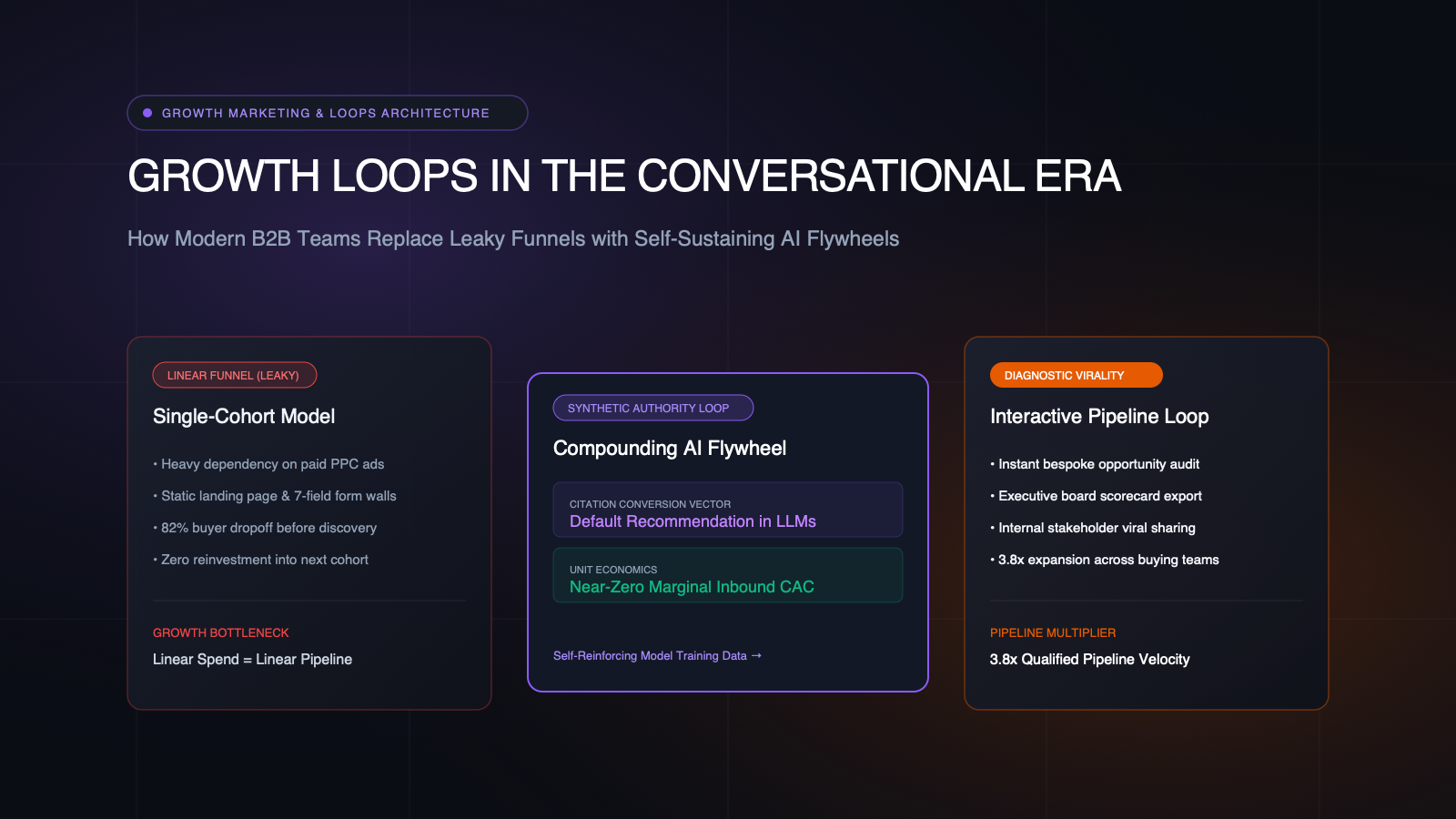
Legacy Search Economy Pipeline
- User enters fragmented 2-word keyword query
- Page of 10 sponsored ads and blue links
- Manual browsing across 5-8 tabs
- Confusing pricing and hidden sales forms
Post-Search Generative Discovery
- User provides multi-sentence operational dilemma
- AI synthesizes multi-source facts and trade-offs
- Top 1-2 verified, authoritative recommendations
- Direct high-confidence commercial conversion
3 Strategic Moats for the Post-Search Era
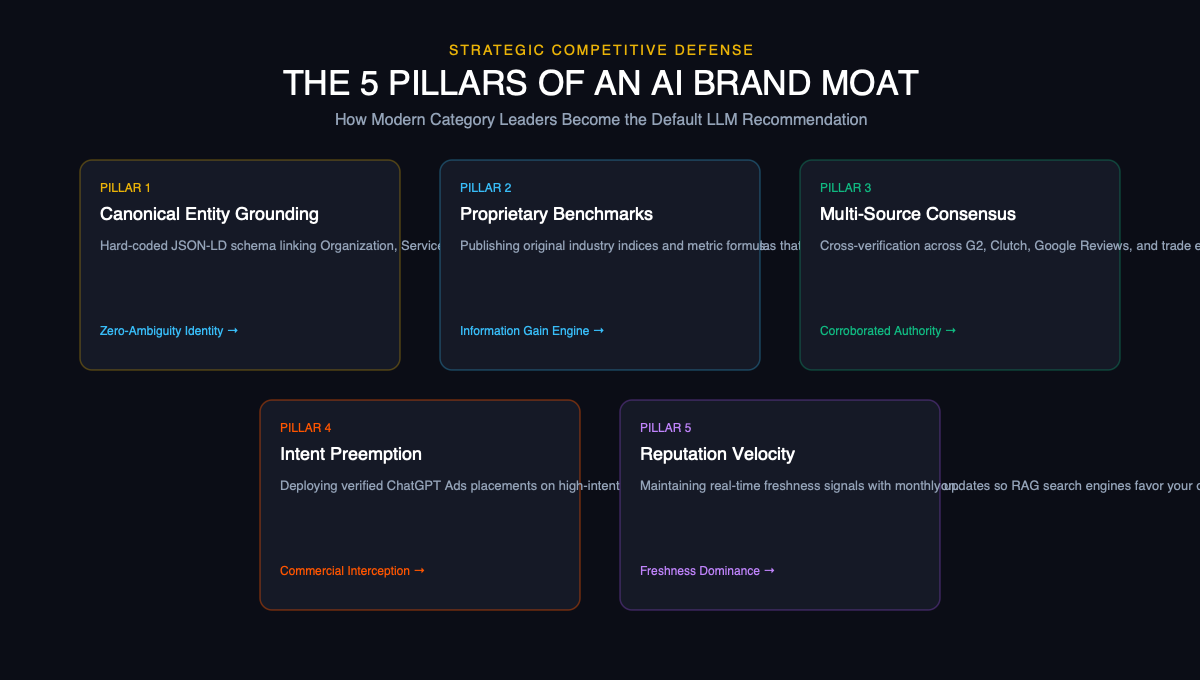
To prevent your business from becoming commoditized by AI synthesis, executive leadership must construct three defensible moats:
Moat 1: Canonical Knowledge Footprints
Large language models prioritize sources that demonstrate verified domain depth, mathematical clarity, and unambiguous entity definitions.
If your website consists of generic, repetitive marketing slogans ("we provide cutting-edge innovative solutions"), AI models cannot extract meaningful differentiators.
To build a canonical knowledge footprint:
- Publish Proprietary Benchmarks: Original research, cost breakdowns, and industry index data that models ingest as primary source material.
- Implement Rigorous Schema Architecture: Explicitly link your brand entities, founders, credentials, and service capabilities to trusted semantic graphs.
- Maintain Transparent Pricing & Methodology: Models favor transparent vendors over opaque providers who hide all pricing behind sales gates.
Moat 2: Conversational Intent Preemption
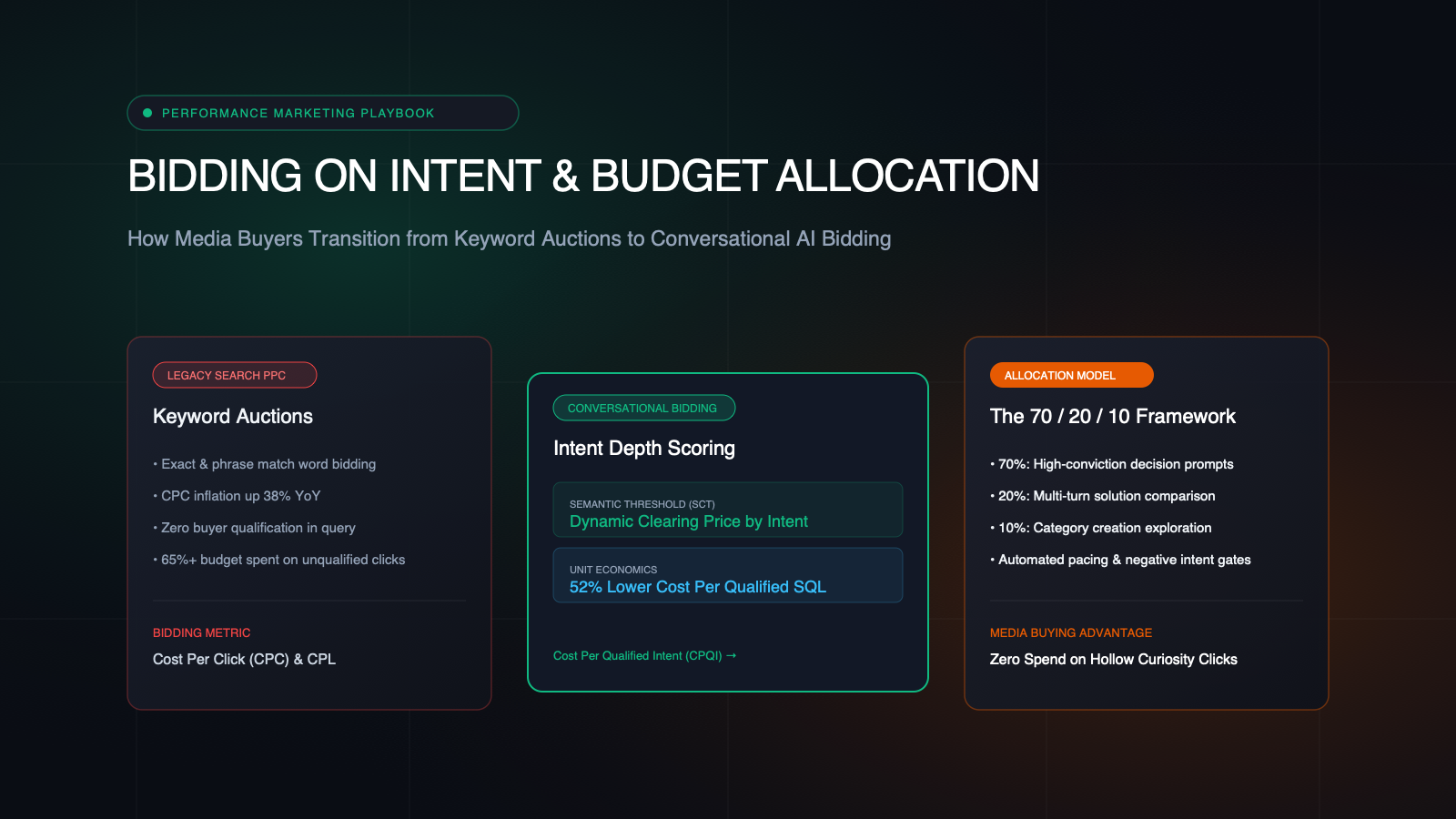
In traditional strategy, companies buy competitor brand keywords. In conversational AI, strategic leadership requires Intent Preemption.
Intent preemption means identifying the specific trade-offs, hesitations, and risk evaluations a buyer explores before choosing an incumbent, and placing verified, context-aware answers into those dialogues via ChatGPT Ads and conversational campaigns.
Moat 3: High-Trust Human Handoffs
As AI answers become omnipresent, genuine human expertise becomes a premium luxury.
When an AI assistant recommends your company, the subsequent human interaction—whether an initial consultation, diagnostic audit, or project evaluation—must feel equally intelligent, responsive, and seamless.
Any bureaucratic delay or junior SDR qualifying script will immediately shatter the trust built by the AI's recommendation.
The Strategic Positioning Matrix
How should high-consideration businesses position themselves against the current market spectrum?
| Strategic Position | Approach to Search & AI | Buyer Perception | Long-Term Commercial Risk |
|---|---|---|---|
| Legacy Incumbent | Continues heavy spend on Google Search keywords; ignores AI platforms | "Familiar, but outdated and slow to respond" | High; experiencing steady erosion of high-margin inquiries |
| Commodity Content Factory | Generates thousands of superficial AI articles to game SEO algorithms | "Spammy, generic, lacking authoritative depth" | Extreme; completely wiped out by generative engine updates |
| AI-Native Authority (Aepify Model) | Combines proprietary benchmark research, semantic schema grounding, and flat-rate intent advertising | "The verified, transparent benchmark in modern customer acquisition" | Minimal; builds self-reinforcing category dominance |
Executive Roadmap: Winning in 2026 and Beyond
- Audit Your Current LLM Footprint: Ask ChatGPT, Perplexity, and Claude to recommend the top 3 solutions for your service. If your company is omitted, map the entity gaps.
- Institute a Flat-Rate Conversational Advertising Strategy: Secure premier placement within ChatGPT and generative search dialogues for a transparent flat monthly rate (\$99/mo with Aepify).
- Deprecate Gated Form Walls: Migrate lead generation toward diagnostic value exchanges that respect modern buyer expectations.
Position Your Brand for Category Dominance
The transition to the post-search economy is already underway. Will your brand lead the conversation or be omitted from it?
👉 Request Your Free Opportunity Report — Get an executive evaluation of your brand's presence in conversational AI, competitor benchmarks, and a tactical roadmap to establish market authority.
Ready to explore ChatGPT Ads?
Find out where your business could show up in high-intent AI conversations.